



Johnny
Blades RNZ Pacific senior journalist
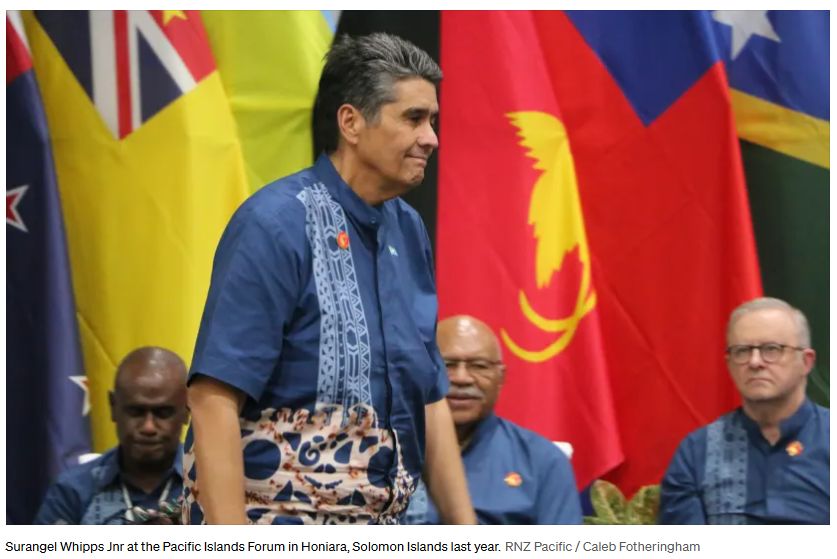
Palau’s
President Surangel Whipps Jr says countries of the wider
region need to work together to reduce geopolitical tensions
and the risk of nuclear conflict.
This comes after China’s
test launch of a nuclear-capable ballistic missile with
a dummy warhead into the South Pacific on Monday. Beijing
said the test was “consistent with international law and
customary international practice and is not directed at any
specific country or target”.
Whipps spoke to RNZ
Pacific about his country’s concerns over China’s actions
and how Palau wants a more collaborative and transparent
approach to international affairs in the
Pacific.
(The transcript has been edited for
brevity and clarity.)
Johnny Blades: Big
news this week in the South Pacific with the test missile
launch by China, a nuclear-capable missile test. What are
your thoughts about that?
Surangel
Whipps Jnr: Well, first of all, Palau was
unfortunately in war during World War Two, a site of one of
the bloodiest battles ever. And when the people of Palau
passed their Constitution, which today is Constitution Day,
46 years ago, one of the parts of the Constitution was a
nuclear free constitution, and I think that just goes to our
ambition to preserve peace and never get into the situation
that we were in World War Two.
Advertisement – scroll to continue reading
So when China acts in
very opaque or secretive launches like this, it raises
anxiety, fears, and causes great concern for all of us that
live on these islands that want to live in peace and
harmony, and that was demonstrated last year in Honiara [at
the Pacific Islands Forum (PIF)], when we all signed the
Pacific Ocean of Peace Declaration.
The missile really
went right into the heart of the Pacific, crossing over all
of us in the Pacific. Of course, Palau is very close to
China, so anything that comes across comes near us. We know
in 2024, they launched a missile, they didn’t inform us,
this one is launched – they didn’t inform us, and these
types of behaviours really go against long standing
treaties. There’s the Hague Code of Conduct, which 145
states subscribe to, about voluntary pre-launch
notifications – they didn’t follow that, so this is where we
are in very concerning times with these types of
activities.
We ask China to act and follow
international treaties, respect sovereignty. We understand
every country has a way to defend themselves, but at the
same time they wouldn’t be allowed to put other countries in
harm’s way, and that’s why it’s important that we follow law
that we’ve established and treaties that we’ve
established.
JB: Is Palau also concerned about
the missile tests that the US regularly holds in the
Pacific?
SWJ: Well, the US
has a base in the Marshall Islands, they follow protocols
and inform countries that are in their vicinity about what’s
going on. So I think we all understand that countries have
to defend themselves, but the reason why we have these
protocols is to ensure that we’re all informed and there’s a
transparent process. What is the purpose of this testing? It
seems to us that now we’re on a rapid buildup of nuclear
capability, which the world was working toward reducing. So
we definitely need to work together to bring tensions down
and reduce nuclear risk for our ocean.
JB:
Were you just saying earlier that China didn’t inform your
government before its missile test, because I know it did
inform some of the regional countries, at
least?
SWJ: Yes, it did not
inform us, and also occurred in 2024 where we weren’t
informed. We also raise concerns then. Based on where
they’re launching them from in China and ending up in the
Pacific, they come over our area, and they could easily sway
and end up on our islands, that’s that’s of course our
concern.
We feel that it’s important that we’re
transparent and we’re informed. Interestingly, Chen Bo, the
special envoy for China, he was in Fiji when we were having
[Forum Troika meeting]. He did not mention to anybody there
that they were doing these tests, and this was just a few
days before the launch.
You would think that a high
official from the Chinese government, who saw me there and
met with me, and wanted to talk about issues instead of what
they were doing, was was quite odd.
JB: Your
country is in an interesting position being one of the
countries in the region that recognises Taiwan
diplomatically, but I note you’ve sort of talked about being
open to all partners, and with the Pacific Islands Forum
summit coming up in your country, I think you’ve given the
nod for China to also join the summit. Is that your
approach, kind of like open to
all?
SWJ: We have to
understand that, first of all, the Pacific Island Leaders
Forum that’s being hosted in Palau is a Pacific Island
leaders forum, so that means it follows what the Pacific
Island leaders agreed to. We all respect the other
sovereignty. Yes, I have diplomatic relations with Taiwan.
We don’t have diplomatic relations with China, but this is a
Pacific Island Forum and under the Pacific Island Forum,
China is a dialogue partner, Taiwan is a development
partner, both countries contribute to the Pacific Islands
Forum. So as partners, as I’ve always said, everyone is
welcome.
Now, I’ve also made it very clear that
there’s there’s meetings for dialogue partners, there’s
meetings for develop partners. These are separate meetings.
The only time that Taiwan wasn’t allowed to a Pacific Island
Forum meeting was in Solomon Island, but that wasn’t just
Taiwan, it was all all partners were told they weren’t
allowed to come.
What I consistently said is that in
Palau, of course, everybody is welcome to participate
according to all the ways that we participate in all other
forums. That’s why China, as a dialogue partner, will come
and participate as a developed partner. We don’t have a
bilateral relationship, but I guess I’d say through the
Forum we have a relationship, and that relationship is
respected and valued, just like all relationships that we
have with our partner.
The Forum is an opportunity to
bring partners in and say, ‘How are you here to help promote
the 2050 strategy? Are you here to help promote peace and
security?’ I think at the Forum it’s important to bring
China, and maybe they can share how they are promoting peace
and security for us all in this blue Pacific, which is for
us, we feel threatened and concerned and disappointed about
their recent actions.
JB: Many Pacific leaders
are making clear that Pacific Islands countries want peace.
I’m just wondering, with all the geopolitical kind of
competition, is it unhelpful that Australia, for instance,
is very busy signing these sort of defence and security
treaties with various Pacific countries? Does it effectively
ratchet up the tension when we need it to be going
down?
SWJ: I believe that we
should be working with partners to preserve peace and
prosperity and freedom. Australia signing declarations with
partners, like monument partners that share the same values
that respect rule of law, freedom, and democracy is
important.
Building alliances to me ensure a free and
open Indo-Pacific that promotes peace that we all want.
Palau has, of course, Compact of Free Association with the
United States. It’s very clear our relationship is fine. And
the United States has a working relationship with Australia.
So these all work together to ensure deterrence, because we
all also believe in that if you want peace, you have to be
prepared to deter.
JB: Do you think everyone
needs to work together a bit more in the wider Pacific,
including China and the US, in the Pacific Islands region.
Does it need to be more
collaborative?
SWJ: I think
that’s always the goal – to be able to communicate clearly,
so we know what everybody’s intentions are, operate in a
transparent manner, and that’s why there’s all these
treaties to work toward that area that we can trust each
other and that we can work together to promote
peace.
Unfortunately, for us in Palau, you would like
to see China moving in that direction, but for Palau, that
hasn’t been the case. China continues to disrespect our EEZ
(exclusive economic zone) again, another research vessel in
our area, and maybe it was, who knows, maybe it was here to
travel the metal, that missile that was flying over. But
this is why dialogue, transparency, builds trust,
cooperation, and reduces tensions, and that’s I think where
it needs to start from.
Unfortunately China acts in
manners that bully, for example, they didn’t spend time
talking to me about the missile that they’re going to
launch. They spent time lecturing me, totally disrespecting
Palau, and telling us how to run the Pacific Island Forum,
when the Forum has clear rules, the members of all group,
too, and trying to tell us how we should run the Pacific
Island Forum. If we don’t do it their way and deny certain
countries from coming, then therefore, retaliate. I mean,
what kind of language is that? And so that’s that’s deeply
concerning to us. Then a few days later, launching missile
just goes to show that they don’t respect our sovereignty.
They act in a way to bully us and you are saying things
like, ‘well, you’re just a country, we’re a big
country’.
Obviously, we know we’re a small country,
but we’re still a sovereign country, and our sovereignty
should be respected, and also the integrity of the PIF
should be respected, and it’s unfortunate they try to bully
and and and do what they do. We all want peace, we want to
promote peace and trust and cooperation, and that’s the
goal, and that’s why they’re allowed to come to Palau,
because about is working together in
partnership.
JB: Do you think the Pacific
Islands Forum that’s coming up in your country will be
dominated by this dynamic, this tension of geopolitics, and
possibly about dominated by defence
discussions?
SWJ: I hope
not. This conference should be about building resilience in
the Pacific, working toward the 2050 Strategy. How do we
have 100% renewable Pacific? How do we manage our ocean
sustainably, and ask for investment to come into the
Pacific, to help us develop fisheires and develop tourism,
and the importance of protection of biodiversity so that we
can really build a sustainable future, not just for the
Pacific, but for the planet, because we believe that a
healthy oceans and [give us a] planet.
The biggest
security for us is an issue that should be talked about is
sea-level rise, storms, the impacts of climate change, not
these other geopolitical tensions, which, if anything, we
should work to reduce, not inflame. I hope that by having
everybody in Palau, we reduce those tensions, not increase
them.
New Zealand’s public broadcaster, providing comprehensive NZ news and current affairs, specialist audio features and documentaries.
Radio New Zealand is a Crown entity established under the Radio New Zealand Act 1995. Radio New Zealand News are vital elements in our programming, providing impartial news and information to New Zealanders every day. Radio New Zealand (RNZ) provides listeners with exciting and independent radio programmes in accordance with the Radio New Zealand Charter.

