
Human Rights Watch (HRW), an international human rights organization, highlighted key trends and figures illustrating the impact of Georgia’s restrictive laws since 2024 in a July 8 report that tracks Georgian Dream’s crackdown on civil society, including through funding restrictions, criminal proceedings, and inspections.
HRW said it interviewed 15 Georgian activists, lawyers, and NGO leaders, who described a “deeply hostile environment” that has led to “self-censorship, staff departures, financial collapse, and a growing reluctance among some communities to seek assistance from such groups.” It cited various studies pointing to dozens of groups either scaling back or ceasing their activities under the laws, with the crackdown particularly damaging the work of regional community organizations.
According to the report, HRW also requested information from Georgian authorities on how the new laws are being implemented, but received only “partial information,” including from the State Audit Office and other government bodies.
“The Georgian government’s goal has been to suppress critical voices and dismantle the country’s vibrant independent civil society, and it is making frightening progress,” Hugh Williamson, Europe and Central Asia director at Human Rights Watch, was quoted in the report. “The authorities are creating a system in which independent groups cannot operate safely, sustain funding, or support the communities that need and have relied on them,” he added.
Foreign Agents Laws
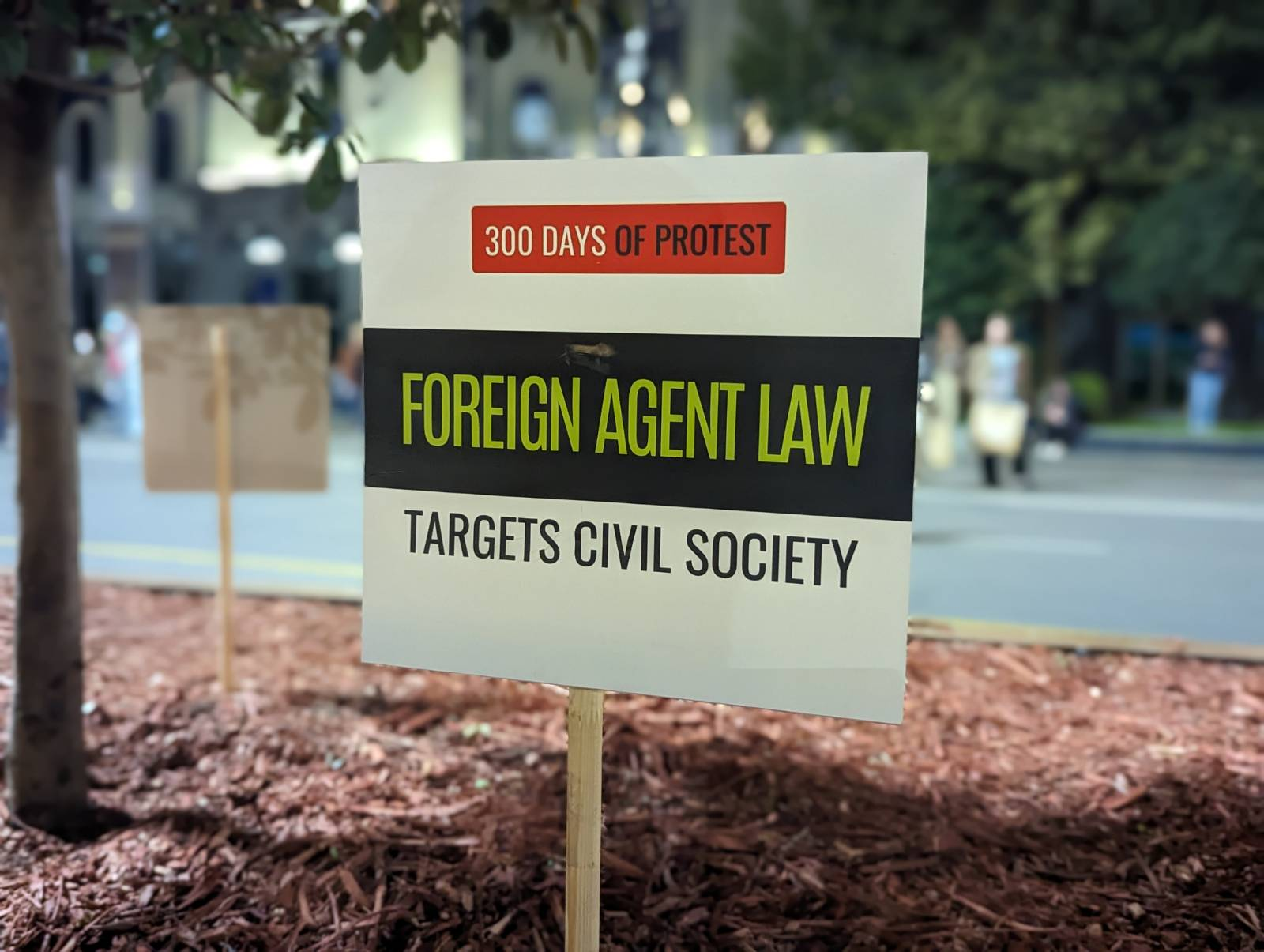
Addressing the first Foreign Agents Law (“Law on Transparency of Foreign Influence”), adopted in spring 2024 amid mass protests, HRW cited official data showing that, as of January 1, 2026, 3,987 nonprofit organizations were active in the country, of which 385 had registered as organizations “serving the interests of a foreign power.” The organization also referred to a report prepared within the OSCE Moscow Mechanism, which said that, as of February 20, “authorities had not fined any organizations refusing to register” under the law.
HRW also criticized the Foreign Agents Registration Act (FARA), which was adopted in April 2025 and introduced criminal liability for those refusing to register in the FARA database or comply with other rules. The group cited concerns that the law contains “vague” and “overly broad definitions” that “stigmatize civil society, threaten and pose serious risks to democratic freedoms, civic space, and the rule of law.”
It said that last summer, “at least seven organizations received letters from the Anti-Corruption Bureau demanding an explanation for not registering as foreign agents and warning them they risked incurring criminal liability,” apparently referring to FARA inspections in August 2025.
Law on Grants
The report also examined a series of restrictive amendments to the Law on Grants, which require government approval for foreign grants and impose criminal liability for non-compliance.
HRW said it’s aware of several cases in which “authorities rejected proposed foreign grants, including a UK Embassy-funded project to support four Georgian organizations monitoring the 2025 municipal elections and a donor request to fund an LGBT rights organization’s healthcare and harm reduction services for marginalized communities.”
After enforcement of the law was transferred from the Anti-Corruption Bureau to the State Audit Office, the latter opened monitoring proceedings against one organization, HRW said, adding that the Office informed it that the “proceedings remained pending as of June 1.”
According to a June 22 government response cited by HRW, authorities received 222 grant applications between April 2025 and June 2026, with a combined value of approximately GEL 109 million. “Of these, 177 applications, worth more than GEL 60 million, had been approved; 10 had been rejected; and 35, worth more than GEL 44.2 million, remained under review.”
According to the HRW, the government did not answer its questions about which projects had been approved or rejected or explain the reasons behind individual decisions, but instead said “applications were assessed individually for their alignment with national interests, the government’s main strategic documents, the proposed use of funds, and expected results.” However, it did not explain in greater detail how these broad criteria are applied in practice, the HRW noted.
HRW also said that “from September 2025 onward, the Anti-Corruption Bureau initiated monitoring and issued information requests to approximately 100 organizations under the grants law.”
‘Sabotage’ Probe
The group further referred to the so-called “sabotage” criminal probe that led to the freezing of bank accounts at least 12 civil society groups in two separate enforcement actions, although no criminal charges against any of the CSOs or their representatives have been reported.
Broader Impact in Numbers
HRW also cited the Georgian Young Lawyers’ Association (GYLA)’s report, which said that among the 136 organizations that jointly applied to the European Court of Human Rights (ECtHR) over the foreign agents law, only three registered under the legislation.
“Most either suspended their activities altogether or significantly scaled them down. Of these, 109 reported difficulty securing funding or an inability to do so; 97 said they had reduced staff or that all staff had left; and 62 said they had been targeted by propaganda and disinformation campaigns.”
The organization also cited an unpublished late-2025 study by the Social Justice Center, another Georgian CSO, based on interviews with 100 civil society representatives, which found that “96 percent of surveyed organizations reported acute financial difficulties, and 94 percent had reduced their activities, with many scaling back to core functions or ceasing operations altogether.”
“Regional organizations have been especially hard hit. Of 114 community organizations active in 2024, only 37 remained operational in 2025, with many nearing closure,” the HRW noted, citing a study by the Centre for Strategic Research and Development of Georgia.
The report called on the Georgian government to “repeal these unjustifiable legal measures and allow independent groups to operate free from undue interference,” while telling Georgia’s international partners that they “should step up their response by increasing the costs of repression, including through sanctions, and urgently expanding support for independent groups.”
It said that “any diplomatic engagement with the government” should make the “full repeal of repressive laws a central criterion for progress.”
HRW also urged the EU and its member states to pursue targeted sanctions against officials “responsible for proposing and implementing repressive laws,” and “expand flexible, emergency, and long-term support to independent civil society and human rights groups, including those operating under restrictive conditions or from exile.”
Also Read:

