

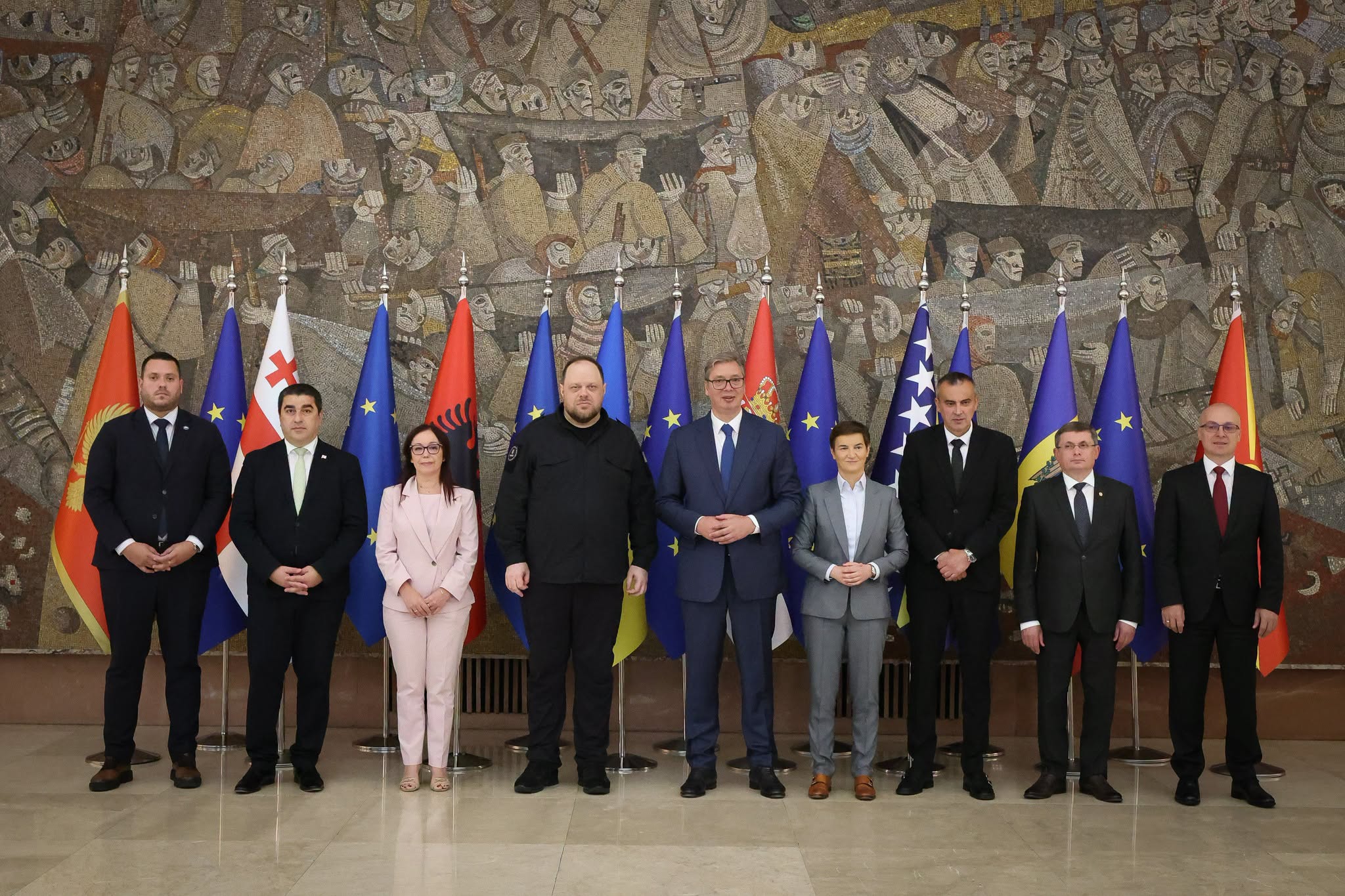
Georgian Dream Parliament Speaker Shalva Papuashvili attended the inaugural Conference of Speakers of Parliaments of EU Candidate Countries in Belgrade, Serbia, on July 7-8. Initiated by Serbia’s National Assembly and Ukraine’s Verkhovna Rada, the conference marked the launch of a new platform aimed at strengthening parliamentary cooperation among EU candidate countries.
The two-day event concluded with the adoption of the Belgrade Declaration, in which the heads of legislative bodies reaffirmed their commitment to their countries’ “European perspective” and expressed support for stronger “inter-parliamentary cooperation,” the “exchange of experience and best practices,” and “regular consultations” on issues related to EU accession. They also agreed to hold the next annual gathering in Moldova in 2027.
In addition to Papuashvili, other participants included Albania’s Deputy Parliament Speaker Klodiana Spahiu, Moldova’s Parliament President Igor Grosu, Ukraine’s Verkhovna Rada Chairman Ruslan Stefanchuk, Serbia’s National Assembly President Ana Brnabić, Bosnia and Herzegovina’s Darko Babalj, and North Macedonia’s Assembly Vice-President Antonio Miloshoski. Serbian President Aleksandar Vučić, who recently visited Georgia, was also pictured at the conference.
The format comes amid strained relations between Tbilisi and Brussels over the Georgian Dream government’s anti-democratic moves and anti-EU rhetoric. The EU said in November that Georgia is a candidate country “in name only” and moved in February to suspend visa-free travel for Georgian holders of diplomatic and service passports.
Papuashvili’s Address to the Conference
At the inaugural conference on July 7, Papuashvili delivered a speech in which he criticized the EU’s current enlargement policy, accusing Brussels of “political blackmail,” calling for a greater role for candidate countries and closer cooperation among them, and urging the bloc to view enlargement as a strategic opportunity rather than a burden.
“The candidate countries must be seen as participants in the enlargement process,” Papuashvili stated, “not its objects.” He then argued that the “EU cannot afford anymore to see itself as an exclusive club that dispenses or withholds the grace of accession to the candidate countries,” adding, “To the contrary, now the EU must get serious about its own overused metaphor: ‘It takes two to tango.’”
Asserting that enlargement should be a “merit-based process,” Papuashvili said the achievements of candidate countries must be assessed “fairly, predictably and consistently,” adding that “conditions must be clear, progress must be duly recognized, and the goalposts must not be moved for political purposes.” He went on to claim that some member states or Brussels invent “new and unpredictable preconditions,” which, according to him, “artificially delay the progress of the candidate states” and “resemble political blackmail,” calling for greater help among candidates themselves “in overcoming these undue obstacles.”
He continued that candidate countries “must avoid the impression” that they are “competitors rather than partners,” saying, “Such fragmentation weakens us.” He said they should ensure that the parliamentary format does not become a “forum for ranking, lecturing or importing bilateral disputes,” but rather a forum for “practical cooperation and joint initiatives.”
Concluding his speech, Papuashvili said, “The best way to address the European Union’s currently weakened geopolitical and economic positions is to step up the game and enlarge to strategically critical geopolitical areas — the Balkans and the Black Sea. This is why the EU should see enlargement as a historic opportunity to revitalize itself and regain global leadership, and not as a burden or charity, as often presented by some.”
Bilateral Meetings
As part of the conference, Papuashvili met on July 8 with Ana Brnabić, the President of the National Assembly of Serbia.
According to Papuashvili, they discussed, among others, the EU integration processes of their countries, with Brnabić saying “Serbia has already been waiting for several years for progress in the EU accession negotiation process, which is being delayed due to opposition from several countries,” and noting that “Georgia is successfully developing its economy, implementing reforms, and firmly defending its sovereignty.”
In addition to the working session involving all conference representatives, no other bilateral meetings held by Papuashvili were reported.
Also Read:

