



Giles
Dexter Political reporter
Labour
has joined the solar election policy contest, offering
subsidies and two new loan schemes to remove the upfront
cost of installing solar.
The SolarSaver policy
package has some similarities to what National
has also announced, with both parties proposing a new
loan scheme secured against applicants’
properties.
Like National’s policy, Labour’s Ratepayer
Assistance Scheme would offer long-term, low-interest loans,
and repaid through rates. Local Government New Zealand and
Rewiring Aotearoa have both been calling for such a
scheme.
In addition, Labour has proposed loans through
lines companies, underwritten by the Crown, and paid back
through power bills.
It would also offer $3000
kickstart subsidies for low and middle-income families, and
set up a community battery fund to help neighbourhoods store
power and share the savings across households.
Renters
would also be able to access the kickstart subsidy to cover
the cost of plug-in solar, with Labour saying it would fix
the regulations to make plug-in solar more
accessible.
Advertisement – scroll to continue reading
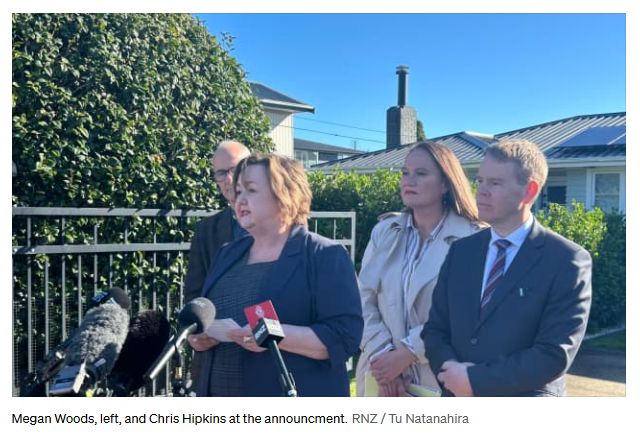
Labour’s energy spokesperson Megan Woods,
who announced the policy in Auckland’s Te Atatū on
Wednesday, said as it stands four out of five households
can’t access the bank finance they’d need to install solar
on their homes.
“Sometimes that’s because the loan
repayments are too high, and sometimes it’s because the
homeowner doesn’t have sufficient equity in their home, and
renters are completely out of luck with the current packages
that are available.”
She said her expectation was that
all of the policy would be up and running within 12 months
of taking office, and the rollout would support new and
existing jobs.
Asked if she was confident of her
costings of $160 million over four years, Woods responded,
“we have our numbers right”.
“There’s nothing
complicated about these costings.”
Woods warned the
plug-in component of their policy would require a law
change.
“We don’t have enough of the plug-in systems
because they’re illegal in New Zealand at the moment – the
first step is making them legal.”
Hipkins claimed
Labour’s policy was “much more comprehensive” than
National’s that was announced a few weeks ago.
He said
he was confident he could get the regulatory changes done
within the 12-month timeframe Labour has set, but workforce
would be a greater challenge.
“If people are going to
have to wait to get solar installed the most likely reason
is workforce.
“So we’ve put quite a heavy emphasis on
policy today about training people up quicker, so with
micro-credentialling we can increase the workforce faster
than if we use traditional ways of doing that,” he
said.
Rewiring Aotearoa chief executive Mike Casey is
ecstatic after saying it was one of the “best days” of his
life when National announced their solar intentions, and
says Labour is going one better.
Casey said the only
thing that would make it even better “is if the Government
took Cabinet decisions to advance the Ratepayer Assistance
Scheme in this term instead of waiting until after the
election”.
“The work is done and sitting with them.
New Zealanders would massively benefit, the Greens said they
can have their votes, and the only thing holding the huge
cost of living relief back is the Coalition deciding not to
prioritise it.”
Asked if Labour would support the
government if it pushed ahead with these changes today,
Woods said “absolutely”.
Hipkins welcomed National’s
“sudden interest in solar” adding that the government could
go further than National’s policy intentions and take
Labour’s policy “because it’s a good policy and much better
than theirs”.
He said the policy would remove the
upfront cost that prevented many families from accessing
solar.
“Renewable energy is the cheapest form of
electricity available, but too many households are locked
out by the initial cost. SolarSaver creates a simple
one-stop shop, provides affordable finance, helps renters
access solar for the first time, and offers targeted grants
for families who need extra support,” he said.
Last
month, National announced its election solar policy, which
would also allow property owners to access low-interest
loans, secured against their property, and repaid through
rates.
National’s Home Energy Fund, which the party
said was a narrower version of the Ratepayer Assistance
Scheme, would be jointly owned by central and local
government, with the Crown putting in a $7 million equity
investment for a 20 percent shareholding in the new
entity.
The party would also allow people to install
solar without the need for council consent.
National
expected 80,000 people would take up its scheme over 15
years.
While National’s policy document did not
mention plug-in solar, campaign chair and energy minister
Simeon Brown posted on social media on Tuesday that “work is
underway” to develop plug-in solar standards.
Brown
says Labour’s solar policy will cost more than National’s
and “put the country’s energy security at
risk”.
“Labour’s announcement is essentially
National’s policy with a bigger price tag. They’ve managed
to take the same idea and make taxpayers pay more for
it.”
Brown said after years of attacks on the
government from Labour about mills and factories closing,
there was an easy solution to help keep the lights on and
make energy more affordable.
“If Labour genuinely
wants to accelerate renewable energy, the best thing it
could do is support Fast Track, which is already cutting
through red tape and bringing renewable generation online
sooner.”
New Zealand’s public broadcaster, providing comprehensive NZ news and current affairs, specialist audio features and documentaries.
Radio New Zealand is a Crown entity established under the Radio New Zealand Act 1995. Radio New Zealand News are vital elements in our programming, providing impartial news and information to New Zealanders every day. Radio New Zealand (RNZ) provides listeners with exciting and independent radio programmes in accordance with the Radio New Zealand Charter.

