

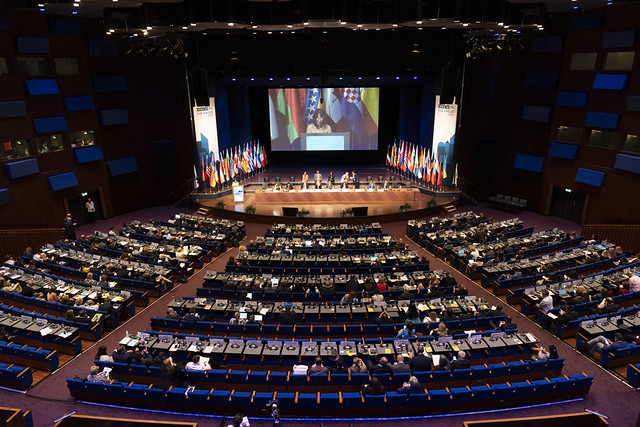
The OSCE Parliamentary Assembly (OSCE PA) adopted the wide-ranging Hague Declaration and accompanying resolutions on July 8, including one on Georgia that calls on Tbilisi to release “all political prisoners,” repeal or revise “restrictive legislation” affecting fundamental freedoms, and embark on a “genuine reform process.”
The resolution, titled “Upholding Election Integrity and Fundamental Freedoms in Georgia,” was sponsored by U.S. Representative Joe Wilson, a vocal critic of the Georgian Dream government.
Ahead of the vote, which marked the conclusion of the OSCE PA’s 33rd Annual Session in The Hague, the Georgian delegation, led by Nikoloz Samkharadze, chair of the disputed parliament’s foreign affairs committee, announced that it would not participate in the vote in protest.
Samkharadze said the amended version of the declaration “deliberately distorts political reality in Georgia, gravely misrepresents and falsifies facts, completely disregards violent attacks on state institutions, and arbitrarily interprets the election observation and Moscow Mechanism report, thus threatening Georgia’s national interests.” He added that the delegation would not participate in the voting process “as a sign of protest.”
Responding to the move, OSCE PA President Pere Joan Pons said, “Leaving seats empty in parliament is always the worst option because democracy is, above all, about being altogether and trying to resolve conflict.”
The Resolution
The resolution expressed concern over Georgia’s October 2024 parliamentary elections, noting that “reports from the OSCE/ODIHR observation mission highlighted significant irregularities, including voter intimidation, pressure on public employees, and a lack of secrecy in the voting process.” It also said the OSCE PA is “disturbed” by “signs of falsification, vote tampering, reports of voter bribery, ‘carousel voting’ and obstruction of opposition observers at polling stations during the October 2025 local elections.”
The resolution emphasized that “the legitimacy of any electoral outcome is contingent upon its adherence to international standards for free, fair, and transparent elections.”
The OSCE PA deplored what it called “restrictive legislation,” citing the “Law on Transparency of Foreign Influence,” also known as the Foreign Agents Law, as well as amendments to the Law on Assemblies and Demonstrations and the Code on Administrative Offences, which it said “severely restrict the freedoms of association, media, expression, and assembly, creating a chilling effect on civil society.”
The resolution expressed alarm over “the systematic use of administrative resources and the consolidation of institutional power,” arguing that these “have created an uneven playing field, undermined public trust in the democratic process and created a de facto one-party rule.”
It also condemned “the continued use of arbitrary detentions, arrests and harassment against members of the political opposition, media representatives, and peaceful protesters,” reiterating that “the erosion of democratic checks and balances and the departure from OSCE commitments directly jeopardize Georgia’s path toward Euro-Atlantic integration.”
The resolution called on the Georgian authorities to “release all Georgian political prisoners” identified by national and international rights groups, “repeal or revise legislation that restricts fundamental freedoms, including provisions affecting freedom of expression, media pluralism and the independence of broadcasters, in line with Georgia’s international human rights obligations.”
It also called on Tbilisi to “initiate a comprehensive and transparent investigation into all reported electoral violations from the 2024 and 2025 elections” and to “bring those responsible to account.”
“Embark on a genuine reform process, in consultation with the Venice Commission and ODIHR, to restore the independence of the judiciary and the Central Election Commission,” the resolution urged the authorities, adding, “Guarantee a safe environment for civil society and independent media to operate without fear of retribution.”
The document also calls on OSCE participating states and the international community to “consistently urge the Georgian authorities to immediately restore democratic norms and organize future electoral processes that fully comply with OSCE commitments,” and to “withhold recognition of any election results in Georgia that have not been certified as free, fair, and democratic by credible international and domestic observation missions.”
Lastly, it urged them to “remain vigilant in monitoring the human rights situation in Georgia, including in the regions of Abkhazia and South Ossetia/Tskhinvali,” and provide “continued support to all affected populations in their pursuit of fundamental freedoms, human dignity and democratic values.”
Also Read:

