

Tskhinvali’s de facto “foreign ministry” said the European Union and its member states are exerting “pressure” on Syria’s new leadership over Damascus’ recognition of Georgia’s occupied territories, while Abkhazia’s de facto foreign minister said such efforts to reverse the recognition are “nothing new” following the fall of Syrian President Bashar al-Assad in December 2024.
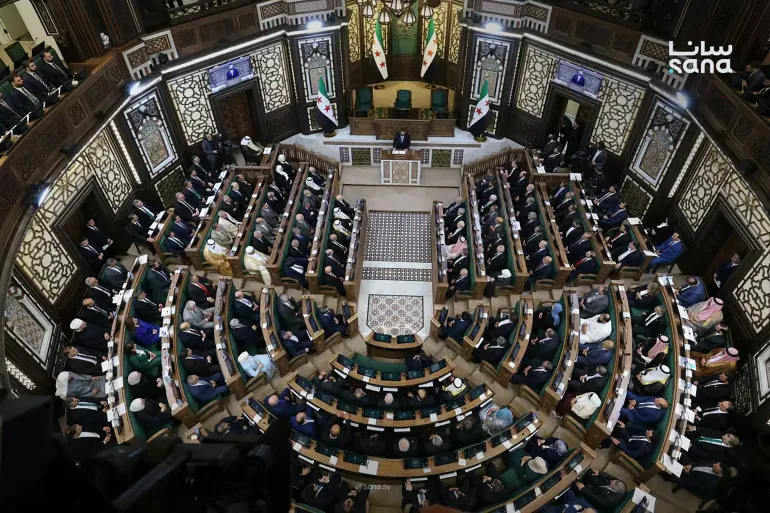
The statements from the occupied Abkhazia and Tskhinvali/South Ossetia regions came days after the EU’s foreign policy chief Kaja Kallas said on July 16 that the bloc and its member states stand ready to engage with Syria’s People’s Assembly, a newly formed legislative body, and its members “to support capacity building and good governance and to work together towards achieving common goals, including ensuring respect for international law and the UN Charter.”
HR/VP Kallas’ statement, issued on behalf of the EU on the inaugural session of the People’s Assembly, was shared by the Lithuanian Foreign Ministry on social media on July 17, where it specified that upholding international law and the UN Charter would include “revoking Assad-era decisions that recognized violations of Ukraine and Georgia’s sovereignty and territorial integrity.” However, Kallas did not explicitly mention this in her statement.
“We regard such rhetoric by the EU as a gross interference in the internal affairs of a sovereign state,” the de facto “foreign ministry” of the Tskhinvali/South Ossetia region stated on July 21, adding that “while the European Union claims to be committed to the principles of international law and respect for state sovereignty, in practice it is attempting to dictate to an independent Syria which foreign policy decisions it should make and which it should revoke.”
According to the de facto ministry, Syria’s 2018 recognition of Georgia’s occupied territories as independent states was an act of a sovereign state’s free will, based on “objective historical reality and the right of peoples to self-determination.”
“This decision was taken in full compliance with international law and is not subject to revision under pressure from external forces,” the de facto “foreign ministry” said, adding that “Brussels’ attempts to use economic and political leverage to revise the existing geopolitical realities in the South Caucasus are futile and counterproductive.”
Abkhazia’s de facto foreign minister, Oleg Bartsis, also reacted to the statements on July 21, saying, “It is no secret that, following the socio-political transformation that the Syrian Arab Republic underwent at the end of 2024, the Georgian leadership made persistent attempts to influence the Syrian side’s position, including through European institutions.”
“There were also attempts to achieve the desired outcome through the Turkish leadership,” Bartsis added, noting, “As we know, none of those efforts succeeded. We continue to maintain inter-state partnership relations with the Syrian Arab Republic.”
According to him, Kallas’ statement is “biased,” and her reference to the UN Charter was “one-sided” because, he argued, the Charter also enshrines the right of peoples to self-determination.
Meanwhile, the Coalition for Change, a Georgian opposition force, said on July 21 that it was appealing to the senior EU official and the foreign ministries of the bloc’s member states to “further raise the issue of revoking Syria’s recognition of Georgia’s occupied territories in their engagement with the Syrian authorities.”
Syria is one of five countries that recognize the independence of Georgia’s Russia-occupied territories. Under Bashar al-Assad, Damascus recognized Abkhazia and the Tskhinvali region as independent states in 2018. Following Assad’s fall in December 2024, calls grew for Syria’s new interim government to reverse the decision.
The calls came from Georgia’s opposition and American Rep. Joe Wilson, a staunch critic of the Georgian Dream government, while Georgian Dream MP Nikoloz Samkharadze, chair of the foreign affairs committee in the disputed parliament, sought assistance from his Turkish counterpart in mediating with Syria’s newly formed government to revoke the recognition.
Also Read:

