


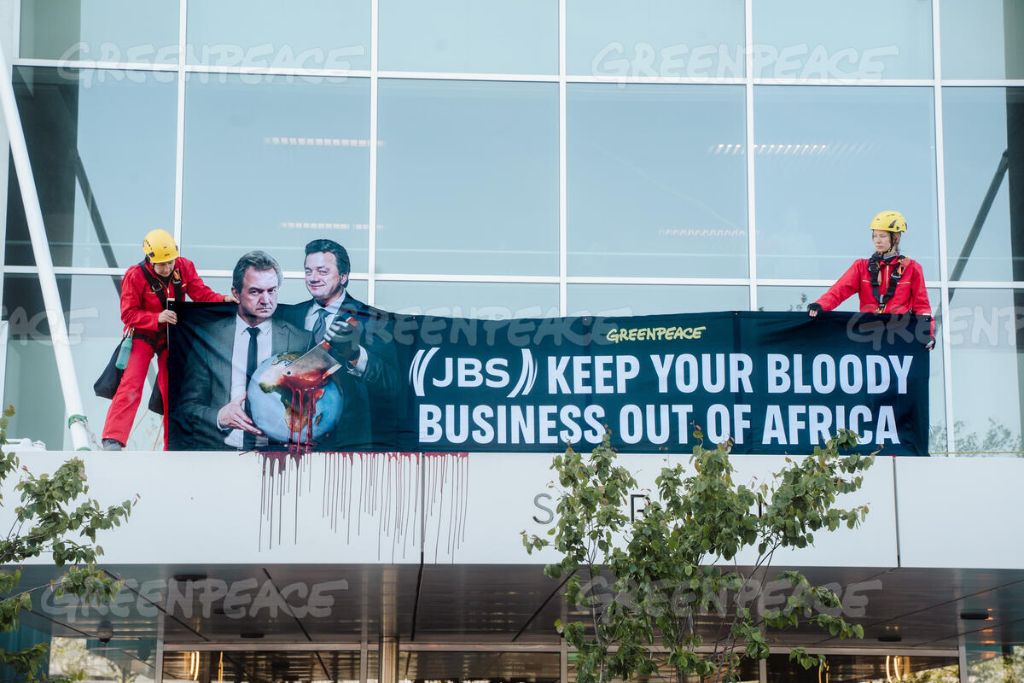
Disrupt JBS Shareholders’ Meeting in Amsterdam / Photo: ©
Greenpeace / Lieve van der
Zijde
AMSTERDAM, Netherlands, 22
July 2026 – Greenpeace Netherlands has petitioned a Dutch
court seeking to compel the world’s largest meat company
JBS, to disclose information, in order to challenge its
business policies in court. This includes its planned US$ 6
billion global expansion, of which almost half is earmarked
for Nigeria.
Headquartered in the Netherlands, JBS is
the parent company of New Zealand cured meat brand, Premier
Beehive, and is also the largest meat and food processing
company in Australia via its subsidiary JBS Foods
Australia.
The escalation to the courts follows the refusal
of JBS to comply with a formal
disclosure demand delivered by Greenpeace Netherlands in
April. The environmental group is utilising new Dutch
legislation, which grants parties with a legitimate interest
the right to demand access to specific corporate data
necessary to build litigation against Dutch companies.
[1]
Advertisement – scroll to continue reading
Elizabeth Atieno, Food Campaigner at Greenpeace
Africa, said: “JBS’ meat empire expanded hand-in-glove
with Amazon rainforest destruction, colossal emissions,
human rights and corruption scandals, all with barely a
semblance of transparency. This is the business model it
wants to export to sub-Saharan Africa.
“JBS promises
food security, but its expansion in Nigeria risks causing
irreversible environmental damage and the displacement of
smallholder farmers to line the pockets of wealthy global
elites,” says Atieno.
“Nigerians know well, from the
legacy of companies like Shell,
the destructive impact wrought by unchecked corporate
power. As Greenpeace Africa has argued
before the African Court of Human Rights, states with
jurisdiction over multinationals must hold those corporate
actors accountable – wherever they operate in the
world.
“We welcome this bold legal action: the
Netherlands and other European states must not be safe
havens for corporations like JBS seeking to evade their
responsibilities.”
In light of JBS’ longstanding
failure to publish accurate and reliable information on its
climate, nature and human rights impacts or its expansion
plans, Greenpeace Netherlands views accessing this data as a
necessary precursor to formal litigation in order to support
its case. The case has the potential to be the first climate
litigation of this scale against the livestock industry.
This could set a major precedent for future legal challenges
against the industrial agriculture sector, a major source of
global emissions, particularly of methane, a potent
greenhouse gas, responsible for 0.5°C of warming since the
Industrial Revolution.[2]
Marieke Vellekoop, Executive
Director at Greenpeace Netherlands, said “In a month where
JBS has thrown its flagship environmental commitments onto
the scrap heap, JBS’ disdain for basic transparency only
adds to the impression that this meat giant has something to
hide and is desperate to prevent its expansion plans from
going public.
“JBS appears to believe that despite
moving to the Netherlands, our rules do not apply to it.
This legal action aims to prove it wrong – and lay the
ground for a first major climate and nature lawsuit against
the dangerous expansion of the global meat
industry.”
At the centre of the dispute is JBS’
planned US$ 2.5 billion investment in industrial livestock
production in Nigeria.[3] Civil society groups in Nigeria
have raised urgent warnings that the aggressive expansion
will threaten local food security, drive regional
instability, and accelerate ecological degradation. There is
no available evidence that JBS has conducted any impact
assessments or community consultations in Nigeria, and local
efforts to gather more information via Freedom of
Information requests have reportedly been
ignored.[4]
Greenpeace Netherlands’ lawyers allege
that JBS’ historic business practices and future expansion
plans are inconsistent with the company’s climate and
biodiversity obligations and represent a breach of its Dutch
duty of care, which requires companies to act in line with
international human rights law.[5]
If the court rules
in favor of Greenpeace Netherlands, it is entitled to seek
the required information in the form of documents and from
senior JBS figures under oath, raising the prospect of its
owners, the billionaire Batista brothers, being forced to
testify in Dutch court. JBS reincorporated
as a Dutch entity (JBS N.V.) last year to facilitate a
dual listing on the New York Stock Exchange.
In April,
JBS was forced to temporarily
suspend its first annual general meeting since moving
its headquarters to Amsterdam after it was disrupted by
dozens of Greenpeace Netherlands activists.
Last week,
JBS scrapped
two flagship commitments to reach Net Zero emissions by 2040
and eradicate deforestation from its supply chain. It also
removed any explicit reference to Indigenous lands from all
of its current policies. Greenpeace Netherlands is concerned
this indicates JBS is seeking to expand unconstrained by the
climate, nature and human rights impacts of its
business.
Notes:
[1] JBS
announcement
[2] The livestock sector is estimated
to be responsible for 31% of global methane emissions (more
than oil and gas operations). In comparison to CO2, methane
is shorter lived (around 12 years) but has a much stronger
ability to trap heat in the atmosphere over its lifetime: it
has approximately 80 times more climate impact than CO2 when
measured over 20 years. This means that changes in methane
emissions have a more rapid effect on the climate than
changes in CO2. See Greenpeace
Netherlands letter to JBS dated 30 April 2026.
[3]
JBS Foods Australia, Our
Business
[4] ABC, Australia’s
biggest meat company JBS is repeatedly failing to protect
its workers from horrific injuries, 25 April
2022
[5] Experts
raise concerns over the risks of industrial animal
farming (The Sun
Nigeria)

