



Lillian
Hanly Political Reporter
A large security
operation is underway for the
Indian Prime Minister’s visit and the public should
expect disruptions in Auckland on Saturday, police
say.
Narendra Modi will arrive in New Zealand by
private jet on Friday evening for what Prime Minister
Christopher Luxon labelled an “historic” visit.
It
comes as the government progresses legislation for the
India Free Trade Agreement, which doesn’t have the
support of coalition partner New Zealand First.
In the
leadup to the visit there were motorcade rehearsals and
significant security checks in preparation for the prominent
visitor.
Operation Commander Inspector Grae Anderson
said the police operation was well-advanced ahead of the
visit, and additional support from specialist groups was
being deployed, including public order teams from across the
country.
“These specialist resources will be able to
assist with supporter crowds or any other disruptions that
may occur.
“Given a visit of this stature, the public
should expect there will be some disruptions in parts of the
city through different points of the day.”
Advertisement – scroll to continue reading
Luxon said
New Zealanders would notice a bigger police presence, saying
on Thursday the security operation was “very significant,”
because there was a “very significant world leader in
town”.
“A major significant global player, and as you
would expect there’ll be intense security.”
When the
visit was announced, Luxon called it “historic”, given it
was the first visit by an Indian prime minister to New
Zealand in 40 years.
He said it reflected the growing
momentum in the New Zealand-India relationship and
discussions between the leaders would include trade and
investment, maritime security, education, technology,
tourism, sport, and global issues.
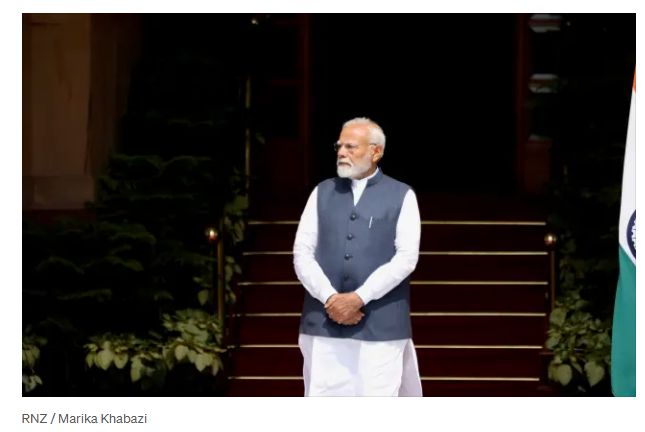
Modi
is visiting New Zealand after visits to Indonesia and
Australia. Since he became Prime Minister in 2014, he’s
visited around 80 countries, more than doubling the number
of trips of his predecessor.
On his trip to New
Zealand, the Indian government said Modi would hold
bilateral discussions with Luxon and “review the entire
gamut of the bilateral relationship, which had seen
significant progress in the last two years”.
Modi also
plans to meet prominent business and sports personalities.
As well, he will address a large gathering of the Indian
diaspora at a sold-out event at Spark Arena, Kia ora
Modi. It reportedly requires attendees to carry a copy
of their passport and has not been organised by the
government.
The Aotearoa Alliance of Progressive
Indians wrote an open letter taking issue with Modi’s visit,
and its treatment.
The letter spoke of human rights
abuses, political prisoners and the treatment of Indian
Muslims and Dalits in India, and raised the Hindutva
ideology, which
Modi’s political party follows. It’s described as a
right-wing political and nationalist
ideology.
Concerns about the ideology were raised with
Luxon ahead of the visit, and the possibility of the Kia
ora Modi event being an avenue of spreading the
ideology, but the Prime Minister said he would be attending
to celebrate an “outstanding achievement” for New Zealand to
be hosting Modi.
Luxon said he wasn’t concerned about
the rise of Hindutva.
The visit was also off the back
of the India Free Trade Agreement passing its first reading
in Parliament.
The
FTA would reduce or eliminate tariffs on 95 percent of New
Zealand’s exports to India once fully implemented.
But
it’s been surrounded by controversy, following New Zealand
First’s decision to withhold support for the
agreement.
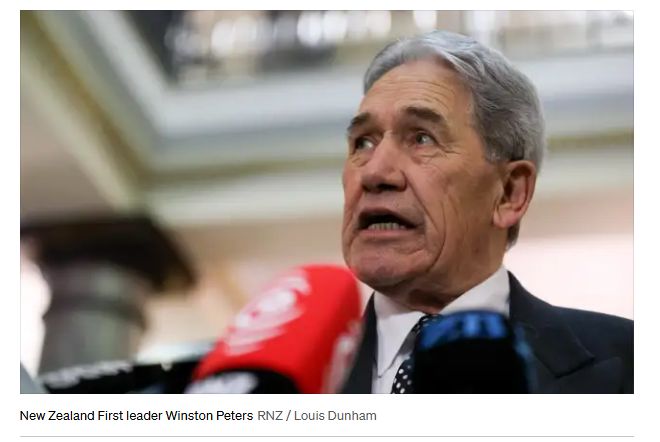
Winston Peters – also the Foreign Affairs
Minister – has consistently criticised it, most recently
claiming National was “covertly” been approving changes to
immigration settings that would discriminate against
Indians.
But the Trade Minister Todd McClay said
immigration changes following the agreement would not breach
the deal’s non-discrimination clauses.
Peters is out
of the country for the visit, but his office pointed RNZ
to comments made by the Minister during a visit to India in
2025 – prior to the FTA being finalised.
“New Zealand
and India have agreed that we can and should be doing more
together.
“Both countries have worked hard over the
last 18 months to bring energy, focus and deeper practical
cooperation to the relationship,” he said at the
time.
When the FTA was announced in December, Peters
called it a “bad deal,” saying it was “neither free nor
fair” and gave too much away especially on immigration
without getting enough in return for New
Zealanders.
Asked if it was convenient for Peters to
be out of the country during this visit, Luxon said
reporters were “overthinking it” and that it was a “leader
level visit”. He said it was “quite normal, it’s quite okay”
Peters was overseas.
A spokesperson for Peters’ also
confirmed the timing of his trip was independent of Modi’s
visit.
Labour leader Chris Hipkins is also expected to
meet Modi on Saturday evening, before he departs the
country.
New Zealand’s public broadcaster, providing comprehensive NZ news and current affairs, specialist audio features and documentaries.
Radio New Zealand is a Crown entity established under the Radio New Zealand Act 1995. Radio New Zealand News are vital elements in our programming, providing impartial news and information to New Zealanders every day. Radio New Zealand (RNZ) provides listeners with exciting and independent radio programmes in accordance with the Radio New Zealand Charter.

