

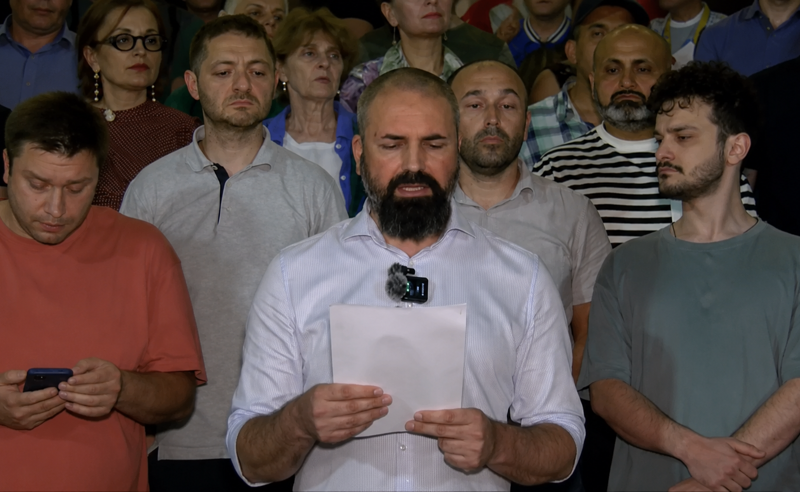
Anti-government protesters demonstrating daily on Tbilisi’s Rustaveli Avenue have addressed an open letter to the European Union and its member states, pledging to continue their protests until what they describe as “political prisoners” are released, the country’s European course is restored, and free and fair elections are held.
The letter, read out in Georgian by rally participants on July 5 on Rustaveli Avenue in front of the parliament building, the regular protest site, came as non-stop protests approach their 600th day since the Georgian Dream government announced on November 28, 2024, a month after the widely disputed October 26 parliamentary elections, that it would not pursue EU integration “until 2028,” a statement that sparked mass protests.
While participation in daily protests has gradually declined amid tightened protest-related restrictions, larger marches continue to be held in Tbilisi on Saturdays. Smaller demonstrations also continue daily in other cities, including Kutaisi, Zugdidi, and Batumi.
The letter begins by stating that participants in the ongoing anti-government protests continue their demonstrations with the aim of “defending Georgia’s European future, the rule of law, human rights, and the free development of our society.”
It then declares that Georgia is an “inseparable part” of European civilization, stressing that the country’s European and Euro-Atlantic aspirations are enshrined in the Constitution, referring to Article 78.
The letter continues by arguing that Georgia is “left out” of a process that created a “real perspective” of EU integration, from which Ukraine and Moldova have benefited, accusing the Georgian Dream of pursuing what it describes as a “one-party,” “anti-European,” and “anti-democratic” course.
It then reviews the widely disputed 2024 parliamentary elections, Tbilisi’s November 28 decision to suspend the EU accession efforts, which it says “rejected” Georgia’s Constitution, the ensuing public resistance, protest dispersals, and “systemic violence and repression.” It also speaks of what it describes as “political prisoners” and “prisoners of conscience.”
It further accuses Georgian Dream of “anti-European propaganda” and the “discreditation and marginalization” of participants in the resistance movement, and claims that “repressive policies” are forcing citizens to leave the country. The letter then cites the latest poll, according to which 71% of Georgians still support the country’s EU accession.
“We express gratitude to the international community, the European Union and its institutions, the governments of its member states, their ambassadors, and friendly peoples for the moral and political solidarity they have shown on issues of EU integration and the release of our like-minded individuals detained for political reasons, as a result of which many of them have even become targets of unjust attacks,” the letter says.
“We will stand firm until the very end and continue the struggle until political and conscience prisoners are released, the European and Euro-Atlantic course defined by Georgia’s Constitution is restored, and the will of society is expressed through free and fair elections,” the letter concludes.
Also Read:
This post is also available in:

