

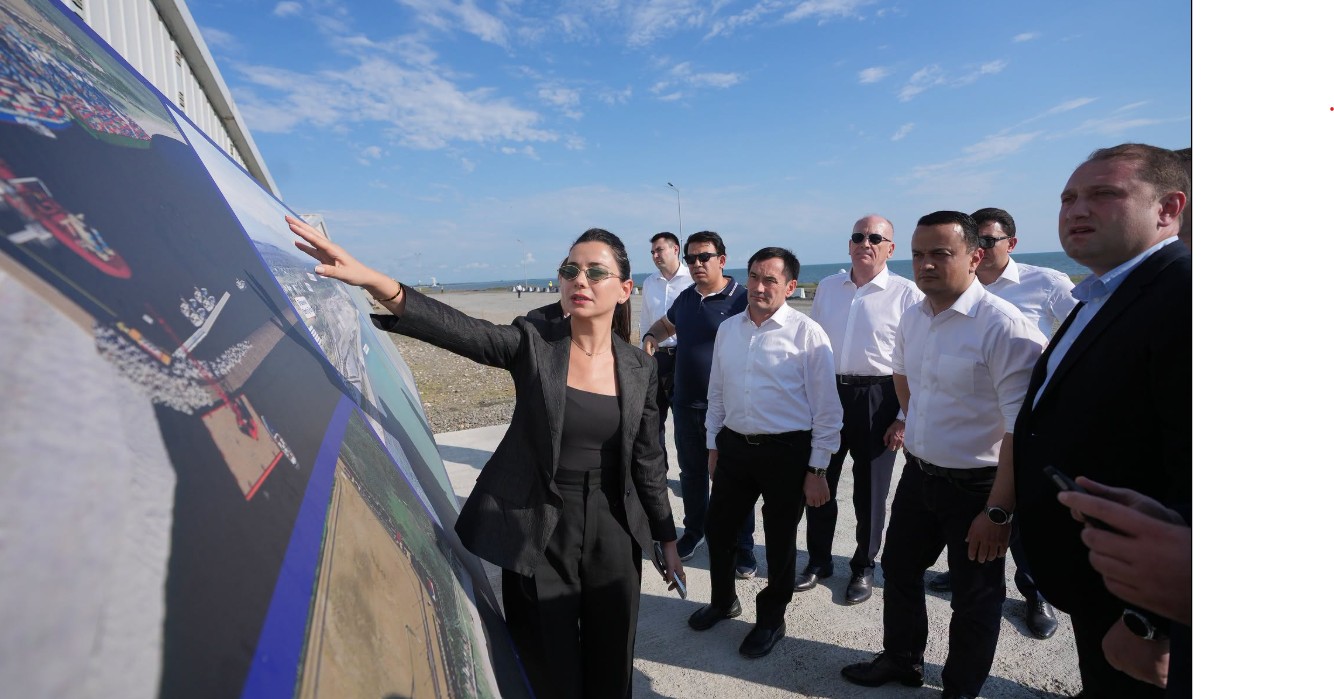
The Anaklia Deep Sea Port will be developed and owned by the Georgian state under a “landlord model,” while international countries and companies will participate as partners, Georgian Dream Economy Minister Mariam Kvrivishvili announced on July 6.
The move marks a reversal of earlier plans to allow one major investor, with the latest pick a Chinese-Singaporean consortium, to develop the controversial mega-project.
Kvrivishvili said the port will be built under the so-called “landlord model,” meaning the Georgian state “will remain the owner of the core maritime and port infrastructure and will itself ensure its development and management.”
“The ‘landlord model’ will allow the state to develop the Anaklia Port not with one partner, as had been planned until now, but simultaneously in partnership with several states and companies, which will create the best conditions for attracting cargo to the port and, consequently, for its most efficient operation,” she said.
“Alongside the creation of port infrastructure,” Kvrivishvili added, “The state will ensure the construction of the road and railway access to Anaklia, while the investments required for the construction of container and bulk cargo terminals will be carried out by international investors and private operators.”
She added that the Georgian government “particularly welcomes” investments from Middle Corridor countries, including China, Central Asian republics, and Azerbaijan.
Explaining the move, Kvrivishvili highlighted the importance of the Middle Corridor – a trade route linking Asia to Europe that bypasses Russia – saying the Anaklia port has become “an internationally important strategic infrastructure project,” and arguing that rising foreign interest requires a model that preserves the state’s “leading role” in the development of strategic infrastructure while ensuring a competitive environment that accommodates multiple partner countries and companies.
The Anaklia Deep Sea Port project was originally awarded in 2016 to the Anaklia Development Consortium, a Georgian-American venture. The project was halted in 2020 after the Georgian Dream government terminated the contract amid controversies. I
The project was revived as Georgia’s “Middle Corridor” transit potential regained prominence amid Russia’s full-scale war in Ukraine. The government took a 51% stake and, in 2024, picked a Sino-Singaporean consortium to develop the project. Also in 2024, Belgian company Jan De Nul was awarded the tender to carry out the maritime infrastructure work for the port. However, observers have pointed out that the talks with the Chinese investor have stalled since, with the deal yet to be completed.
Shifting to a model that ensures the state’s “leading role” in port construction and a multi-partner approach, Kvrivishvili said the government will invest USD 7 billion in strategic transport infrastructure by 2032, including the construction of the Anaklia port, the modernization of Georgian Railways, and the completion of high-speed highways.
“Through the participation of partner countries and taking their interests into account, the Anaklia port should become a center where international interests, capital, and cargo flows converge. This most important decision made by the Government of Georgia will further strengthen Georgia’s national interests, create new economic opportunities, and turn our country into a key participant in the Middle Corridor project,” Kvrivishvili concluded.
Speaking with journalists, Kvrivishvili further said that the new model will require the government to mobilize nearly USD 200 million more than previously planned.
According to Kvrivishvili, the project’s total investment volume remains USD 1.1 billion, but “the proportion changes.” Under the previous model, she said, “the state had to carry out the current infrastructure: the breakwater and deepening of the seabed, which is currently underway, as a state obligation,” as well as “the railway and connecting road, which, under the new model, still remains a state obligation.” The new addition is a component covering “fundamental additional infrastructure, berths, communications, and other accompanying infrastructure.”
She also vowed that the shares will not be sold and that Anaklia will remain a “Georgian port,” saying, “The state will be the owner of the Anaklia Deep Sea Port. No one else will own a project that is so strategically important for our country.”
“As for the involvement of international companies,” she added, “They will be involved directly in the management of terminal infrastructure, which has absolutely nothing to do with ownership. The terminals, including those for container cargo handling, will be leased to our international partners. There is interest from a number of Western countries, and not just one. I cannot confirm specifics, as these are ongoing negotiations.”
Also Read:

