

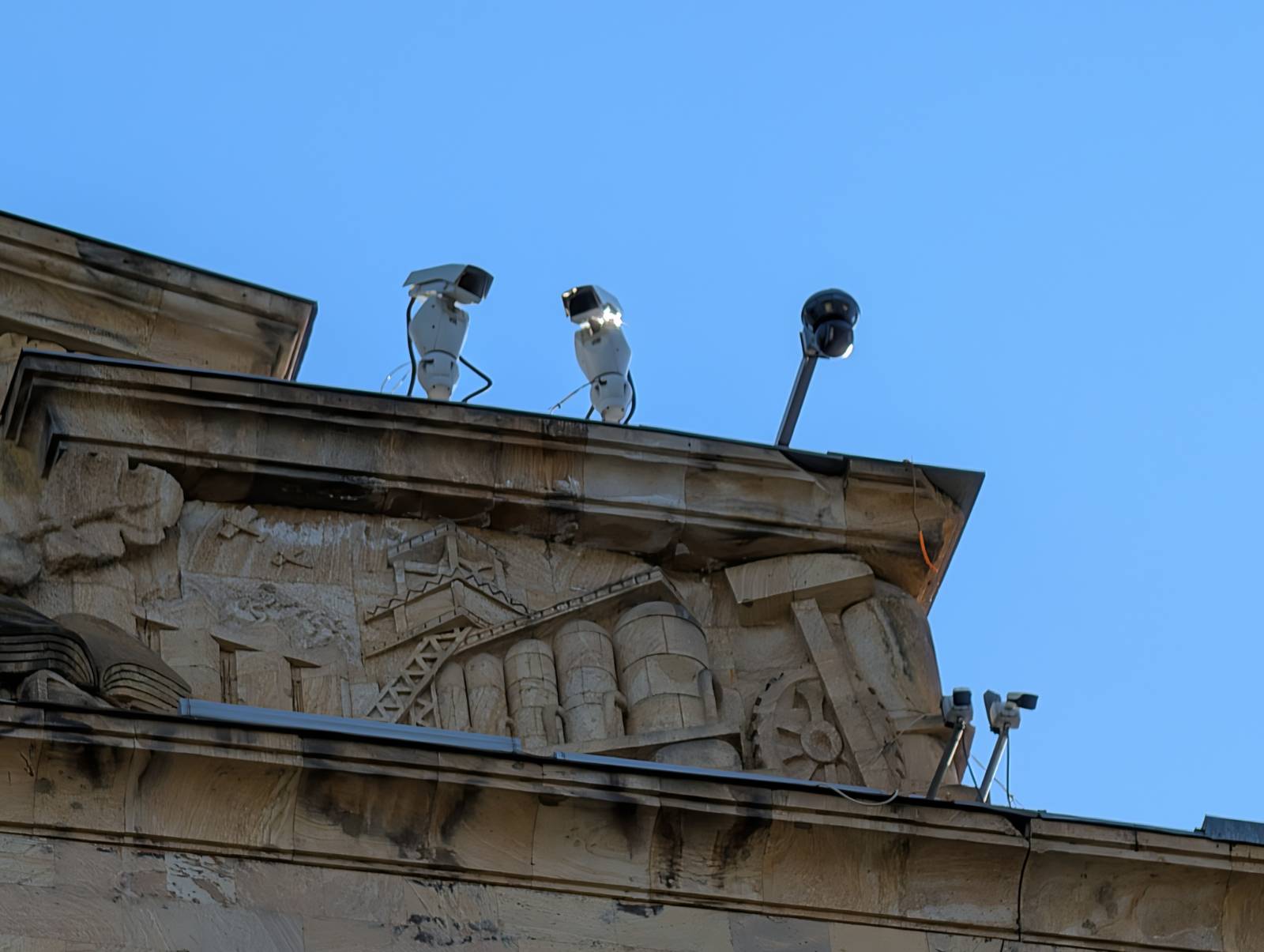
Georgia has been using Polyface, a facial recognition system developed by the Moscow-based company Papillion AO, which is under Western sanctions, to identify protesters during pro-European demonstrations, according to a report by AlgorithmWatch, a non-governmental organization based in Berlin and Zurich.
The report says that Georgia’s Interior Ministry has been procuring the system since 2013, and it has undergone five upgrades before being granted a perpetual license in October 2024.
It notes that Papillion AO is sanctioned by Switzerland, Ukraine, Japan and the United States, and that its products are used by Russian law enforcement, as well as in countries like Tajikitan, Turkmenistan, Kazakhstan and Belarus.
The report suggests that under the 2018 upgrade, Georgia’s ministry operators would have been trained by Russian personnel, and that Papillion AO, like other Russian companies operating in Georgia, “is obliged by Russian law to cooperate with Russian security services if compelled.”
According to AlgorithmWatch, Polyface 3.7.0 — the latest upgrade of the system purchased by Georgia’s Interior Ministry in October 2024 — was delivered in early June 2025, after mass remote identification of anti-government protesters and enforcement measures had already begun.
Hundreds of protesters have been fined and detained for “blocking the road” to traffic and other protest-related violations that Georgian Dream has tightened over time during daily demonstrations outside the parliament building in Tbilisi. Protesters were also covering their faces with masks to conceal their identities, before face covering was also made an administrative offense punishable by detention.
“Polyface is built on a deep learning recognition algorithm developed by 3DiVi, a Russian AI company based in Novosibirsk and backed by a Russian state venture fund,” the report said, adding, “It records high-definition images of large crowds, even in poor lighting, and can identify faces under masks or partially occluded.”
Citing tender documentation, the report said the ministry “explicitly requested licenses for an unlimited number of operators,” while until 2025, it was capped at only 30 simultaneous operators. “The change suggests a rising demand within the ministry to monitor larger demonstrations,” the report said.
The report also detailed how the system identifies individuals. “To match faces to identities, the system uses the ‘Unified Information Bank,’ which provides access to civil registry photographs,” it said, adding that “the software can also run searches against pre-loaded images from social media and other external sources — a feature the ministry requested in 2024, indicating cross-platform surveillance as an intended use.”
By comparing government procurement documents, Polyface’s technical documentation and surveillance footage obtained during its investigation, AlgorithmWatch concluded the software could be deployed in three principal ways.
The first is automated identification, in which the software continuously scans live video feeds, automatically selecting faces from a crowd long enough to capture an image before moving to the next individual without human intervention.
The second is an operator-directed search, allowing personnel to manually control cameras, zoom in on specific individuals and compare their images against government databases in real time. While a 2018 contract permitted up to 30 officials to conduct such searches simultaneously, the report says the 2024 procurement removed that limitation.
The third capability is an automated watchlist system that enables authorities to preload photographs of individuals of interest, including activists, protest organizers, previously fined demonstrators and people identified during earlier intelligence operations. According to AlgorithmWatch, that function has been part of the system since the original 2013 procurement.
Also Read:
This post is also available in:

