

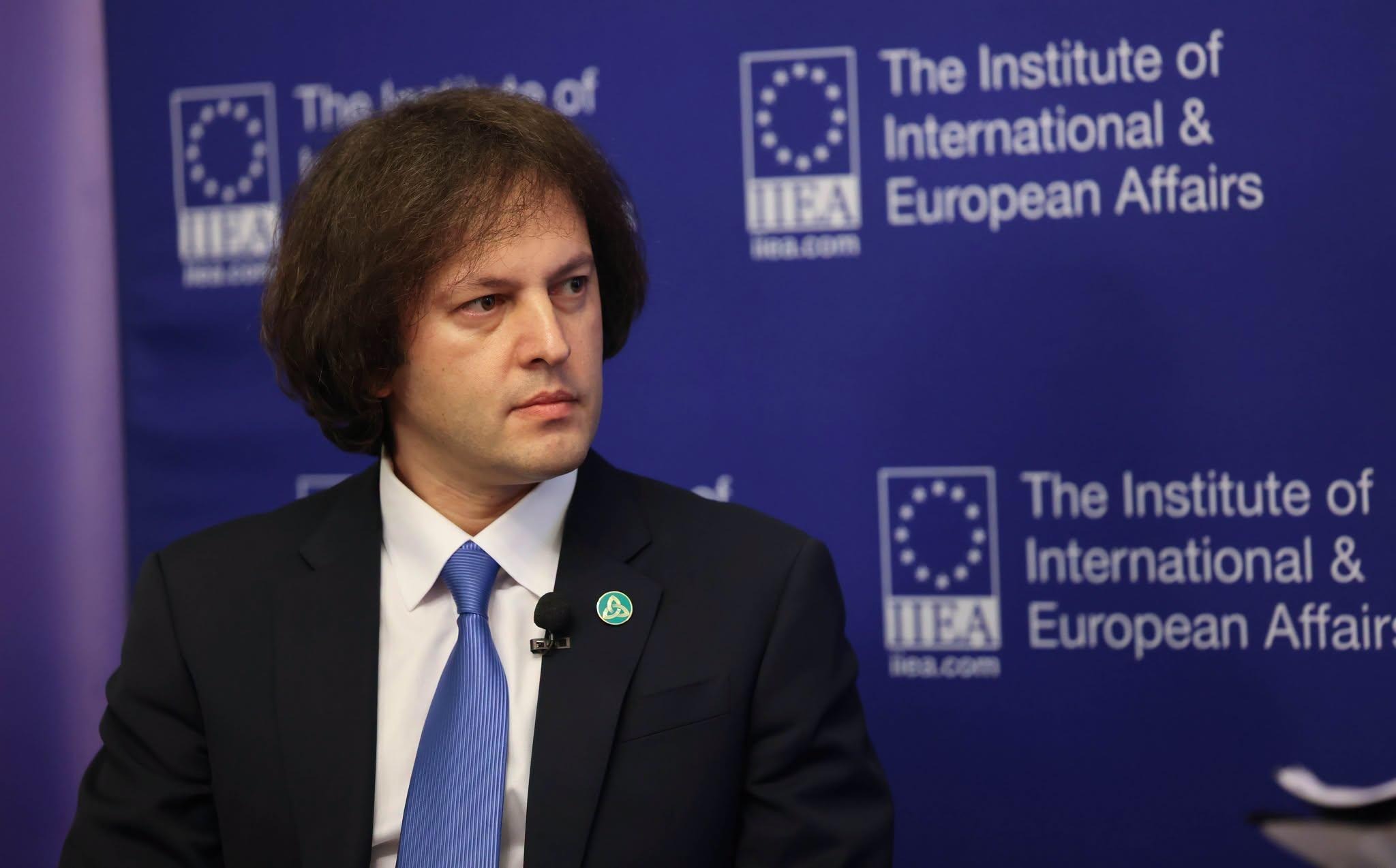
Georgian Prime Minister Irakli Kobakhidze has travelled to Ireland for the ninth European Political Community (EPC) summit in Dublin, which opened on 12 November. During his visit he described relations between Georgia and the European Union as “not satisfactory enough”, while arguing that closer cooperation is in the interest of both sides.
Key points
- Kobakhidze was scheduled to take part in the summit’s opening plenary session and in a roundtable on the security and defence of a democratic Europe on 12 November.
- A government delegation including Foreign Minister Maka Botchorishvili and Head of the Government Administration Levan Zhorzholiani accompanied him.
- On 11 November he spoke at a discussion titled “Georgia’s Role in Europe’s Architecture”, hosted by the Institute of International and European Affairs (IIEA) in Dublin.
- The visit comes a week after the European Commission’s 2026 enlargement report said Georgia’s EU accession remains de facto halted.
About the summit
The EPC is a forum that brings together leaders from EU member states and other European countries. Ireland hosts the ninth summit under the theme “Strong, Secure and Connected Europe”, and a separate informal meeting of the 27 EU leaders is due on 13 November. The EPC is among the Western-led forums to which Georgian leaders have traditionally been invited despite Tbilisi’s wider estrangement from European political circles.
What Kobakhidze said at the IIEA
According to the government’s press release, Kobakhidze told the audience that Georgia considers itself a European nation because of its Christian heritage, traditions and culture, and that Europe should also preserve its “traditional values”. He said Europe is facing “negative trends” related to migration and developments affecting the ethnic and religious identities of European countries.
He also argued that Georgia’s strategic importance to Europe lies in connectivity, calling Georgia and the South Caucasus “the only route connecting Europe with the East”. For that reason, he said, close cooperation between the EU and Georgia matters for Europe as well as for Georgia.
On relations with the EU, Kobakhidze said the current state is “not satisfactory enough” and that the government wants to change it, but that cooperation must be based on shared values. He repeated the government’s account of the dispute: that Georgia’s March 2022 application for candidate status was not granted at the time, that the European Commission later rejected Georgia’s request to open accession negotiations, and that it suspended political dialogue with Tbilisi in June 2024.
The EU’s position
The European Commission sees the situation differently. Its 2026 enlargement report, published on 4 November, says Georgia’s accession process remains de facto halted because of democratic backsliding and concerns over the rule of law and fundamental rights, and that the process could resume if the authorities change course. The EU’s ambassador to Georgia, Paweł Herczyński, has said that a country that wants to join the EU must adopt European laws, not the other way round. Georgian Dream officials reject the Commission’s assessment and accuse Brussels of political bias.
What happens next
After the EPC summit, EU leaders meet informally on 13 November. This article will be updated if Kobakhidze’s meetings in Dublin produce further statements.
Read more: More Georgia news

