

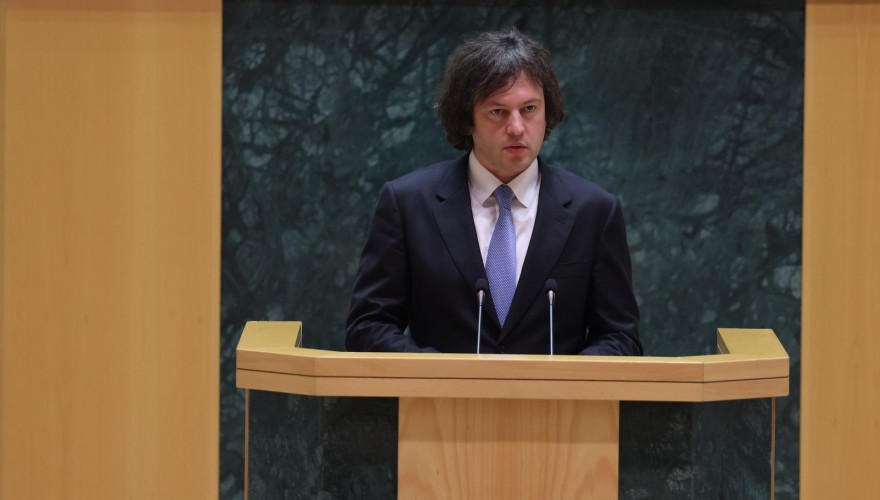
Georgian Dream Prime Minister Irakli Kobakhidze delivered his annual report to the disputed parliament at the plenary session on June 26, marking the end of its spring session.
The presentation was attended predominantly by ruling party MPs, along with government members and the country’s newly enthroned Patriarch Shio III, among others.
A large part of his nearly one hour and forty-minute address focused on the economy, as Kobakhidze cited a range of macroeconomic figures and described many of them as “impressive.” He also praised the government’s performance across multiple areas, including infrastructure, trade, tourism, culture, sport, education, defence, and crime.
Below, we focus on key takeaways from his opening and concluding remarks, as well as on Georgia’s foreign policy.
Opening Remarks
In his opening remarks, Kobakhidze said the past year was a “turning point” in the government’s work, noting that cabinet reshuffles and institutional changes paved the way for a “new stage” in governance and “substantially improved the governance system.”
Asserting that the GD government “works completely transparently,” he said it “abandoned a number of wrong practices.”
In particular, he focused on corruption, saying a key government goal was “the fundamental eradication of corrupt practices in the governance system,” and claiming this had been “substantially achieved,” adding that “corruption in the upper echelons of government has been fundamentally defeated,” while stressing that the fight against corruption must continue on a permanent basis, particularly at lower levels.
Foreign Policy
On foreign policy, Kobakhidze briefly addressed relations with neighbouring and Central Asian countries, as well as with China, the United States, and the European Union.
“We are doing everything possible to strengthen cooperation and we had very important visits to our neighbouring countries during the reporting period: Azerbaijan, Armenia and Turkey,” he said, adding, “We are also placing special emphasis on Central Asia and on developing cooperation with Central Asian countries,” noting that it has “substantial importance” for the country’s “economic potential” and “political resources.”
He also addressed Georgia’s upgrading of relations with China to a “comprehensive strategic partnership,” noting that the strategic partnership between the two countries is reflected in “concrete, tangible results,” highlighting trade as well as tourism.
He then turned to the United States, saying that restoring a strategic partnership with Washington “from a clean slate” and with a “specific roadmap” is “very important” for Tbilisi. “Recent developments have maintained our optimism that the strategic partnership will be restored,” he said, recalling, among others, his phone call with U.S. Secretary of State Marco Rubio and describing the talks as “friendly” and “interesting.”
Kobakhidze then addressed relations with the European Union, saying, “You know they [relations] are full of challenges but we are doing everything to properly fulfil the obligations under the Association Agreement and the Deep and Comprehensive Free Trade Area (DCFTA),” adding that most of them are being met. He again accused Brussels of having “unfair attitudes” towards Tbilisi.
Concluding Remarks
“Overall, over the past year, we managed to calm the country down,” Kobakhidze said in his concluding remarks, reiterating what Georgian Dream members have repeatedly insisted: that the country went through “five attempts at revolution” over the past four years.
He praised the work of the disputed parliament, focusing on widely contested legislation targeting civil society and media organizations, including the Foreign Agents Law, which he referred to as the “Transparency Law,” and the Grants Law. “These were precisely the laws that gave us the opportunity to stabilize the situation,” he said, claiming that foreign grants to local NGOs were being used for “destabilizing the country,” “attacks on state institutions,” “attacks on the Orthodox Church,” and “attempts at sabotage.”
Kobakhidze then singled out several steps he said helped the ruling party “calm the country down.” The first, he said, was “telling the truth to the citizens,” referring to the “vices” in the “European bureaucracy” and the former U.S. administration, as well as to those people “serving not their homeland but foreign powers,” referring to local opposition parties, NGOs, and media.
The second, he said, was legislation, while for the third he added, “We have enforced justice against violent actors.” Kobakhidze said that “everyone who attempts violence against the state and the national interests of the country will be held accountable before the law,” pledging a continued “uncompromising” approach.
As the final point, he spoke about corruption, stressing that the government has adopted, and will continue, an “uncompromised” approach to fighting it.
He then delivered special thanks to Georgian Dream founder and its billionaire honorary chairman Bidzina Ivanishvili, saying, “The achievements of the Georgian government […] are ultimately the result of the direction and the sound principles that Mr. Bidzina Ivanishvili established in Georgian politics after 2012.” He added, “The fact that we have had uninterrupted peace for 14 years, that the country preserves its sovereignty and independence, and that it has made economic progress is primarily the result of this man, Mr. Bidzina Ivanishvili.” MPs responded with applause to these remarks.
At the end of his speech, the Georgian Dream prime minister pledged before the same party-dominated parliament that the government “will continue to do its utmost for the prosperity of Georgia and its people.”

