

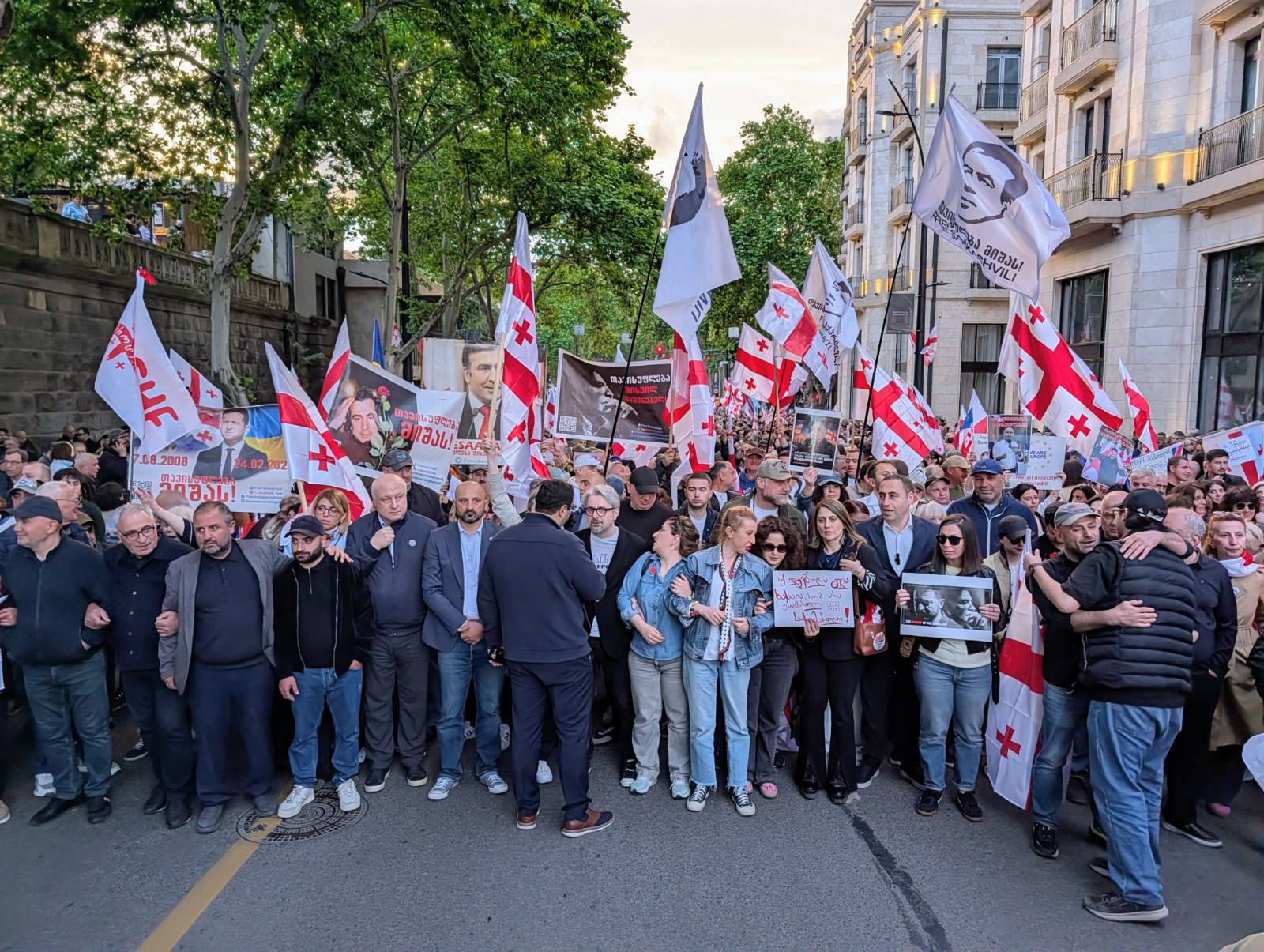
Worries are mounting that more Georgian opposition leaders may be sent – or rather returned – to prison for years amid intensifying court hearings in the so-called “sabotage” case, launched in November as prosecutors accuse eight political figures of “crimes committed against the state.”
Three of those charged in the case – ex-President Mikheil Saakashvili, Droa leader Elene Khoshtaria, and Ahali/Coalition for Change leader Nika Melia are already behind bars after being convicted in different cases.
Three more – Girchi – More Freedom leader Zurab Japaridze, Ahali/Coalition for Change leader Nika Gvaramia, and Strategy Agmashenebeli leader Giorgi Vashadze – anticipate new prison verdicts after being released in the winter, having served full sentences of up to eight months for boycotting the Georgian Dream parliamentary commission (“Tsulukiani Commission”). Leaders of Lelo/Strong Georgia alliance – Mamuka Khazaradze and Badri Japaridze – who were similarly sentenced for boycotting the Tsulukiani Commission, but were released early through a pardon by GD-elected President Mikheil Kavelashvili over their decision to run in the 2025 municipal vote – also face years in jail if convicted again.
“We know that we are being returned to prison. Every coalition leader [who passed the threshold] in the 2024 elections will be either in prison or abroad by the end of the month, or at the latest by the end of August,” Zurab Japaridze told Formula TV channel on July 12.
Concerns over looming jail verdicts intensified after the court increased the frequency of the hearings from once a month until June to at least twice a week.
Japaridze, Vashadze, and Khoshtaria face between seven and 15 years in prison on various sabotage-related charges, while the other leaders also face multi-year prison terms, though shorter ones. Prosecutors have alleged that opposition leaders, acting in various groupings, engaged in “active actions to radicalize the street process” after the 2024 elections, shared information with foreign country representatives to create “artificial grounds” for sanctions, made calls that led to “violent confrontations” during protests, and mobilized funds for “violent groups.”
Among the key witnesses in the case are leaders of United Neutral Georgia, a Georgian Dream-aligned, anti-EU group that announced launching a political party in December. It was following a complaint by United Neutral Georgia that prosecutors opened the “sabotage” probe in February 2025, leading to a series of actions, including the freezing of the bank accounts of several funds and NGOs.
Repression in Times of ‘Reset’?
It remains unclear why the court, believed to be loyal to the ruling party, decided to expedite the process.
What makes the process even less clear is the Georgian ruling party’s ongoing efforts to reset relations with Washington. The erstwhile close ally, the U.S., suspended its strategic partnership with Georgia under Joe Biden’s administration in late 2024 and sanctioned GD founder Bidzina Ivanishvili, with the Donald Trump administration yet to reverse those decisions.
However, citing ideological alignment with Trump, GD has sought to “reboot” relations with Washington, and exchanges and cooperation efforts between officials of the two countries have intensified in recent months. GD Prime Minister Irakli Kobakhidze reiterated this willingness during his address at a U.S. Independence Day event at the American embassy in Tbilisi on July 1.
While the agenda of bilateral exchanges has been dominated by connectivity, security, and migration issues, the U.S. State Department delegation also brought up domestic politics during its May visit. Namely, the delegation stressed with GD the need for “a stable domestic political climate that facilitates opposition engagement,” among others, for a sustainable strategic partnership between the two countries.
Those efforts, however, have come amid parallel actions in the U.S. Congress, among others, pushed by Georgian Dream-critical Rep. Joe Wilson. One of the latest moves came on June 8, when the U.S. House of Representatives passed a bill requiring a report on Russian and Chinese influence and intelligence assets in Georgia, as well as a 5-year strategy on bilateral relations with Georgia.
Zurab Japaridze has been among those who have suggested that the intensifying “sabotage” hearings are “probably a signal to the West: either ‘you will settle with us on our terms, or we will force the people you talk to out of the country or put them in prison.’” Alternatively, “they are also clearing the political field,” the politician told reporters on July 9.
Another reason why GD may seek the guilty verdicts is the opposition’s declared goal to seek foreign pressure as part of their resistance against Georgia Dream policies.
In a July 10 social media post, Nika Gvaramia, leader of Ahali/Coalition for Change and one of the defendants in the sabotage case, wrote that opposition strategy is “Rallies inside, sanctions outside, alternative.” The post, which came amid a separate debate about opposition tactics, pointed at the efforts – particularly that of Opposition Alliance, a coalition of nine parties formed in March – to secure foreign pressure on Georgian Dream through continued protests while presenting the public with a political alternative, should Georgian Dream be pushed out of power.
Responding to Gvaramia’s statement about the strategy, Irakli Kobakhidze said that the criminal case has been launched “precisely in connection with this approach,” describing it as “treason” and noting that the strategy “constitutes a treacherous approach, which, in a broader sense, is a criminal approach.
Similarly, United Neutral Georgia leader Vato Shakarashvili told reporters on the day of his court testimony that the opposition “is committing a continuous crime” when they promote the “sanction outside, rally inside” strategy.
‘You Can’t Plan Anything’
“You cannot plan anything … you face a fence after which it is hard to plan anything, you have some ideas, you want to do something, but cannot go beyond it,” Zura Japaridze told Formula TV in July, pointing to the distracting pressure of the ongoing criminal probe.
The “sabotage case” and other criminal prosecutions are only one part in a series of distractions the Georgian opposition has faced over the past year.
Since 2024, opposition has come under different lines of pressure. In November 2025, Georgian Dream filed a constitutional appeal seeking to ban three major opposition parties: the United National Movement (UNM), Ahali/Coalition for Change, and Lelo/Strong Georgia. The party then withdrew and refiled the appeal in April 2026 to add the Federalist party to it, in what at the time appeared to be an attempt to artificially extend the maximum nine-month period available for the Constitutional Court — also widely viewed as dominated by GD loyalists — to review the appeal.
A law adopted by the disputed parliament in October 2025 allows to strip individuals “associated” with parties declared unconstitutional of their rights to establish or join political parties, run in elections, or hold public office. Later, a series of amendments in March 2026 also introduced eight-year bans on political party membership for those who have worked in foreign-funded organizations. It remains unclear how these laws will be enforced.
Yet all those distractions from planning only increase the urgency of a viable plan.
There is a growing sense that the “rallies inside, sanctions from outside” strategy alone is not enough amid a persisting and possibly worsening political crisis, with rallies not large enough, regions largely alienated from the process, public apathy growing, and time working against the politicians. Some government-critical commentators have openly questioned the efficiency of boycott policies, and the main opposition forces remain split over the course of action.
While in the initial months after the disputed 2024 elections and the subsequent anti-government protests, the hope and demand were to secure internationally supervised early elections, the general focus is now gradually shifting to 2028, the year of the next scheduled parliamentary elections.
GD Pledges ‘2028 Elections Without Agents’
There is a broad understanding that the pressure on the opposition, along with recent changes to election laws, including stripping Georgians abroad of their right to vote, has only further diminished expectations of at least some levels of fairness in future elections. But there are fears that boycotting the vote would allow the worst-case scenario to unfold.
Commenting on the prospects that new jail verdicts could push opposition towards further boycott, Tamta Mikeladze from Social Justice Center, a local human rights group, expressed worries over a “high risk” that in 2028, Georgian Dream will secure a constitutional majority, and that this is precisely what the ruling party is aiming at.
“Under [Georgian Dream’s] constitutional majority, our security, economy, and foreign policy system will also be changed institutionally, and the development logic we’ve pursued since the 90s will be fully upended,” Mikeladze wrote on Facebook.
But questions towards opposition parties over their plans regarding 2028 come amid parallel pledges by the ruling party officials not to allow their participation in the vote.
Referring to the opposition parties that the ruling party seeks to ban through the constitutional appeal, GD Prime Minister Irakli Kobakhidze told Imedi TV on July 16 that “our objective is that our political spectrum meets the 2028 [parliamentary] elections without agents.”
“Agentura [a term denoting spy network] cannot be a part of the political system,” Kobakhidze said. “As long as the agentura is a part of the political system, a healthy democratic system cannot be achieved.”
In this context, some commentators suggested that revealing their 2008 plans too early would make the opposition an even bigger target of GD repressions – a view shared by some opposition figures like Gvaramia as well. But while the views remain divided about the specific plan, or about whether to reveal it, pressure grows on the parties to intensify their mobilizing work with the public.
Disunity and Work in Progress
What makes the mission of coming up with a long-term action plan more impossible is a lack of unity among key opposition actors.
While nine political parties united in the Opposition Alliance, two forces that had crossed the threshold in the disputed 2024 parliamentary elections — Lelo/Strong Georgia and For Georgia, a party led by ex-Prime Minister Giorgi Gakharia— stayed outside the project. Both forces split with the broader opposition camp after deciding to participate in the partially boycotted 2025 local elections.
Lelo has struggled to rejoin the mainstream opposition since, while For Georgia became the only one of the four parliamentary forces to reverse its boycott and take up its MP seats in October 2025. The move gave Gakharia’s party greater political visibility and access to public funding, and so far shielded it from the constitutional appeal seeking to ban opposition parties. However, it did not prevent its now-exiled founder, Gakharia, from facing prosecution in two separate criminal cases over his official tenure as Interior Minister, with some expectations that his name, too, will also be added to the ongoing “sabotage” trials.
The Opposition Alliance itself has faced internal crises, particularly after jailed ex-President Mikheil Saakashvili, whose United National Movement (UNM) is part of the coalition, clashed with fellow Alliance leaders over strategy. Saakashvili, whom his critics accuse of singlehandedly influencing the processes inside his party, later announced reforms within the UNM aimed at returning the party to its “popular” roots with more focus on the regions and horizontal networks. However, he ended up triggering a separate internal unease inside UNM ahead of pending chairperson elections.
There have, however, been parallel efforts among smaller groups — including those in the process of entering a political scene — to develop digital and physical ways of reaching a broader public.
At least two parties that are members of the Opposition Alliance have been touring Georgian regions as part of their outreach campaigns. Among them, the Federalist party, led by former European Georgia duo Tamar Chergoleishvili and Giga Bokeria, has tried to combine physical trips with social media campaigns focusing on issues specific to the regions and towns they visit. Another such party, Freedom Square, led by Levan Tsutskiridze, has been travelling around as part of the recently launched “For the love of Georgia” campaign, bringing together activists, politicians, and civil society actors.
Another group – Georgia First (Jer Sakartvelo) movement, led by Viktor Kipiani, a former lawyer of Georgian Dream founder Bidzina Ivanishvili, held a party launching event late in June. Separately, Movement for Social Democracy, a progressive movement that emerged amid anti-government protests, has also been touring regions in an effort to build a network amid plans to launch as a political party by September.
These forces, too, have previously reported various obstacles to registering their parties or movements, as well as broader financial scrutiny and checks from authorities. It remains to be seen how much political space Georgian Dream will allow them to operate in.
Also Read:

