

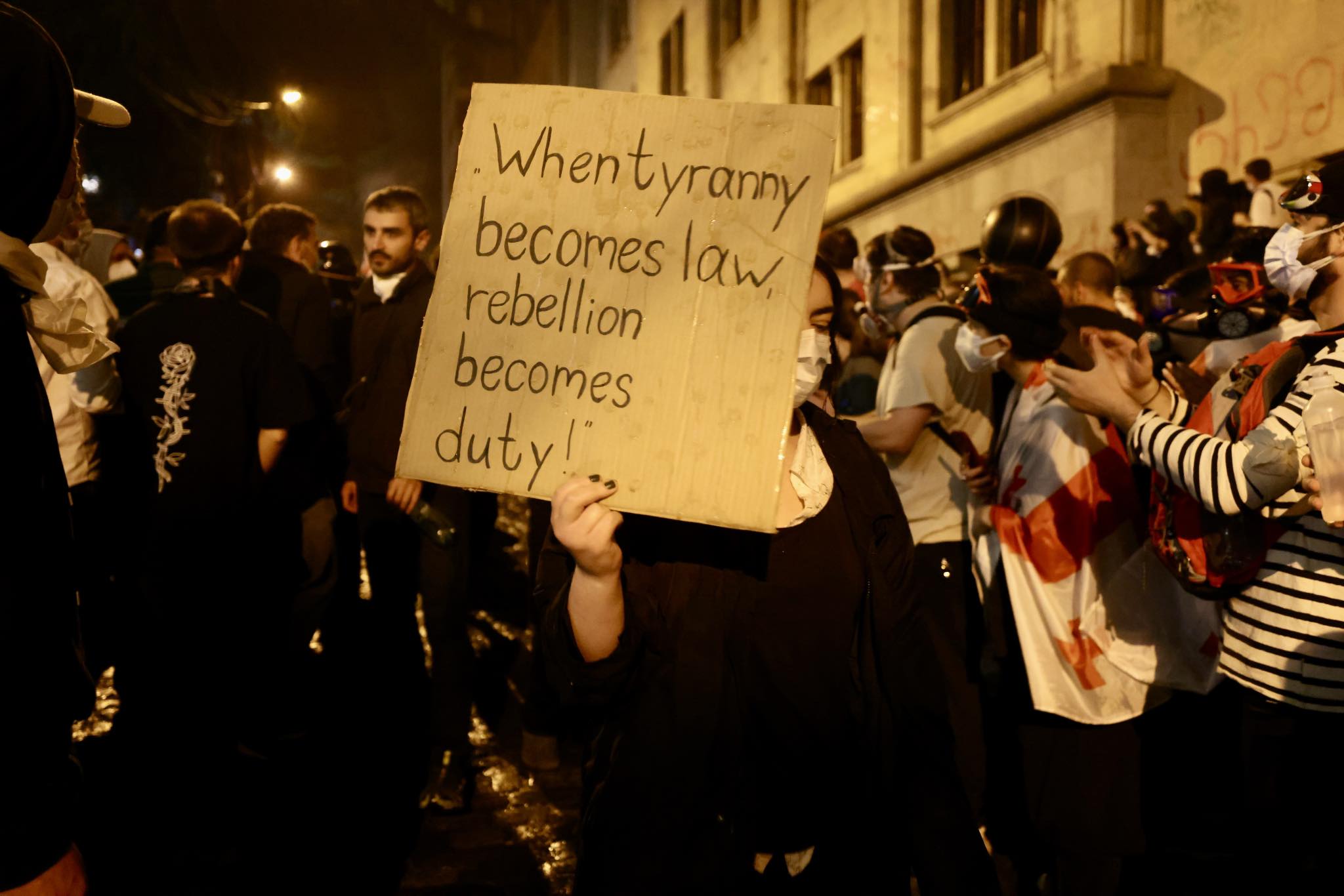
Amnesty International, a UK-based human rights organization, said Georgia’s ruling party has built a “sophisticated architecture of repression” over the 500 days of protests through what it described as restrictive legislation, police abuses, disinformation campaigns, and judicial practices aimed at suppressing dissent.
In a June 15 report titled “Georgia: Anatomy of Repression: 500 Days of Protest, Crackdown and Resilience,” the organization examined developments since the Georgian Dream government announced on November 28, 2024, that it would halt the country’s EU accession process until 2028.
“Since spring 2024, and especially since the mass daily protests that began on 28 November 2024, the authorities have used the full machinery of the state to deter, punish and extinguish dissent,” the watchdog said, adding that the information space has been “weaponized” to brand civil society organizations, independent media, opposition figures, and protesters as “foreign agents,” “extremists” or “threats to national security.” It added that “these narratives have not remained rhetorical” and “they have often been followed by harassment, physical attacks, investigations, prosecutions, asset freezes and other punitive measures.”
“Georgia’s experience over the last three years is a cautionary tale of how governments can rapidly turn state institutions into potent tools of repression for the sake of entrenching their own power,” said Denis Krivosheev, Amnesty International’s Deputy Director for Eastern Europe and Central Asia, according to the organization’s press release.
The report said that Georgian authorities have built “a sophisticated architecture of repression, and “what took many years to develop in other contexts has been assembled in Georgia with striking speed: a coordinated system in which disinformation, restrictive laws, abusive policing and weaponized judicial processes reinforce one another in a quest to entrench power.”
According to the organization, “thousands have experienced arrest,” while “hundreds of people have been beaten in the streets, humiliated in detention and subjected to torture or other ill-treatment.” It further said that more than 150 protesters, activists, and government critics have been imprisoned following what it described as “politically motivated and unfair proceedings, with little prospect of finding justice.”
The report argued that civic space in Georgia has been “severely restricted,” as organizations assisting victims of abuses have faced threats, attacks, investigations, asset freezes, and operational restrictions, while “independent journalists have
been physically targeted, harassed, prosecuted, cut off from funding and pushed into ‘survival mode’.”
The report also criticized a series of legislative amendments adopted by the Georgian Dream “with no meaningful consultation,” that have “unduly restricted the rights to freedom of association, expression, including media freedom, and peaceful assembly.”
It further argued that “measures framed as protecting ‘transparency’, ‘sovereignty’, ‘public order’ or ‘family values’ have in practice imposed intrusive state control, introduced sweeping police powers, heavy fines, administrative and criminal liability, suffocating Georgia’s once vibrant civil society.”
According to the organization, the police have been given a “new legal architecture to increase its coercive force,” as they have repeatedly used “unlawful and punitive force against largely peaceful protesters, including beatings and arbitrary arrests,” adding that the “misuse of less lethal weapons has affected thousands of protestors and injured many more.”
It said that “the coordinated nature of these abuses points to a state-sanctioned pattern of punishment,” arguing that effective investigations into alleged police abuses have been “rare,” as “Senior officials implicated in violent crackdowns have avoided accountability.”
The report also criticized Georgia’s judiciary, arguing that courts have “effectively enforced and legitimized the criminalization of peaceful protest” and have turned into “tools of rubber-stampers of injustice” by “punishing dissent, financially exhausting protesters and giving repression the veneer of legality.”
“As this report shows, this is not a chain of isolated abuses but rather a system of authoritarian practices intended to entrench power, where the formal appearance of the rule of law remains intact but its substance has been hollowed out,” the report concludes.
Recommendations
- Calls on Georgian Authorities
Amnesty International called on the Georgian authorities to halt “smearing campaigns” against dissent, saying that “all those affected must receive full and adequate reparation, including truth, restitution, compensation, rehabilitation, and guarantees of non-repetition.” It also called on the authorities to “cease the use, and threats of use, of tax investigations, funding inquiries, and abuse of other regulatory mechanisms as instruments of harassing and delegitimizing media outlets.”
The organization called for the repeal of controversial legislation, including the Foreign Agents Law, the Foreign Agents Registration Act (FARA), Law on Grants, Broadcasting Law, amendments that penalized verbal insults against officials and amendemnts on “Speech and Expression” ensuring that “all national legislation regulating civil society organizations is brought in full conformity with Georgia’s international human rights obligations regarding the right to freedom of association, including the right to seek, receive and utilize resources from foreign and international sources.”
The organization also called for “prompt, thorough, independent, impartial and effective investigations into all allegations of unlawful force during protests, including the use of tear gas, water cannons, and batons by police,” and urged the authorities to cooperate with “an independent international investigation into the chemical substances deployed against protesters in 2024 and 2025, should such an investigation be initiated.”
It further called on the authorities to ensure independent investigations into allegations of torture and other ill-treatment of people detained during the 2024-2025 protests, with the probe extended “to senior commanders who directed or acquiesced.”
Regarding the judiciary, the report urged Georgia to conduct an independent review of all criminal convictions of protesters and activists imposed since 2024. “All convictions found to have resulted from unfair proceedings must be quashed and those imprisoned released.”
- Recommendations to International Partners
Amnesty International also addressed the European Union, the Council of Europe, and other international partners, calling on them to “maintain and expand support to NGOs, human rights defenders and media outlets affected by smearing and disinformation campaigns.”
The report advised the international partners to “call on the Georgian government to repeal and amend the repressive legislation that is unduly restricting the rights to freedom of expression, association and peaceful assembly,” and support the Venice Commission’s work in “assessing Georgia’s legislative programme and press the Georgian government to implement their recommendations in full.”
It further urged the EU to “impose an immediate and comprehensive embargo on the sale and transfer of all policing equipment to Georgia, including less-lethal weapons, surveillance technology, and vehicles, until an independent investigation into the use of chemical agents and other unlawful and abusive use of force by police has been completed, those responsible are held to account, and credible accountability mechanisms are in place.”
The organization also urged the international partners to “initiate investigations by the OPCW [Organisation for the Prohibition of Chemical Weapons] into the allegations regarding the use of chemical weapons against protesters to the OPCW and press for Georgian cooperation with any resulting investigation.”
The report additionally called on the Council of Europe and other international institutions to strengthen oversight of Georgia’s compliance with human rights obligations, monitor detention conditions of imprisoned protesters and opposition figures, and support the implementation of relevant judgments of the European Court of Human Rights and recommendations issued by international human rights bodies.
Also Read:

