

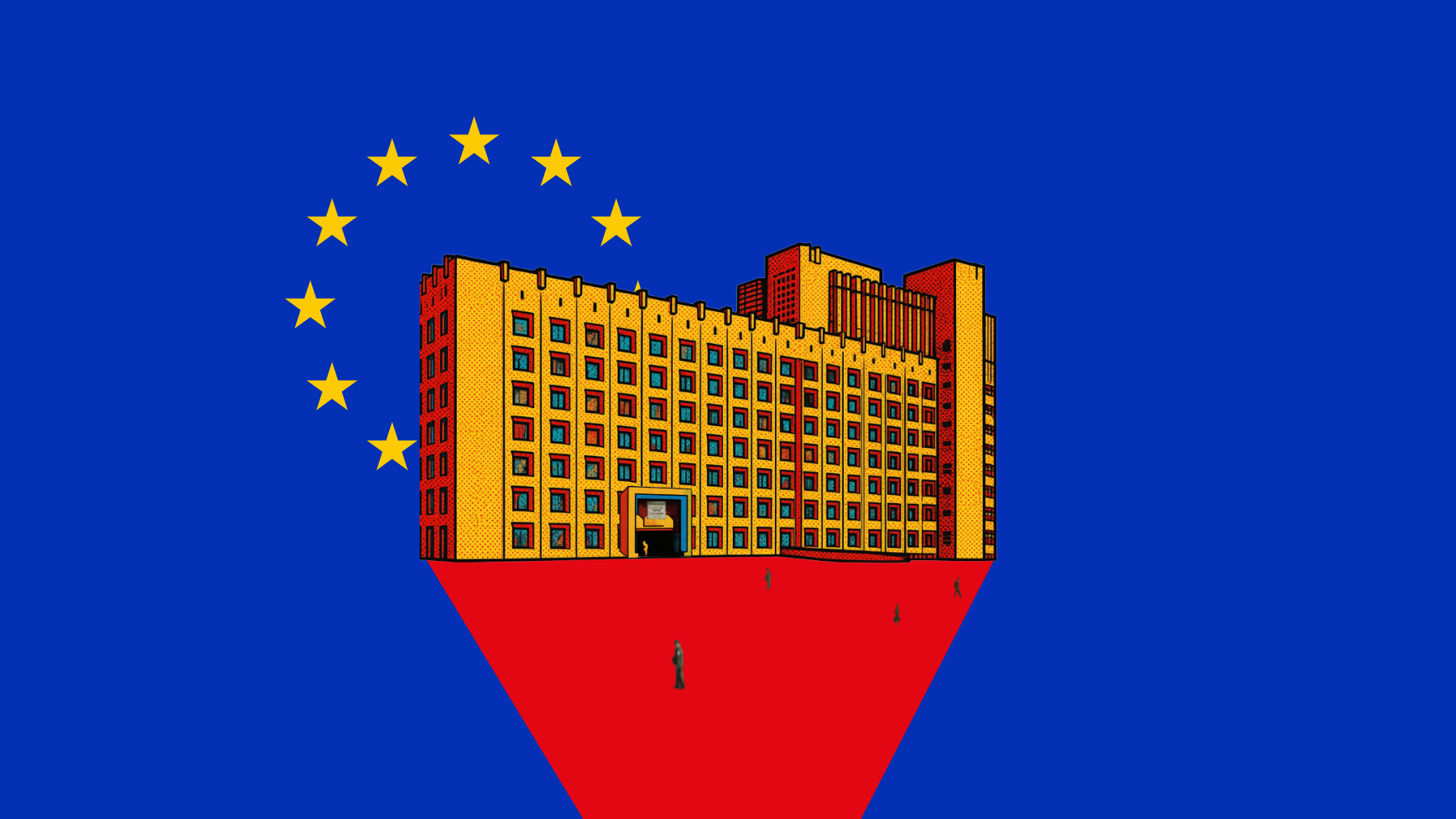
Georgian civil servants knew perfectly well that what they were doing was low-key. Rewriting a procurement regulation was never a heroic act. Harmonizing a food safety standard with a European directive drew no applause, and documentary filmmakers had perhaps something more exciting to do than point their cameras at someone sitting in their office for weeks, comparing Georgian legal text with Brussels’ language.
Yet those working in the public service did all this with a sense of purpose, a belief that they were each a small and necessary piece of something much larger than themselves. Then that sense left, and so did the people, slowly and quietly. All that is left is memory and inertia — the momentum is gone.
Ana Kvernadze is a public policy consultant with experience in governance, social policy, and reform.
The public apparatus that Georgia inherited from the Soviet Union was a particular kind of self-reinforcing order, in which everyone understood the real rules while reciting formal ones with straight faces. The gap between what the state claimed to be and what it actually was had become so familiar that most simply stopped noticing it, just as you stop noticing a crack in a ceiling that you’ve been staring at for the past twenty years.
The generation of reformers who came to power after the Rose Revolution knew that one cannot modernize a system that has been designed, through decades of accumulated dysfunction, to resist modernization from within, so they never tried. Instead, they chose to demolish and rebuild.
The work went at times faster than was wise, and at times ignorant of what was lost in the process. But it was vibrant, something very rare for the post-Soviet world and very new for the ordinary Georgians, who had spent their adult lives learning to expect nothing from the state and suddenly faced a whole new reality. Then, advancing on its European Integration path, Georgia launched formal talks on the Association Agreement (AA) in 2010, under the United National Movement (UNM) government. When Georgian Dream came to power in 2012, they inherited the AA process and brought it to signature in 2014.
The smooth transition meant that Georgia’s state bureaucracy could still present itself as an institutional machine capable of carrying a strategic national project across an electoral rupture.
Bureaucracy of Belonging
The initial years of opening up to European reforms passed under the shadow of quiet, familiar anxieties of a small, liberalised economy being asked to absorb the regulatory weight of Europe. But slowly, the work on AA gave the Georgian public administration a clearer direction. The reforms penetrated state institutions through both the legislative process and the everyday work of an entire generation of public servants and policy professionals. They were meant to create a habit of building a country in which an ordinary Georgian might look around and conclude, without heroic optimism, that staying was more rational than leaving.
Every chapter of the agreement fell on somebody’s desk and created a human obligation. By that, it also created a civil servant who had to read a directive drafted in Brussels for twenty-seven member states, extract what it meant for a country of four million with its own history of institutional dysfunction, draft the necessary changes to Georgian laws, push those changes through a legislative process with its own inertia and appetite for delay, and then somehow ensure that what had been written down was actually practiced by the border officials, police, or regulators who had spent their careers in the world where you could change overnight the laws but not the work culture.
People in the public service who carried out this work were, for the most part, young and proud in a way that may sound naïve, though it was not naive at all. State functionaries would return from Brussels technical working groups with a kind of borrowed confidence, the sense of having sat at a table where serious countries conducted serious business and having held their own. Donor organizations would arrive with funding and expertise, slotting into a system that was already generating its own momentum.
This atmosphere thrived in the years leading up to 2017, when Georgia secured its major accomplishment on its European integration path – visa-free travel with the EU. While arriving as a political decision, the visa-free regime was at the same time a product and showcase of invisible bureaucratic work that required years of alignment across justice, border management, and document security.
Quiet Exodus
Nobody left on the same day, and nobody announced they were leaving for the reasons they were actually leaving. People who have spent years inside an institution rarely say, on their way out, that the institution has broken their faith in itself. Instead, they choose to tell a cleaner story of a better opportunity elsewhere, which is sometimes even true, and which allows everyone involved to preserve the dignity of a parting. It does not require anyone to name what has actually happened.
What actually happened was that the unspoken contract that had sustained the European decade of Georgian public administration quietly waned in the months that followed the Georgian ruling party’s November 2024 announcement on halting EU integration, just like relationships between people sometimes end through a gradual accumulation of silences.
It is true that cracks were there before. The civil service in Georgia had never been independent from politics in the way that Western administrations at least formally aspire to be. Anyone who worked inside knew this and made their accommodations with it: the European direction felt serious enough to create genuine professional space even within that politically organized system. The system sustained a generation of people who felt that their expertise mattered, that the quality of their work would eventually reach someone with authority and inclination to act on it, and that the reform agenda they were serving was larger than any single political cycle and would outlive it.
Once that sense disappeared, the same people found themselves with skills that had become contextually orphaned. They left, some quietly, some with disappointment, and some with silent resentment for spending years serving an institution that no longer knew what to do with them.
Legacy of Convenience
Not all of that work has vanished with Georgia’s anti-Western turn.
Regulations and directives that a generation of Georgian civil servants spent years aligning with European standards are still here, but their fate since has depended on political and economic convenience. The technical regulations derived from AA are largely in place because the businesses have found ways to accommodate them, and the political class has found no particular reason to object. The food safety frameworks that took years to harmonize with the EU requirements continue to function at a level that keeps Georgian exports moving.
But not all of that European reform legacy turned out to be politically comfortable. Such was, for example, civil service reform, one of the more substantial moves of the EU-alignment years. It was designed to shield the civil service from political interference, establish merit-based hiring and promotion, and provide institutional safeguards that would allow public officials to perform their duties without having to calculate whether the outcome would be acceptable to those in power.
It took the Georgian ruling party only weeks to dismantle that achievement after groups of Georgian civil servants began signing protest petitions in response to the Georgian Dream’s anti-EU turn. The party responded by amending the law with speed and surgical precision to send a clear signal to civil servants that speaking their minds could now carry consequences. Overnight, the amendments left the public service without the vital safeguards it had enjoyed, a move that was followed by repeated reports of politically motivated purges in state institutions.
What Remains
Today, what remains inside the system is a machinery of public service without its moral center, resembling a railway administration that keeps publishing a flawless timetable after the headquarters has quietly decided the trains should no longer follow that route.
The donors and development partners who provided much of the technical energy and external accountability now operate in a narrowed space that fits comfortably within the boundaries of what the political system has decided it can tolerate. This often means capacity building in areas that cost nothing and threaten no one, producing a training here, a workshop there.
The picture is even bleaker at the local level, as the public service is increasingly staffed by people whose primary qualification is that they do not present a problem to those who appointed them. The central institutions hold, more or less, on the inertia of what was built before.
The inertia, however, is not momentum, and a system that has stopped improving is the one that has started, quietly and without announcement, to go the other way.

