

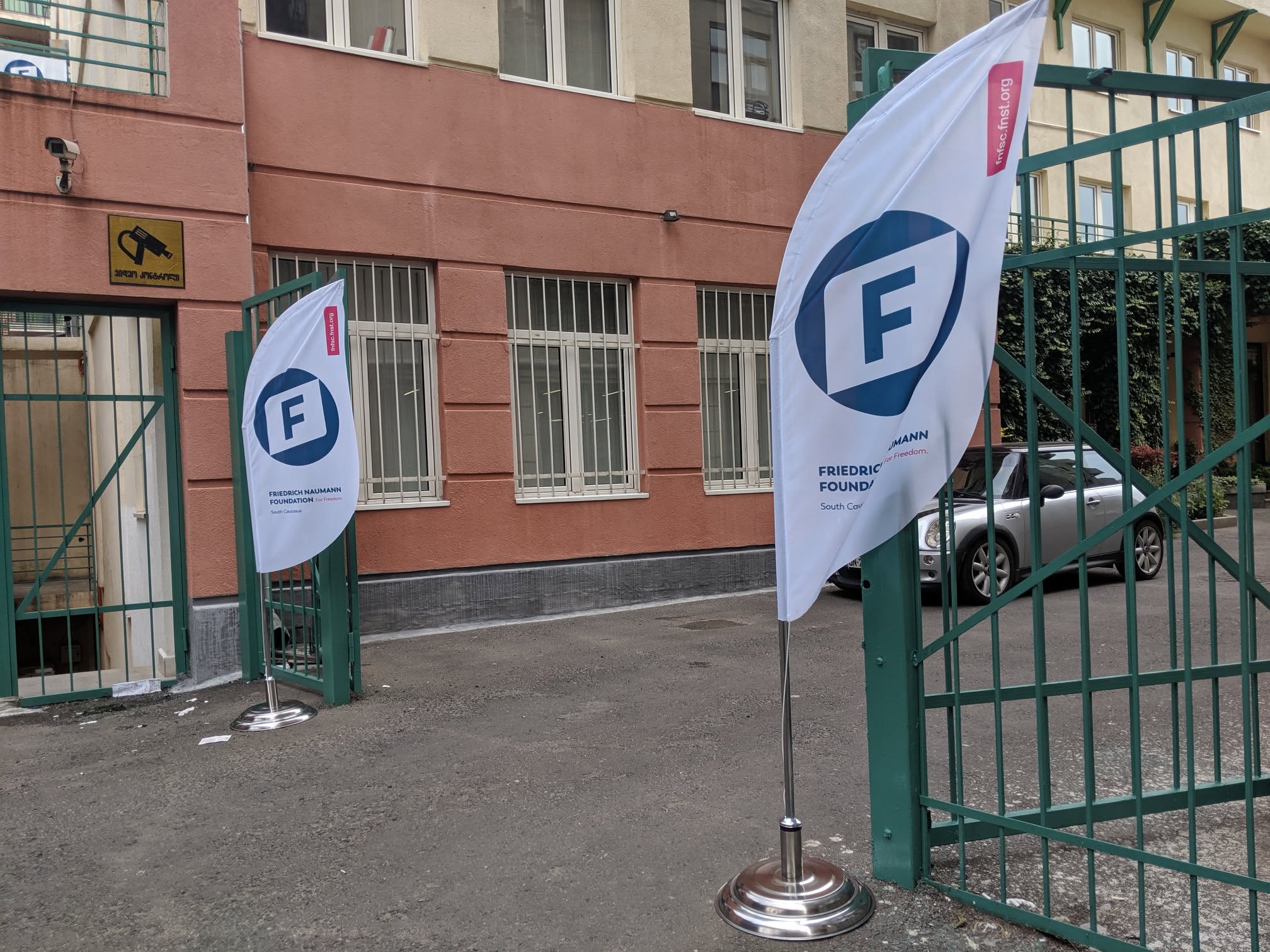
The Friedrich Naumann Foundation for Freedom (FNF) is another major German foundation, after the Konrad Adenauer Foundation (KAS), to announce an exit from Georgia amid funding restrictions introduced by the ruling Georgian Dream party as part of its crackdown on media and civil society.
FNF said in its October 2 statement that it ceased operations in Georgia and closed its Tbilisi office, saying restrictions under Georgia’s Law on Grants had made it impossible to continue its work, citing, among others, the rejection by Georgian authorities of its applications to continue funding the projects under new grants laws.
“The Georgian government’s actions make it impossible for the FNF to continue working in the country,” the statement said.
The decision follows a series of funding restrictions introduced in Georgia since 2024, including amendments to the Law on Grants in 2025 that introduced mandatory government approval for foreign donors to disburse local grants, and March 2026 amendments to the same law that further expanded the restrictions to foreign organizations willing to provide funds to their local branches.
The Foundation, closely affiliated with Germany’s liberal Free Democratic Party (FDP), has operated in the country since 2002.
It said that the “unavoidable” decision was made after it had applied this year under Georgia’s Law on Grants to continue funding projects and working with partner organizations, but “the Georgian authorities demanded that every single program component be subordinated to the priorities of the Georgian government and that appropriate approvals be obtained for all activities.” The FNF said that such conditions “fundamentally undermine the necessary freedom of action required of a liberal foundation.”
It noted that it then had sought to “exhaust all possibilities” to continue its work in Georgia and “support those forces committed to a democratic future for the country,” however, “this application was rejected on July 28, 2026.”
“Therefore, we no longer see any possibilities for work that aligns with our values and principles.”
The FNF said that it has been active in Georgia since 2002, working with “many partner organizations” and “liberal leaders” to promote “a free society, a European future for Georgia, and a close dialogue between societies.”
The Foundation said Georgia had previously been “a symbol of hope and democratic progress,” while noting that it “will continue to stand alongside all Georgians who are committed to a free and democratic order in their country.”
“We will give them a voice from outside the country and support them in working toward a free and democratic future for their nation,” the statement said.
The FNF thanked its staff and partners, saying that in recent years “many of them have had to take on increasing personal risks when they have worked for a democratic liberal order in their country.”
“We therefore view Georgia’s political developments with great concern.”
The announcement came a day after the Konrad Adenauer Foundation (KAS) said that it had closed its Tbilisi office on September 30 after more than two decades of work in Georgia, similarly citing Georgia’s grant restrictions
Georgia’s Tightening Funding Environment
As part of its crackdown on civil society and media, the ruling Georgian Dream party has gradually restricted access to foreign funding through a series of laws since 2024, including the Georgian version of the Foreign Agents Registration Act (FARA) and a repeatedly amended Law on Grants. Under the current versions, both laws carry criminal penalties, including several years in prison, for certain violations related to foreign funding.
That includes failure to seek government consent for certain foreign grants under the Law on Grants, punishable by up to six years in prison, and failure to register as a foreign agent under FARA, punishable by up to five years in prison.
While dozens of civil society organizations have reported inspections by the now-abolished Anti-Corruption Bureau over the past year, the cases never grew into criminal prosecutions. However, local and international watchdogs have repeatedly pointed to the chilling effects of what they consider vague and arbitrary legislation, leading many organizations either to shut down or scale back their activities.
Recently, Tbilisi also revived pressure and scrutiny of foreign organizations, including the Council of Europe, for working with local groups.
Also Read:

