

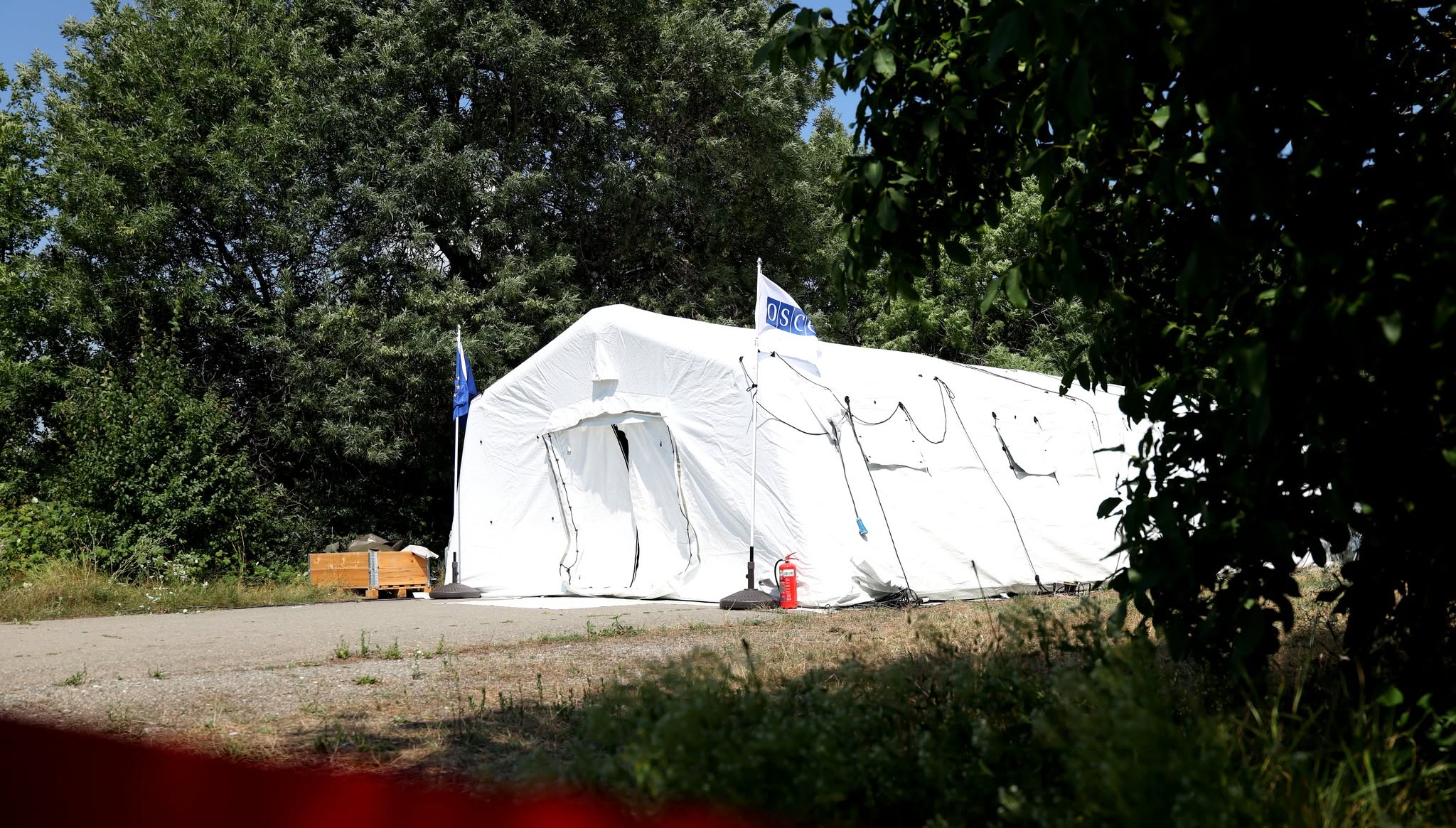
The 133rd meeting of the Incident Prevention and Response Mechanism (IRPM) took place on July 23 in the village of Ergneti, near the occupation line in Georgia’s Russia-occupied Tskhinvali region.
The meeting was co-facilitated by Bettina Patricia Boughani, Head of the EU Monitoring Mission in Georgia (EUMM), and Christoph Späti, Special Representative of the OSCE Chairperson-in-Office for the South Caucasus.
The next IPRM meeting is set to take place on September 8.
SSSG Statement
In a routine statement, the State Security Service of Georgia said that “all important incidents” recorded in the occupied region and along the occupation line since the previous IPRM meeting were discussed.
The SSSG representatives “once again firmly raised the issue” of bringing to justice the representative(s) of the Russian occupying forces responsible for the killing of Georgian citizen Tamaz Ginturi and ensuring accountability.
They also “once again condemned the illegal so-called borderization,” while “a significant part” of the discussions focused on the “illegal restriction of freedom of movement and the regime in place at the so-called crossing points.”
The meeting also highlighted “the growing trend of violations of fundamental human rights in the occupied Tskhinvali region,” the SSSG said, adding that Tbilisi’s representatives “strongly demanded the immediate release of all persons held in illegal detention.”
EUMM, OSCE Statement
In line with previous statements, the OSCE press release said the meeting co-facilitators “appreciated the continued commitment of all participants to the IPRM format” and “reiterated its importance as a practical platform for addressing security issues and matters of concern to conflict-affected communities.”
“Participants exchanged views on recent security developments, including the installation of obstacles, military exercises and flights in the vicinity of the administrative boundary line (ABL). The ongoing detention of individuals remained a key issue. All cases were discussed, with the EUMM and OSCE reiterating their appeal to discontinue the practice of detentions and to extend the humanitarian approach towards those affected,” the press release said.
According to the statement, IPRM participants also discussed challenges faced by conflict-affected communities along the ABL, including restrictions on freedom of movement. The co-facilitators welcomed the temporary opening of crossing points during the Lomisoba festivities and called for their full opening, saying that regular movement across the ABL would improve the “daily lives, safety and livelihoods” of affected communities. Participants also discussed irrigation water issues and highlighted the EUMM-managed Hotline as a key tool for “sharing information, addressing incidents and defusing tensions.”
De Facto Authority’s Statement
Igor Kochiev, representing the de facto authorities in the occupied Tskhinvali region, said after the meeting that participants discussed, among others, alleged “airspace violations” over the region, approaches to “sanitary fences” along the occupation line, the Georgian police checkpoint in Chorchana-Tsnelisi, and the case of Tamaz Goloev, an Akhalgori resident detained in Tbilisi on espionage charges.
According to Kochiev, one case involving an unmanned aerial vehicle was recorded since the previous IPRM meeting, while he suggested there may have been additional cases. He also said that one piloted aircraft crossed into the occupied region’s airspace from Tbilisi-controlled territory near the village of Tsinakari. Kochiev said the Tskhinvali side activated the hotline and that the case was discussed during the IPRM meeting, with Tbilisi saying the incident was unintentional.
Kochiev also addressed the issue of the “sanitary fences” along the occupation line, saying that approaching it is considered a “border violation.” He said no violations by EUMM patrols had been recorded since the previous meeting, calling it a source of “cautious optimism,” while noting one case involving Georgian police representatives approaching the fence. Kochiev added that the “sanitary fence” is built 5 to 50 meters from what the de facto authorities describe as the “actual state border line,” with the distance exceeding 100 meters in some areas depending on the terrain.
Regarding the Georgian police checkpoint in Chorchana-Tsnelisi, established in 2019 under then-Interior Minister Giorgi Gakharia, Kochiev said the authorities of the occupied region continue to insist on restoring the status quo. “There has been no significant progress on this issue either, and the problem continues to be raised,” he said. According to Kochiev, the Tskhinvali authorities continue dialogue, hoping for a constructive approach from Tbilisi.
In addition, Kochiev said the occupied region’s delegation “expressed serious concern” over the lack of information about the health condition and status of Tamaz Goloev, who was arrested in April by the Georgian State Security Service on espionage charges. He said the delegation had only received assurances from Tbilisi that Goloev had no health complaints, noting that a court hearing scheduled for June 25 did not take place and that a new date had yet to be set.
The Incident Prevention and Response Mechanism (IPRM) was established in 2009 within the framework of the Geneva International Discussions that followed the 2008 Russo-Georgian war. It serves as a forum for the regular discussion of security-related incidents and developments on the ground. IPRM meetings have been held regularly in Ergneti, near the Tskhinvali occupation line, with the participation of representatives from Tbilisi and the Tskhinvali de facto authorities. In contrast, meetings in Gali, in occupied Abkhazia, have been suspended multiple times, from 2012 to 2016, and again since 2018. The meetings are co-facilitated by the OSCE and the European Union Monitoring Mission in Georgia (EUMM).
Also Read:

