

Official statistics show that 114,374 people emigrated from Georgia in 2025, while 131,501 immigrated. The country thus recorded positive net migration. The number of people leaving the country declined compared to both 2024 and 2023, with a similar trend observed among Georgian nationals alone.
Those figures, however, do not offset the more negative picture emerging from data over the past decade, which show that emigration among Georgian citizens has significantly outpaced immigration. Nor have they eased growing concerns about the Georgians leaving their country amid the anti-democratic drift and economic difficulties.
The official data, despite their limited scope, point to several major developments that may have shaped migration patterns into and out of Georgia over the past decade: the introduction of the EU visa-free regime in 2017, COVID-related travel restrictions, and the influx of Russian nationals following Russia’s full-scale invasion of Ukraine. The statistics, however, may not yet reflect the full effects of more recent developments, including the ongoing political crisis and the government’s crackdown on immigration.
Below is a more detailed breakdown.

Methodology and its limitations
Georgia updates migration statistics annually. Since 2012, Georgia’s National Statistics Office (Geostat) has relied on data provided by the Interior Ministry’s Border Police to calculate the number of emigrants and immigrants.
Geostat defines an emigrant as a person who leaves the country and subsequently spends at least 183 cumulative days abroad during the following 12 months. The definition also requires that the person had spent “at least a cumulative duration of 183 days of residence inside the country [Georgia] during the 12 months before leaving the country.”
Similarly, an immigrant is defined as a person who enters Georgia, was not a usual resident of the country before arrival, and subsequently spends at least 183 days in Georgia during the following 12 months. The definition also requires that the person had spent at least 183 cumulative days outside Georgia during the 12 months before entering the country.
Publicly available data offer a breakdown by gender, nationality, and age group. They do not, however, allow for a breakdown by age within each citizenship category. Nor do they, unlike census data, distinguish between ethnicity and citizenship, making it difficult to determine what share of the foreign nationals included in the statistics may be ethnic Georgians who acquired foreign citizenship after emigrating.
There are no publicly available figures on the social or economic factors behind emigration, the reasons for leaving or returning to the country, the average duration of emigration or stay in Georgia, or the Georgian regions most affected by emigration.
And, given the 183-day rule used to define emigration and immigration, the 2025 data may not yet capture the full impact of Georgian political developments on migration trends. More recent restrictions on immigration, including a legislative crackdown on migrant workers, may also not yet be reflected in future statistics.
Key Numbers
Official data for all nationalities show positive net migration of 17,127 people in 2025, with 131,501 immigrants arriving in Georgia and 114,374 emigrating. Both immigration and emigration declined from 2024, when 135,811 people arrived in Georgia and 121,425 left the country.
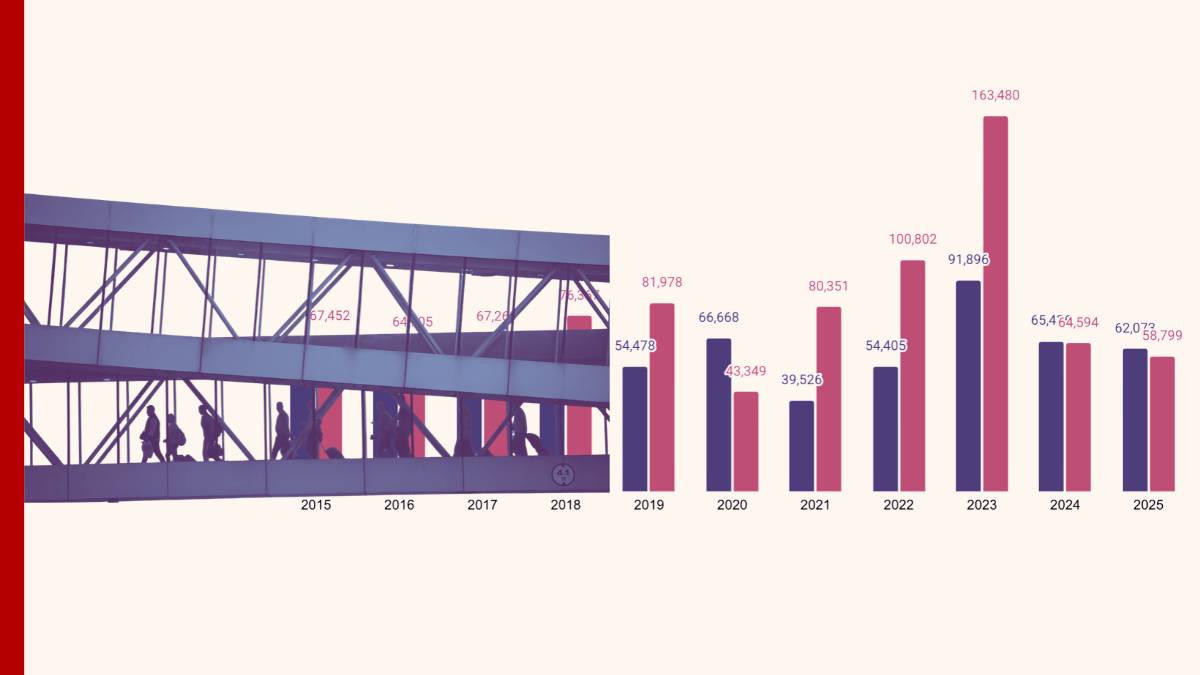
A similar trend is evident among Georgian nationals alone. Of the 114,374 people who emigrated in 2025, 58,799 were Georgian citizens, down from 64,594 in 2024. More Georgian citizens also immigrated (62,073) than emigrated in 2025, and the number of immigrants holding Georgian citizenship likewise declined from the previous year (65,436).
Russians were the largest foreign-national group in both directions of migration. According to official data, 20,139 Russian nationals immigrated to Georgia in 2025, while 19,226 emigrated. Both figures were down from 2024, when 23,574 Russian nationals arrived, and 25,612 left the country.
People in their twenties and thirties accounted for the largest age groups among emigrants. The largest group was those aged 25–29, numbering 17,105. They were followed by people aged 20–24 (14,723), 30–34 (14,562), and 35–39 (12,510). All four age groups recorded lower figures than in 2024.
Of those who emigrated in 2025, 68,152 were men, and 46,222 were women. In 2024, the corresponding figures were 72,782 men and 48,643 women. Meanwhile, 2,333 people acquired Georgian citizenship and 1,426 lost it during the year, according to Geostat.

Figures stabilize after 2020-2023 swings
While the 2024–2025 figures show a gradual decline in both immigration and emigration among Georgian and foreign nationals, this stabilization follows sharp fluctuations in 2020–2023, coinciding with the COVID-related travel restrictions and their gradual easing, as well as the influx associated with Russia’s full-scale invasion of Ukraine.
Geostat data show that emigration among Georgian citizens had been rising since 2017, the year the EU visa-free regime was introduced, before dropping sharply in 2020, apparently as a result of pandemic-related restrictions. Emigration among Georgian nationals then surged again from 2021, with the country recording nearly twice as many emigrants as immigrants among its citizens each year. The trend peaked in 2023, when 163,480 Georgian citizens emigrated, compared to 91,896 who immigrated, also a decade-high figure.
Another trend that has significantly affected overall migration figures since 2022 is the influx of Russian nationals following Russia’s full-scale invasion of Ukraine. According to Geostat, 62,304 Russian nationals arrived in Georgia in 2022, compared to 10,881 in 2021, while only 5,935 left the country that year. The trend continued in 2023, when 52,627 Russian nationals immigrated to Georgia, before the numbers began to decline, falling to 23,574 in 2024 and 20,139 in 2025.
The emigration data suggest that some of those who arrived amid the war began leaving Georgia in 2023, when 35,344 Russian nationals emigrated. The outflow continued in 2024, when more Russian nationals left (25,612) than arrived, and in 2025, when emigration declined further to 19,226, still remaining below the number of arrivals (20,139).

Longer Trends
When considering all nationalities and age groups, the figures for the past decade present a relatively balanced picture: Georgia recorded 1,267,991 instances of immigration and 1,264,116 instances of emigration. These figures may include the same individuals immigrating to and emigrating from the country multiple times.
There is a more significant imbalance, however, when looking at individual nationality groups. Among Georgian nationals alone, Georgia recorded 628,718 instances of immigration and 869,146 instances of emigration in 2015-2025.
Among Russian nationals, the country recorded 229,369 instances of immigration and 131,366 instances of emigration over the same period. Publicly available data do not show how many of them are ethnic Georgians holding Russian or dual citizenship who may have returned to Georgia.

Other Groups of Foreign Nationals
Among groups of foreign nationals immigrating to Georgia in 2025, the Russian citizens (20,139) were followed by Ukrainians (6,937), Indians (5,685), Azerbaijanis (5,574), and Turkish citizens (5,341). Other groups included citizens of Kazakhstan (2,362), Israel (1,955), Belarus (1,938), the United States (1,696), and China (1,090). The “other countries” category accounted for 16,671 people.
Among foreign nationals who left Georgia last year, Russians (19,226) are followed by Indian citizens (4,456), Ukrainians (3,658), Turkish (3,328), Chinese (3,070), Azerbaijanis (2,547), and U.S. citizens (1,357). Armenian and Iranian citizens accounted for 1,110 emigrants each. The “other countries” category comprised 15,332 people.
Importantly, in 2025–2026, Georgia introduced a series of legislative restrictions as part of its declared crackdown on “illegal” migration. These included tightening labor migration laws, effectively barring foreigners without permanent residence from working in certain jobs, and stepping up deportations. More than 3,000 foreign nationals had already been expelled by October. The effects of these measures may become visible in future (2026-2027) migration statistics.
Georgia’s Population Per Latest Census
According to Geostat’s 2024 census results, Georgia’s population stood at 3,929,581 as of November 14, 2024, an increase of 215,777 people, or 5.8%, compared with the 2014 census, which recorded 3,713,804 people.
The number of Georgian citizens increased by 2.5% over the decade to 3,775,415. However, their share of the total population declined from 99.2% to 96.1%. Foreign citizens permanently residing in Georgia numbered 133,857.
Russians were the largest group of foreign citizens permanently residing in the country, with 37,715 people, up from 7,620 in 2014. The number of Indian citizens rose to 23,925, from 416 a decade earlier, while the number of Ukrainians increased to 11,542, from 1,631.
The census also recorded increases in the numbers of citizens of Azerbaijan and Armenia permanently residing in Georgia, to 8,309 and 5,381, respectively. They were followed by citizens of Turkey (5,262), Belarus (4,473), Iran (4,322), Israel (3,244), and Jordan (3,037).
Also Read:

