


Researchers from Skoltech — a VEB.RF Group institution
— have developed an optimization framework to help
factories compare strategies for using on-site solar power
and the electric vehicles of employees to reduce electricity
costs. Evaluated in a Moscow case study, the approach
accounts for industrial electricity billing rules, operating
decisions, and drivers’ willingness to participate,
helping businesses assess options before investing. The study
came out in Applied Energy.
researchers modeled how an enterprise can exploit variable
electricity prices in conjunction with solar generation by
managing the charging and discharging of employees’
electric vehicles, with financial incentives for drivers.
(Photo/Ahmed Eltwam)
As the
share of renewables in the global electricity mix is
projected to keep growing, finding enough land for solar and
wind farms and other generation facilities is becoming
increasingly difficult. This challenge is compounded by the
need for infrastructure upgrades where existing transmission
lines cannot carry the additional output.
Generating
electricity close to where it is consumed could provide part
of the solution by cutting the need for long-distance
transmission and making use of existing buildings or
developed sites. Factories are prime candidates: Their large
electricity demand can absorb on-site generation, and their
roofs and industrial grounds mitigate the need for new
land.
Advertisement – scroll to continue reading
Businesses considering this route need to work
out how to combine available resources into a financially
worthwhile project. Cars parked at work sit idle for hours.
With bidirectional chargers, which allow electricity to flow
into and out of car batteries, employees’ electric
vehicles could supply part of a factory’s needs. Known as
vehicle-to-grid technology, this approach can add
flexibility to a factory’s energy use. Unlike stationary
storage, however, cars arrive and leave with their owners,
who need enough charge at the end of the day for making
their trips and who may opt out entirely.
Factory
owners can manage when cars charge and whether participating
vehicles may supply power back to the workplace. Each
arrangement involves different operating decisions and
financial considerations. Add solar generation into the mix,
and the picture changes further. For a case study, the
researchers looked at the Russian market, where industrial
consumers pay for electricity at hourly prices and for
capacity linked to demand during particular peak hours.
Solar generation and flexible vehicle charging can therefore
reduce different parts of the electricity bill.
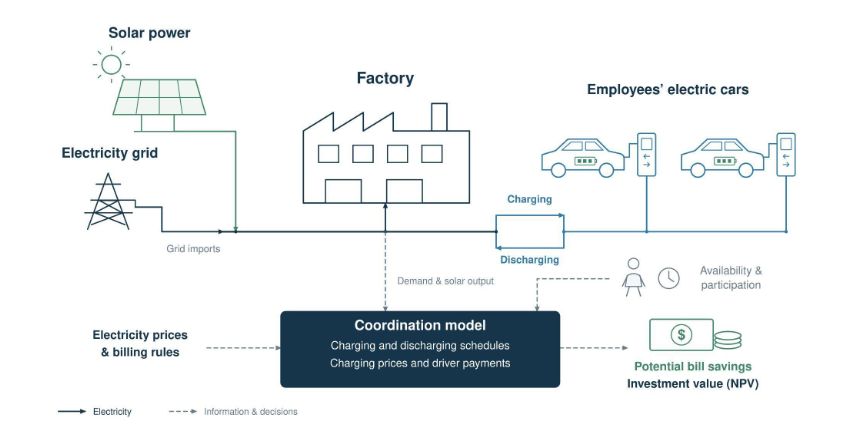
The
Skoltech team identified a lack of long-term investment
assessments that would account for solar power, workplace
vehicle-to-grid supply, driver participation, and Russian
billing rules. The framework proposed in the study links
driver participation, charging prices, compensation for
supplying electricity, and car battery charge levels. This
means that the incentives offered determine how much
flexibility is available: Not every connected car is
automatically counted as available.
For a test period
of 10 years, the researchers compared six supply scenarios:
grid-only supply, solar panels alone, vehicle-to-grid alone,
solar with managed charging, and combined solar and
vehicle-to-grid under fixed and behavioral participation
assumptions. Under an unchanging vehicle fleet and solar
infrastructure, the model jointly optimized operating
schedules, charging prices, and driver compensation within
battery and connectivity limits, then assessed the resulting
financial returns.
Distinct economic opportunities
emerged depending on the scenario: While solar generation
reduced electricity purchases, coordinating vehicle charging
and discharging created additional value under the
case-study conditions. Managed charging provided benefits
without requiring battery discharge, and bidirectional
operation offered further flexibility. Accounting for driver
participation produced more conservative financial estimates
than assuming every technically available car participates.
In terms of capital efficiency, vehicle-to-grid solutions
alone are expected to recoup their investment faster than
when paired with solar cells, even though the latter
approach yields greater long-term
returns.
“Employees’ electric cars create an
opportunity to use the same battery for personal transport
and workplace energy flexibility. We factor drivers’
willingness to participate into the coordination of solar
power, charging, and discharging. This helps businesses
compare operating arrangements and assess whether the
additional flexibility justifies the investment,” said the
study’s lead author, Ahmed Eltwam, a PhD
student in Skoltech’s Engineering
Systems program.
“A systematic assessment of
project viability could encourage more investment in on-site
solar power and workplace vehicle-to-grid services.
Businesses could lower electricity costs, and employees
could be paid for the flexibility their vehicles provide. At
a broader scale, deployment coordinated with grid needs
could support national renewable energy targets while
avoiding some of the costly network upgrades,” said the
study’s principal investigator, Associate Professor of the
Practice Marina Dolmatova of Skoltech
Energy.
The findings are based on simulations with
estimated market and operating inputs. Participation
assumptions were informed by published research rather than
a workplace survey. Although evaluated for Moscow, the
framework can be adapted to local electricity prices,
billing rules, demand, weather, and vehicle availability.
Financial outcomes remain specific to the analyzed
conditions, including the alignment of operation with
capacity-charge hours. Testing and calibrating the model
against real workplace charging behavior and operating data
is a priority for future research.
About
Skoltech:
Skoltech is a private international
university (part of the VEB.RF group) in Russia, cultivating
a new generation of leaders in technology, science, and
business. As a factory of technologies, it conducts research
in breakthrough fields and promotes technological innovation
to solve critical problems that face Russia and the world.
Skoltech focuses on six priority areas: life sciences,
health, and agro; telecommunications, photonics, and quantum
technologies; artificial intelligence; advanced materials
and engineering; energy efficiency and the energy
transition; and advanced studies. Established in 2011 in
collaboration with the Massachusetts Institute of Technology
(MIT), Skoltech was listed among the world’s top 100 young
universities by the Nature Index in its both editions (2019,
2021). On Research.com, the Institute ranks as Russian
university No. 2 overall and No. 1 for genetics. In the
recent SCImago Institutions Rankings, Skoltech placed first
nationwide for computer science. Website: https://www.skoltech.ru/.

