

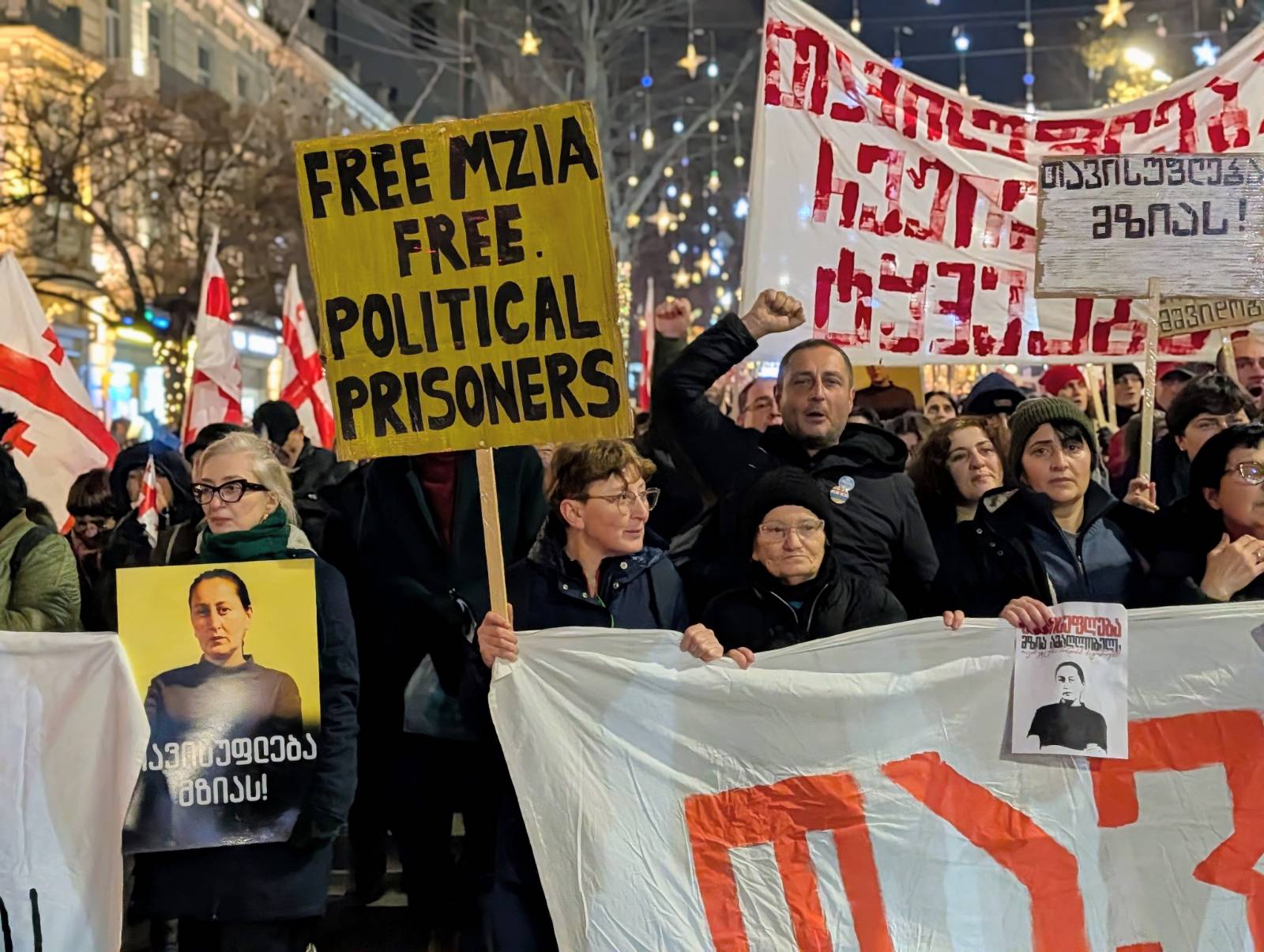
Transparency International — Georgia, a local civil society organization, has published a list of 91 convicted people currently in detention whom it considers “political prisoners,” based on criteria set out in a resolution of the Parliamentary Assembly of the Council of Europe (PACE).
The list, published on July 21, includes mainly people convicted in connection with the anti-government protests that began on November 28, 2024, after the Georgian Dream government announced it was suspending the country’s EU accession process. It also includes, among others, participants in the October 4, 2025 election-day unrest, opposition politicians, and former business associates of ruling party founder and honorary chairman Bidzina Ivanishvili.
“Such a high number of political prisoners once again points to the existence of politically motivated justice in Georgia and the deterioration of the human rights situation,” TI-Georgia said.
The list was compiled based on PACE Resolution 1900 (2012), which sets out five criteria under which a person deprived of their liberty is to be regarded as a “political prisoner.” The first criterion states that detention must have been imposed in violation of the “fundamental guarantees” set out in the European Convention on Human Rights, including freedom of thought, conscience and religion, freedom of expression and information, and freedom of assembly and association.
The other criteria include cases where detention was imposed for “purely political reasons” without connection to any offence; where the length or conditions of detention are “clearly out of proportion” to the offence; where a person was detained “in a discriminatory manner” compared with others; or where detention resulted from proceedings that were “clearly unfair” and appeared to be connected to political motives of the authorities.
According to TI-Georgia, all but three people on the list meet the first criterion, while all 91 meet the first, third, and fifth criteria. The watchdog said that “each case has been assessed individually, based on the circumstances of the case, court decisions, and international human rights standards,” adding that the list was compiled “not on political assessments, but on the legal test established by the Council of Europe.”
Thirteen people on the list meet all five criteria, including journalist Mzia Amaghlobeli, who is serving a two-year prison sentence, and opposition politician Elene Khoshtaria, who is serving a one-and-a-half-year sentence. Their cases have been widely condemned by local and international political and rights groups.
Other prominent figures on the list include opposition leaders Nika Melia and Levan Khabeishvili, former United National Movement government ministers Bacho Akhalaia and Irakli Okruashvili, opera singer Paata Burchuladze, doctor Gogi Chakhunashvili, theatre actor Andro Chichinadze, and poet Zviad Ratiani. The list also includes dozens of young people detained in connection with the first months of anti-government protests in November and December 2024.
The list does not include opposition politician Aleko Elisashvili, who was recently sentenced to 13 years in prison on an attempted terrorism charge, but identifies him as a “potential candidate” for inclusion. TI-Georgia said it would decide on his inclusion after the court publishes the reasoned judgment explaining its finding that Elisashvili acted with a “terrorist purpose,” a claim his lawyers have categorically denied.
The most frequent charges against people on the list include “violence against a police officer” (13 cases), “attempted seizure of a strategic facility” (19 cases), “group violence” (35 cases), and “group action” that “disrupted public order” (19 cases). The list also includes three Russian citizens convicted of “drug possession.” Other offences cited include property damage, violence against police officers, blocking roads, and inflicting bodily harm.
Recent court proceedings have shown a shift in the handling of some protest-related cases. While prison sentences have remained common in major prosecutions, several defendants have recently entered plea agreements resulting in suspended sentences or reduced prison terms.
Georgian Dream has long rejected accusations that the country has “political prisoners” and calls for their release, insisting that every individual is serving a sentence for a specific offence.
Also Read:

