



Tuwhenuaroa
Natanahira Political reporter
Lauren
Crimp Political reporter
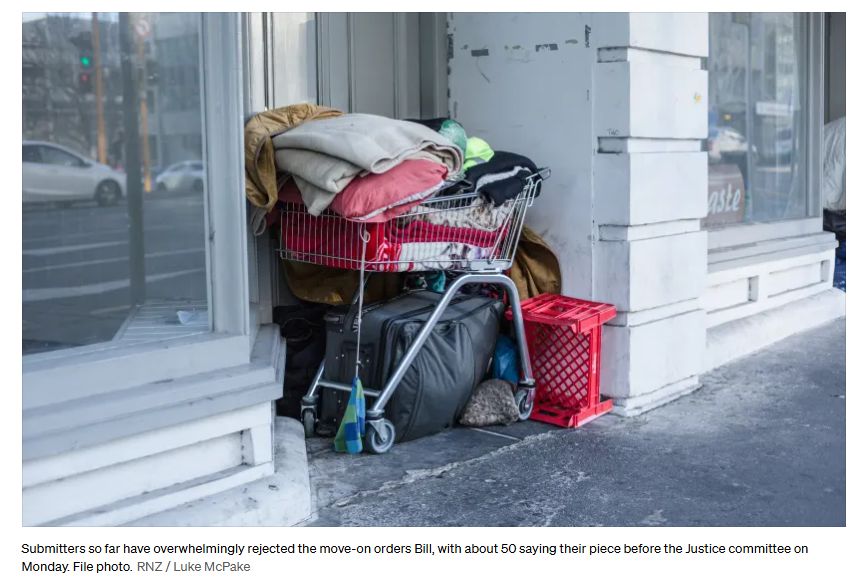
Fear
surrounding the incoming move on orders is already pushing
rough sleepers of out Auckland’s central city, says a social
service provider.
Oral submissions on the Summary
Offences (Move-on Orders) Amendment Bill were heard by the
Justice committee on Monday, with most speaking
in opposition to its introduction.
Lifewise is an
Auckland-based community organisation which supports
children, the elderly and people on the street. Chief
executive Pam Elgar told RNZ her organisation had seen
homeless people “shifting” out of the CBD into other
neighbouring suburbs.
She said it was because of fears
around the impending move-on legislation.
“We’re all
creatures of habit, so when you find a place that’s
relatively safe – a place you feel okay in – whether it’s
sleeping under a bridge or in the doorways of a property,
and you’re no longer there, it means something has triggered
that fear.
Advertisement – scroll to continue reading
“It’s not a safe space to be on the street,
so if people are moving around as we believe they are, then
that’s a concern. We believe that’s triggered because of the
distrust in this government and this legislation coming in,”
she said.
The latest Auckland Council data showed
there were 706
people known to be sleeping in cars, streets and local
parks in January, up from 653 in January last year but down
from a peak of 940 in September 2025.
Elgar said that
did not match up with what her staff and other organisations
were seeing.
“We believe they’re moving, and you can’t
count them, because our experience is the people coming into
Merge are increasing, the people coming into Auckland City
Mission are increasing.”
She said data on the number
of homeless people in Auckland was conducted by council
compliance officers who only covered a small part of the
city.
“The count that the compliance officers are
doing can’t be extrapolated to make points about
homelessness. It is simply a count on one day about where
they are and it isn’t telling us that people are better off
because the numbers are lower.
“Let me be really
clear, the compliance officers are simply doing their job…
I believe public servants are doing the best that they can
do, but they are combined within a cohort of responsibility
that they have to do.”
‘The hardest thing is just
finding them’
Lifewise outreach worker Kat Feo finds
temporary accommodation rough sleepers and told RNZ clients
from all over the country are flocking to
Auckland.
She said it was getting hard to keep track
of where they all are.
“I’ve come by some that’s come
from Wellington, Christchurch, Rotorua, Hamilton… a lot of
them have no contact, so we just try our best to outreach
and try and find them whatever areas that we
cover.”
While getting people temporary accommodation
was not too difficult because of the connections Likewise
had, there were still many barriers, Feo said.
“The
hardest thing is just finding them or having to activate
their benefits through MSD, just supporting and advocating
for them and getting their ID before we place them into
temporary housing.
“We’ve got one car, we’ve got to
share the car amongst six of us, so that’s one barrier and
just having to try and find ways to try and get them into
it.” she said.
Victoria Crawford – originally from
Wellington – came to Auckland in 2024 for rehab after a
three-and-a-half year stint in prison.
Crawford told
RNZ she was released from prison without any accommodation
to go to and had been struggling to find support
since.
“I’m relying on working income for financial
assistance and I’m not getting ahead in life using the
system the way others can – my accommodation situation isn’t
good.
“I went to Work and Income last week to get a
food grant and some other things… that was really
difficult, so I had to do things by phone – it’s
endless.
“There are people in government agencies who
are well aware of my situation. They know what’s going on
with me. They could help me, but they refuse to,” she
claimed.
Crawford told RNZ she was supportive of the
move-on legislation.
“I actually do think it’s quite
fair that the police have the powers to move homeless on
because some are really disrespectful with the way they
treat the streets. They leave things in a mess, they’ll
urinate in places they’re not meant to, they’re causing
trouble for members of the public.”
While it was true
many homeless people had complex needs, their issues were
behavioural, not criminal, Elger said.
“Certainly some
of the homeless that we deal with have mental health issues,
they’ve got complex health deeds, they have got addiction
needs, which creates some behavioural issues…. If you
don’t know and experience people from the street, and don’t
know how to treat people with dignity, then you get scared,”
she said.
“What happens when people go out into maybe
the ‘leafier’ suburbs, then you’ve got people who just
aren’t experiencing them, so don’t know how to be, and how
to just treat people normally.”
Elger said homeless
people were not dangerous.
“What we hear time and time
again from homeless is, just say kia ora, say hello, give us
a smile.”
“We’re not anybody other than like you, we
just want to be treated with dignity – we just don’t happen
to have a home.” Elger said.
‘A risk of
inconsistency, arbitrariness, and legal
challenges’
The police union has also questioned the
need for move on orders, warning they would pull officers
away from other duties and displace vulnerable people
without appropriate support.
Police Association
president Steve Watt had serious concerns about the regime’s
practicality and effectiveness.
“The bill risks
placing police in a role of managing the visible effects of
homelessness, addiction, mental health issues, poverty, and
youth vulnerability, rather than addressing the underlying
causes,” he said.
“Our primary concern is that police
will be expected to repeatedly relocate vulnerable people
without the resources, services, or legal guidance needed to
achieve lasting outcomes.”
Some of those moved on
could be as young as 14, and Watt said that conflicted with
youth justice principles which are focused on welfare and
rehabilitation.
He pointed out officers already had
powers to address disorderly or offensive behaviour, assault
and obstruction, property damage, and graffiti.
“So we
do question why additional powers are needed when existing
legislation already covers public order
offending.”
Watt said the bill lacked detail, leaving
officers with significant discretion over where to move
people to, how far away they should go.
That created
uncertainty around things like handling homeless people’s
belongings and referring people to support services, he
said.
“It creates a risk of inconsistency,
arbitrariness, and legal challenges,” he said.
Watt
warned police had limited resources and enforcing move on
orders would be resource intensive, requiring assessment,
follow up and possible enforcement.
“Repeated move-on
orders could divert frontline officers from core policing
functions such as prevention, response, and
investigations.”
Watt said the change to be in direct
conflict with police gradually
withdrawing from mental health callouts, which had been
happening over the past few months to relieve frontline
pressure.
“It draws us back into that … social
problem that really doesn’t sit with police.”
Public
pressure to act
Another submitter from Wellington’s
Downtown Community Ministry, which supports homeless people,
felt the law would place police in a difficult position –
having to move people on knowing they had nowhere to
go.
“Police know the people, and they know the
stories, and they know the circumstances that that person’s
in,” said chief executive Natalia Cleland.
“I think
there will be public pressure from them, they will not be
able to walk past someone who they know for certain isn’t
causing a problem and doesn’t have anywhere to
go.”
Watt said Cleland was right.
Formerly
homeless man challenges MPs to a weekend on the
street
Wellingtonian Pat Metham told the committee he
had become homeless after a serious injury ended his tennis
coaching career.
He said he chewed through his savings
and ended up on the street.
“I had no idea what to do
and had never been in such a situation,” he said.
“My
experience taught me just how quickly someone’s
circumstances can change, and just how difficult it is to
get help when you need it.”
He spoke of the constant
struggle and fear that came with living on the street, and
urged the committee to amend the bill to focus only on
genuinely harmful behaviour.
“Not on the simple fact
that someone has nowhere else to go and is trying to
survive.”
Metham also laid down a challenge, asking
members to join him on the street for a weekend with only a
sleeping bag and a drink bottle.
“We would speak with
members of the Wellington homeless community, do our best to
find food and somewhere to sleep, which may be the street,”
he said.
“I respectfully think that members of this
committee need to understand homelessness and its
reality.”
Submissions will continue to be heard on
Friday.
New Zealand’s public broadcaster, providing comprehensive NZ news and current affairs, specialist audio features and documentaries.
Radio New Zealand is a Crown entity established under the Radio New Zealand Act 1995. Radio New Zealand News are vital elements in our programming, providing impartial news and information to New Zealanders every day. Radio New Zealand (RNZ) provides listeners with exciting and independent radio programmes in accordance with the Radio New Zealand Charter.

