

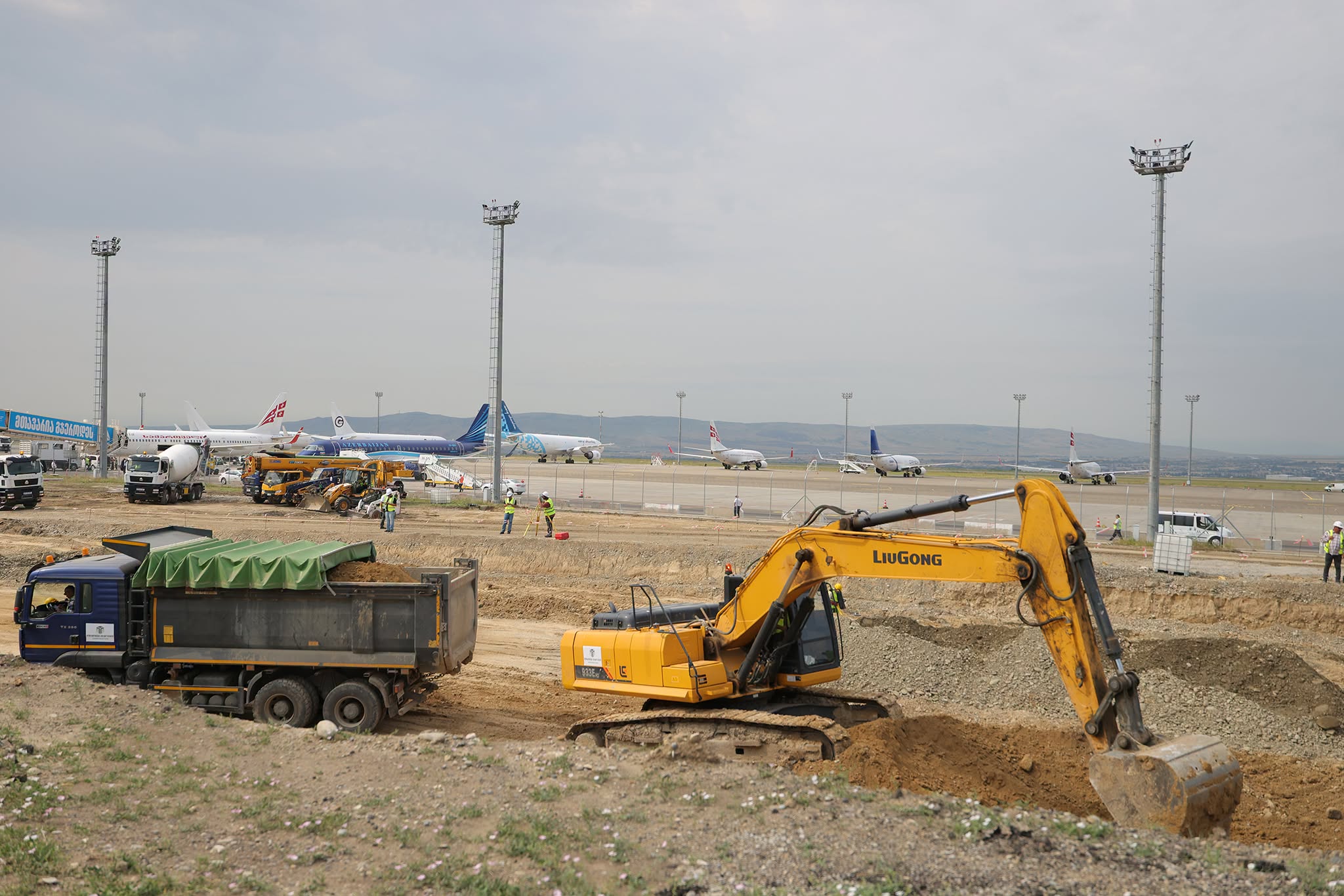
TAV Georgia, the Georgian subsidiary of TAV Airports, a multinational airport operator, which is part of French aviation giant Groupe ADP, said it is investing USD 150 million in expanding and developing Tbilisi International Airport, as representatives of the company, along with Georgian Dream Prime Minister Irakli Kobakhidze and Economy Minister Mariam Kvrivishvili, attended the launch of the expansion project on July 13.
According to TAV Georgia, which is the sole operator of Tbilisi and Batumi International Airports, the project, scheduled to run from 2026 to 2028, will double Tbilisi airport’s annual passenger capacity from five million to ten million. It said that the need for expansion is driven by growing passenger traffic in recent years, noting that the airport served a record 5.4 million passengers in 2025.
TAV Georgia said that as part of the project, the number of passenger boarding bridges will be doubled from five to ten, while seven new remote aircraft stands, nine check-in counters, 24 passport control points, and two baggage belts will be added. It further said the project will also upgrade existing passenger areas, create new retail, dining, and business lounge spaces, and expand parking facilities near the terminal.
The project comes as the Georgian Dream government pursues other aviation initiatives, including plans to build a new international airport near the Vaziani military base outside Tbilisi.
While the plans were first announced in 2023, with officials then projecting construction would begin in 2024, Irakli Kobakhidze told Parliament in June 2026 that work is now expected to start at the end of 2027 and be completed by the end of 2031. According to Kobakhidze, the new Vaziani airport, with an annual capacity of about 20 million passengers, will begin operations once the contract for the existing Tbilisi airport expires.
TAV Georgia has operated in the country since 2005, and the expansion project stems from an agreement signed on January 15, 2025, between the Ministry of Economy, United Airports of Georgia (UAG), and TAV Georgia, which extended the company’s concession at Tbilisi International Airport until 2032 in exchange for its commitment to double the airport’s throughput capacity and carry out an investment worth of USD 150 million.
Inauguration Ceremony
Georgian Dream Prime Minister Irakli Kobakhidze, Economy Minister Mariam Kvrivishvili, TAV Airports Executive Board Member and Executive Committee Chair Franck Mereyde, and TAV Georgia General Manager Tea Zakaradze attended and addressed the project’s inauguration ceremony on July 13.
The ceremony came days after heavy rain disrupted operations at Tbilisi Airport. Three flights were diverted to Kutaisi, Baku, and Almaty due to thunderstorms, while part of the terminal building was flooded. Videos showing the flooding circulated on social media, prompting criticism over the airport’s ability to handle severe weather.
Kobakhidze described the initiative as “one of the largest expansion and development projects” for Tbilisi International Airport, saying the investment agreement represents “yet another important result of the consistent policy” of the Georgian government and that it “fully protects the state’s interests.”
“Tbilisi International Airport is one of Georgia’s most important strategic infrastructure assets, playing a key role in the country’s economic development, connectivity, tourism, and investment attractiveness,” he said, adding, “Modern and efficient infrastructure enhances national competitiveness, creates new jobs, and strengthens Georgia’s position within the regional and global transport network. This is why our Government places particular emphasis on implementing projects of this scale.”
He also noted the “unprecedented” passenger growth across Georgia’s three international airports in 2025, reaching 8.5 million passengers.
Economy Minister Mariam Kvrivishvili said in her address that the airport is entering “a new and highly important stage” of development.
“Tbilisi International Airport is not merely transport infrastructure,” she said, “It is one of the main pillars of Georgia’s economic growth, tourism development, investment attraction, trade, and expansion of the country’s international connectivity. That is why its development is a task of strategic importance for the state.”
Kvirivhshvili noted that over the past five years, 43 new airlines have begun operating in Georgia’s aviation market, highlighting the recent launch of direct flights between Tbilisi and Copenhagen by Norwegian Airlines. She also said that China Eastern Airlines is set to begin operating direct flights between Tbilisi and Shanghai. According to Kvrivishvili, 85 airlines currently operate in Georgia, serving 125 destinations. She said the country remains focused on expanding its aviation infrastructure despite the “regional situation” and “numerous challenges.”
Kvrivishvili said Georgia’s airports handled nearly 788,000 passengers in June, up 4% year-on-year. She added that the country’s airports served a record 8.5 million passengers and nearly 38,000 flights in 2025, while air cargo volumes increased by 49% compared to the previous year.
The minister said the government is also advancing other aviation projects, including the planned Vaziani International Airport, the development of Telavi’s local airport, and the construction of a new passenger terminal at Mestia Airport, saying “the expansion of Tbilisi International Airport is also part of this same logical development.”
TAV Airports Executive Board Member and Executive Committee Chair Franck Mereyde addressed the event next. He, alongside Kobakhidze, Kvrivishvili, and TAV Georgia General Manager Tea Zakaradze, placed a time capsule at the airport’s foundation.
Also Read:

