



Lillian
Hanly Political Reporter
Labour
will change the law to ensure
retirement village residents get their money back within
three months of departure, if elected.
Seniors
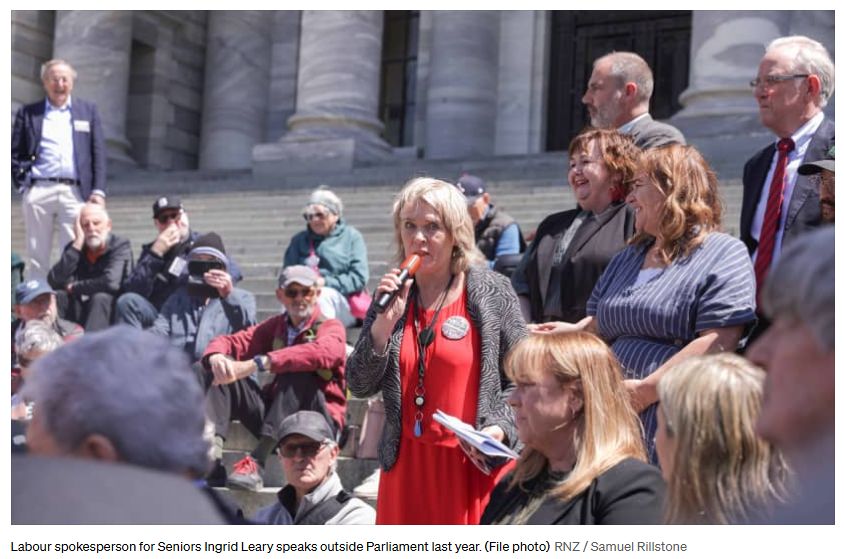
spokesperson Ingrid Leary accepted a Consumer NZ petition
signed by 40,000 people on Tuesday, supporting her Members
Bill requiring villages to pay back residents’ money within
three months.
But leader Chris Hipkins, speaking to
the around 100 people gathered at the petition handover,
said Labour would change the law if it was to form a
government after the election.
He said if the members
bill could be passed before the election, it would be, but
gave an assurance he would pass it after the election if it
wasn’t.
“I know how hard you have fought for this, and
I also know how difficult it can be when someone is vacating
a retirement village unit, and we don’t need to make that
any harder, we should be aiming to make it
easier.”
The government was making changes in the
Retirement Villages Amendment Bill that would see residents
and their families paid interest after six months of leaving
a unit and would have to be fully repaid after 12
months.
Advertisement – scroll to continue reading
National President of the Retirement Village
Residents Association Brian Peat said 12 months was
“completely unfair.”
He said the “big 6” retirement
villages, such as the Rymans, the Summersets, the Arvidas,
“those guys have always paid back in six months
anyway.”
Peat said the government was now saying they
could take even more time, “it’s just not
acceptable.”
Summerset told RNZ this was incorrect,
saying if residents’ homes were not sold after six months,
the village pays interest until their home is sold, “but we
don’t automatically repay”.
On Labour’s proposal, Peat
said it was “pleasing” to see a major party commit to the
shorter time frame, and that it would apply to every
existing resident in villages now.
“They’re the two
things that we’ve always advocated for, and this is what we
would like to see in the review of the Act.”
Some of
those gathered at the petition handover told RNZ the shorter
time frame would mean families were able to pay funeral fees
because they’d have their money straight away. It would also
mean families that “are being crucified in the current
financial system” would have money available to
them.
“That money is ours, and we want it for either
if we’re moving into care, we need that money to pay for our
care, and if we are dying, please God, then our families
need that money. It is our money. It does not belong to the
owners of retirement villages.”
Another person told
RNZ it was a “vote-getter.”
Another said Labour’s
announcement was “excellent,” and that they were surprised
most political parties didn’t attend, given only Labour and
the Greens were present.
“It’s the logical, fair, and
correct thing to do.”
Seniors Minister Casey Costello
acknowledged the matter of “fairness”, but said people
needed to consider “unintended consequences.”
She said
not-for-profits and smaller providers were being considered
too, not just the big corporates, as well as retrospective
legislation impacting current contracts.
Costello said
three months was “very problematic”, especially for the
smaller aged care providers.
“You’ve got to be very
careful about what that impact will be in terms of the
provision of housing for older people.”
Executive
director of the Retirement Villages Association, Michelle
Palmer, said she understood why people want faster
repayments, and no one wanted to see families facing
unnecessary delays.
“There are some isolated cases
where wait times have been too long, and that’s
unacceptable. The culprit usually isn’t the village operator
– it’s the real estate market.
“The reality is the
average repayment time is around seven to eight months, so
most people do receive payment in a reasonable
timeframe.”
She said that’s how the system worked,
units needed to be cleared of possessions, refurbished,
marketed and sold, then settlement would often depend on the
next resident selling their own home.
“We support the
broader reform programme and agree there is room to improve
the exit process introducing a 12-month repayment
guarantee.”
She said where families face genuine
hardship, “for example funeral costs or a move into
specialised care,” the Association supported a practical
process that allowed early access to a portion of
funds.
New Zealand’s public broadcaster, providing comprehensive NZ news and current affairs, specialist audio features and documentaries.
Radio New Zealand is a Crown entity established under the Radio New Zealand Act 1995. Radio New Zealand News are vital elements in our programming, providing impartial news and information to New Zealanders every day. Radio New Zealand (RNZ) provides listeners with exciting and independent radio programmes in accordance with the Radio New Zealand Charter.

