

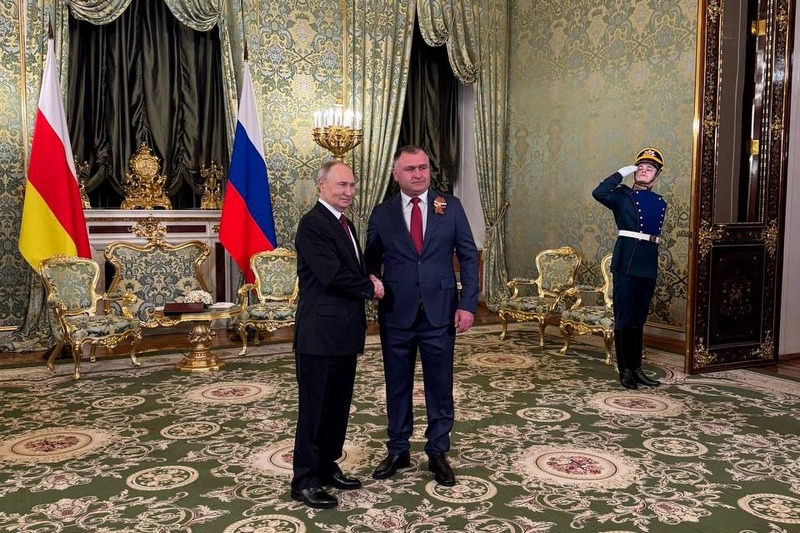
Alan Gagloev has resigned as the de facto leader of occupied Tskhinvali/South Ossetia and has been appointed adviser to Russian President Vladimir Putin, amid the so-called “Treaty on Deepening Allied Cooperation” between Tskhinvali and Moscow, which Tbilisi sees as another step toward the region’s annexation.
Gagloev, who has held the de facto post of “president” of the occupied region since 2022, announced his resignation on June 23, as Putin has already signed a decree appointing him as his adviser.
Tskhinvali-based news agency Res, which reported the developments, said that in his resignation address, Gagloev referred to the so-called treaty signed on May 9 between him and Putin, stating that it will help the region “reunite with Great Russia.”
“Today, our task is to ensure that our cherished dream comes true – to overcome the fate of a divided people and reunite with North Ossetia, to reunite with Great Russia,” Gagloev said, as quoted by Res.
According to the news agency, Gagloev said he met with Putin the previous day and received an offer to become his adviser and to assist in implementing the agreement signed between the parties.
“I supported our historical leader Vladimir Vladimirovich Putin and am ready to stand by his side,” he said.
Gagloev’s resignation came a week after Marat Kambolov, a longtime official in Russian federal government bodies, was appointed the de facto “prime minister” of Tskhinvali following the resignation of Dzambalot Tadtayev, also amid the May 9 treaty. Kambolov is now set to assume the temporary duties of the “president.”
The May 9 treaty, which Tskhinvali and Moscow already ratified, followed earlier treaties signed between Moscow and the de facto authorities of Georgia’s occupied Abkhazia and Tskhinvali regions, including the so-called “alliance and integration” treaties signed with Sokhumi and Tskhinvali in 2015, which expanded Russia’s influence over the two regions. Officials and observers in Tbilisi, as well as in the broader international community, have long raised concerns about Moscow’s de facto annexation policies, particularly regarding Tskhinvali.
The May 9 treaty stipulates that Russia and the occupied Tskhinvali region “shall expand cooperation with the aim of ensuring regional peace and stability, pursuing coordinated foreign policy and policies in the areas of defense and security, as well as border policy, […] improving socio-economic conditions, developing infrastructure and human potential, harmonizing legal norms, and creating a favorable environment for the free movement of capital, goods, services, and labor between the Contracting Parties.” The treaty says, among others, that citizens of one side “may hold state and municipal positions” in the other.
Georgian Dream Foreign Minister Maka Botchorishvili said on May 15 that the treaty is evidence of Russia’s further steps toward the annexation of Georgia’s regions.
This post is also available in:

