

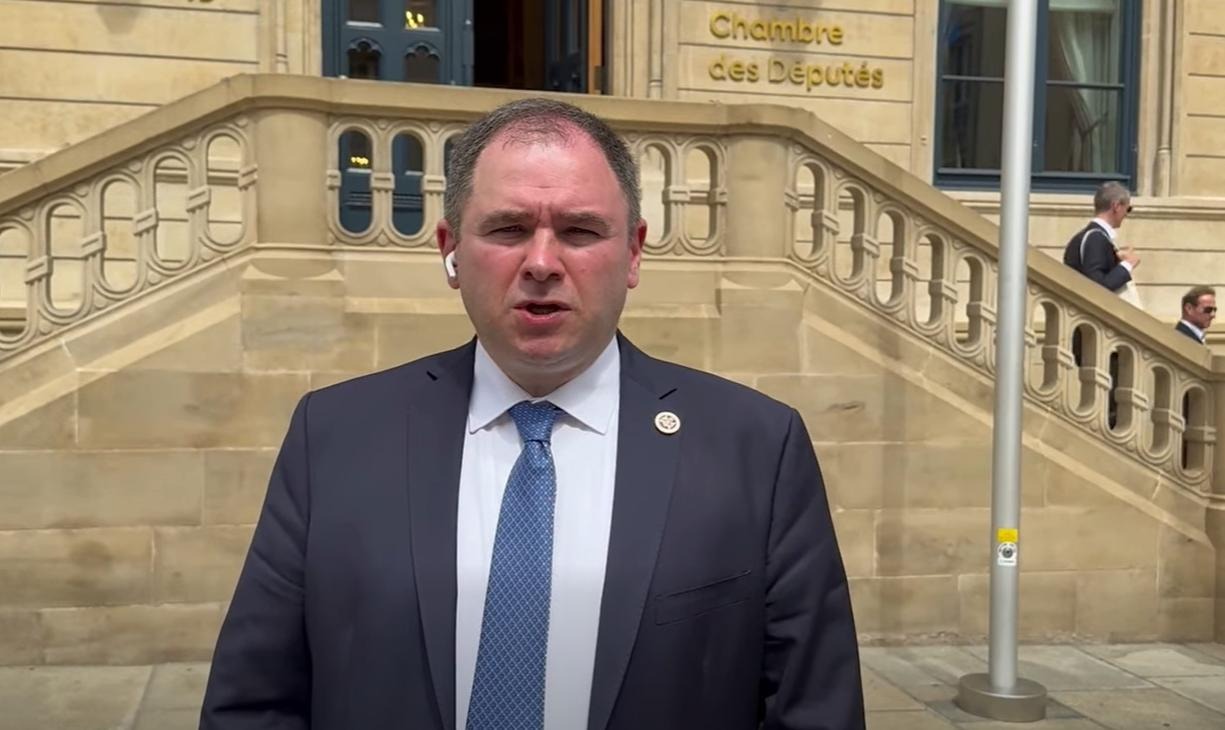
Georgian Dream MPs “asked” Luxembourgish officials to “raise the issue” with the European Commission regarding the “renewal of dialogue” with Tbilisi, Nikoloz Samkharadze, Chair of the Foreign Relations Committee of Georgia’s disputed Parliament, said, adding that the ruling party is “ready to discuss” what he described as “critical issues” with Brussels, including the controversial Foreign Agents Law.
“We are ready to resume dialogue in any format. We are also ready to discuss critical issues, including the law that was the formal reason for suspending dialogue between the EU and Georgia, I mean the transparency law,” Samkharadze said on June 16 after meeting colleagues at Luxembourg’s parliament and foreign ministry alongside fellow GD MP Levan Makhashvili, Chair of the European Integration Committee of Georgia’s disputed parliament.
He apparently referred to the Law on Transparency of Foreign Influence, adopted in May 2024, which is dubbed by critics the “Foreign Agents Law,”
He added that the Luxembourgish side “took our position quite constructively,” noting, “We hope that when meetings among [EU] member states take place, Luxembourg will support the renewal of dialogue with Georgia.”
The remarks come amid continuing strained relations between Tbilisi and Brussels, which suspended high-level contacts with Georgian authorities in June 2024 in a decision taken in response to, among other factors, the Foreign Agents Law, one of the first pieces of legislation targeting civil society in the country.
The move, however, also followed GD’s anti-Western and anti-European rhetoric at the time, while the ruling party has since adopted several similar and more restrictive legislation amid wider concerns over human rights and democratic backsliding in the country.
The EU said in November that Georgia is a candidate country “in name only” and moved in February to suspend visa-free travel for Georgian holders of diplomatic and service passports. On June 11, 2026, Georgian and EU officials met in Brussels for an “enhanced dialogue,” which automatically followed the suspension of visa-free regime, with the Georgian side expressing a “positive” outlook after the meeting, while an EU official described the talks as “rather unfruitful.”
In April, EU foreign policy chief Kaja Kallas said that while Georgia shows “no signs of reversing democratic backsliding,” an indication of Tbilisi’s willingness to change course would be “genuine engagement” in human rights dialogue. At the same time, Enlargement Commissioner Marta Kos said the EU is open to involving Georgia in regional connectivity projects but is able to do so “to the extent that they also show that they want to engage on other areas.”
Also Read:

