


Healesville, Wurundjeri Country, Australia: Acclaimed
photographer and performance artist William Yang, leading
contemporary artist John Young AM, and one of Australia’s
foremost scholars of Asian art, Professor Claire Roberts,
will headline a public program of conversations at
TarraWarra Museum of Art exploring Australia’s enduring
artistic dialogue with China.
Presented alongside the
major exhibition Inside the Mirage (25 July – 1
November 2026), the three-part public program explores
migration, identity, philosophy and cultural exchange
through talks, performance and bilingual experiences that
extend the exhibition’s ideas beyond the gallery.
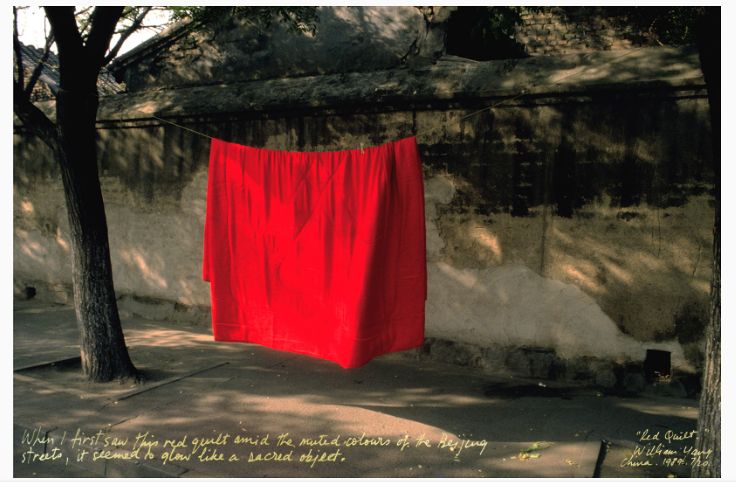
Yang, Red Quilt, 1989, Inkjet print with gold pen ink on
Innova Softex paper
© William Yang, courtesy of
the artist and Art Atrium, Sydney
(Photo/Supplied)
The season
opens on Saturday 15 August with Becoming
Myself, a rare keynote lecture, performance slideshow
and conversation with William Yang. One of Australia’s most
significant artist-storytellers, Yang reflects on growing up
in Far North Queensland, embracing his Chinese heritage and
navigating life between cultures, memory and place. Drawing
on more than five decades of photography, memoir and
performance, the presentation offers a deeply personal
exploration of identity and belonging through one of
Australia’s most influential documentary artists.
Advertisement – scroll to continue reading
On
Saturday 5 September, artist John Young AM joins Professor
Claire Roberts, author of Fairweather and China, for
Fairweather Transformations, an intimate conversation
exploring Ian Fairweather’s lifelong engagement with Chinese
philosophy and the continuing influence of his ideas on
contemporary Australian art.
The season concludes on
Saturday 3 October with We Are All Visitors, a bilingual
exhibition tour led by curator James Lynch and exhibiting
artist Meng-Yu Yan, with live Mandarin translation by Yan Yu
Lok. Centred on Yan’s video work Double Witness,
inspired by Taiwanese queer writer Qiu Miaojin, the tour
invites English and Mandarin-speaking audiences into a
shared exploration of migration, language and
belonging.
The public program accompanies Inside
the Mirage, a major exhibition curated by James Lynch
and shaped by the imaginative and philosophical worlds of
Ian Fairweather (1891–1974) and John Young AM. Bringing
together twelve rarely seen Fairweather paintings from the
TarraWarra Museum of Art Collection alongside works by nine
contemporary Australian artists, the exhibition traces an
enduring artistic conversation shaped by Fairweather’s
engagement with Chinese language, Daoist philosophy and
poetry, and its continuing influence on contemporary
Australian art.
Featured artists include Gordon
Bennett, Mikala Dwyer, Narelle Jubelin, Michael Stevenson,
My Le Thi, Zhou Xiaoping and Johnny Bulunbulun, Meng-Yu Yan,
and William Yang, whose works collectively examine
migration, diaspora, memory and cultural
identity.
James Lynch, Curator at TarraWarra Museum of
Art, said:
“John Young keeps Fairweather’s story
alive through his own painting process, while the
exhibition’s contemporary artists expand these conversations
across diasporas, cultures and generations. Together, they
invite us to imagine new ways of belonging in an
interconnected world.”
Dr Victoria Lynn,
TarraWarra Museum of Art Director, said:
“The works
by Ian Fairweather are brought to life through a
scintillating juxtaposition with John Young and nine
contemporary Australian artists, demonstrating the enduring
importance of cross-cultural exchange in Australian art. The
accompanying public program extends these conversations
through artists whose own practices have shaped how we
understand identity, migration and belonging in
Australia.”
A significant accompanying publication
features new scholarship by James Lynch, Dr Jacqueline Lo,
Director of the Indo-Pacific Research Centre at Murdoch
University, and art historian Genevieve Trail, offering new
perspectives on migration, cultural translation and artistic
exchange.
The exhibition officially opens on Sunday 26
July with a Welcome to Country by Stacie Piper, followed by
opening remarks from Professor Lisa Slade, Hugh Ramsay Chair
of Australian Art History at the University of
Melbourne.
Inside the Mirage is on view
exclusively at TarraWarra Museum of Art from 25 July to 1
November 2026.
EVENT DETAILS
Exhibition Opening
Event
Sunday 26 July | 2–4 pm
Official
Proceedings at the Eva and Marc Besen Centre
2.30 pm:
Welcome to Country by Stacie Piper
2.45 pm: Opening
remarks by Professor Lisa Slade, Hugh Ramsay Chair of
Australian Art History, School of Culture and Communication,
University of Melbourne.
Light refreshments will be
served.
Public Program
Saturday 15 August |
2–4pm
Becoming
Myself
Rare keynote lecture, performance slideshow
and conversation with William Yang.
Keynote:
$40/$35/$25 | Places are strictly limited | Museum entry
included
Light refreshments served. Return bus from
Federation Square.
Saturday 5 September |
2–3.30pm
Fairweather Transformations
John Young AM
in conversation with Professor Claire Roberts, facilitated
by James Lynch.
$25/$20/$15 | Museum entry
included
Saturday 3 October | 2–3.30pm
We Are
All Visitors
Bilingual exhibition tour with James Lynch
and Meng Yu Yan, with live Mandarin translation by Yan Yu
Lok.
$25/$20/$15 | Museum entry included | Places are
strictly limited
BIOGRAPHIES
Claire
Roberts is Professor of Art History in the School of Culture
and Communication at the University of Melbourne. Roberts
has published widely on Asian and Australian art, visual and
material culture, and curated numerous
exhibitions.Publications include: Fairweather and
China, Melbourne University Press, (2021); Ian
Fairweather: A Life in Letters, Melbourne: Text
Publishing, (2019); and Yang Zhichao: Chinese Bible
Art Gallery of New South Wales & Sherman Contemporary
Art Foundation, (2015) among many more.
Ian
Fairweather (1891–1974) was the last of nine children and
grew up in a village in Stirlingshire, Scotland, where he
was raised by his aunts until the age of ten. After
completing his schooling in London and Switzerland, he
joined the army and served as a lieutenant on the French
front lines during the First World War. Soon captured, he
spent three years in a prisoner-of-war camp. After the war,
he returned to London and studied art at the Slade School
under Henry Tonks, as well as studying Japanese and Chinese
languages and philosophy at the University of London.
Fairweather travelled extensively in the 1920s and 1930s,
living in Beijing, China, and travelling throughout
Southeast Asia. After living in Melbourne, Cairns and Darwin
for extended periods, Fairweather settled on remote Bribie
Island, Queensland, in 1954, where he remained until his
death. Fairweather’s work was first exhibited in Melbourne
at Cynthia Reed’s studio and gallery in 1934, and he held
regular solo exhibitions at Macquarie Galleries, Sydney,
throughout the 1950s, 1960s and 1970s. Fairweather was
included in major exhibitions such as the Carnegie Institute
International exhibition, Pittsburgh (1937), and
Australian Painting: Colonial, Impressionist,
Contemporary at the Tate Gallery, London (1963). He
represented Australia at the VII Bienal de São
Paulo, Brazil (1963).
James Lynch is
aNaarm/Melbourne-based artist and curator who has worked
across the university and museum sectors for more than two
decades. In 2025, he joined the TarraWarra Museum of Art as
Curator, co-curating the collection exhibitionThe City
Wakes, The City Sleeps, as well asBehindthe Glass, the
first rehang of the Eva and Marc Besen Centre’s Visible
Art Storage, which highlighted trailblazing women artists
from Australia.Previously, he served as Curator at Deakin
University, where he developed survey exhibitions for
leading Australian artists,
includingJumaadi,Fayend’Evie, Sarah Goffman and
Charlie Sofo, as well asthematic group exhibitions such
asConversations in Space, Holding in the Hand and many
more. Prior to this, Lynch held the role of Curator,
Collection, at the Monash University Museum of Art. His
curatorial work has elaborated alternative narratives and
new perspectives on the relationships between art, artists
and the contexts in which theyoperate.
John Young
AM was born in Hong Kong in 1956 and moved to Sydney to
study in 1967. Since his first exhibition in 1979, Young has
become one of Australia’s foremost senior contemporary
artists, noted for his discursive and scholarly approach.
Young has held more than eighty solo exhibitions worldwide,
as well as four major survey exhibitions. His work has been
presented in major exhibitions both in Australia and
internationally, including at the Solomon R. Guggenheim
Museum, New York; the Kennedy Centre, Washington; and the
Aga Khan Museum, Toronto. In the past decade, Young
developed two major bodies of work: The History
Projects, focusing on histories of violence and
benevolence, later developing this into a visual history of
the Chinese in Australia since 1840; and Abstract
Paintings, a reassessment of technology’s devastation
of bodily skills and knowledge. John Young is represented by
Arc One, Melbourne; Philip Bacon Galleries, Brisbane; and
Moore Contemporary, Perth.
William Yang (b. 1943,
Mareeba, Queensland) is an Australian photographer and
performance artist who lives and works in Sydney, New South
Wales. Renowned for his exploration of cultural and sexual
identity, Yang’s multidisciplinary practice spans
photography, writing, performance, and film. Yang began his
career as a playwright before turning to photography after
relocating to Sydney in 1969, where he worked as a freelance
photographer documenting the city’s vibrant social life
from its glamorous celebrity circles to its hedonistic,
subcultural gay community. His seminal exhibition
Sydneyphiles (1977) and book Sydney Diary
(1984) chronicled the emergence of Sydney’s gay scene
during the 1970s and 1980s. In the 1980s, Yang deepened his
engagement with his Chinese heritage, expanding his
photographic practice to include landscape and explorations
of the Chinese-Australian experience. From 1989, he began
integrating his photographic work with writing and
performance, creating distinctive monologues accompanied by
slide projections. These deeply personal works examine
identity, memory, and belonging, and have toured
internationally.
BACKGROUND
TarraWarra Museum of
Art has a significant connection to both John Young and Ian
Fairweather. In 2005, the Museum presented John Young’s
first survey exhibition, Orient/Occident, curated by
the late Maudie Palmer AO and spanning 27 years of work. In
2012, the Museum presented the three-person exhibition
Passages with artists Brian Castro, Khai Liew and
John Young. In 2015, TarraWarra Museum of Art partnered with
the University of Queensland and curator Steven Alderton to
re-present Ian Fairweather’s 1965 exhibition The
Drunken Buddha in its entirety and to help republish the
second edition of Fairweather’s translation of the ancient
Chinese folk tale.
ABOUT TARRAWARRA
MUSEUM OF ART
TarraWarra Museum of Art is a leading
not-for-profit public art museum presenting inventive and
thought-provoking exhibitions and programs on twentieth- and
twenty-first-century Australian art. The Museum is home to
one of the nation’s most significant collections, spanning
from the 1930s to today.
Its permanent collection was
established through the generous donation of more than 600
artworks by the late Marc Besen AC and Eva Besen AO, its
founding patrons. Located in the heart of the Yarra Valley
on Wurrundjeri Country, the Museum fosters deep engagement
with art, place and ideas. Its remarkable natural setting
and immersive architectural environment offer visitors a
space for curiosity, reflection and imagination.
The
Museum’s newest addition, the Eva and Marc Besen Centre,
which opened in May 2025, expands this vision through its
purpose-built Visible Art Storage for more than 300 works,
as well as a learning centre and performance space designed
by Kerstin Thompson Architects. Since opening, the Centre
has received major national recognition, including the
Australian Institute of Architects’ Victorian Chapter’s
William Wardell Award for Public Architecture, the Victorian
Award for Interior Architecture, and the National Award for
Public Architecture at the 2025 National Architecture
Awards. The Visible Art Storage is accessible to visitors
through scheduled guided
tours.

