



Johnny
Blades, RNZ Pacific senior
journalist
Pacific
Communities in New Zealand’s regions are feeling the pinch
from cost of living pressures and government cuts to social
support services in the past couple of years.
That’s
the message from people working in the area of social
services – who are themselves often Pacific people, feeling
their own strains too.
RNZ Pacific visited Masterton
to talk to workers from two Pacific households in the
Wairarapa.
The last census shows Pacific peoples make
up just 3.7 percent of the Wairarapa population, or almost
2000 people out of around 50,000 residents.
But like
elsewhere around the country, they often do the frontline
work with society’s most vulnerable.
Social
strains
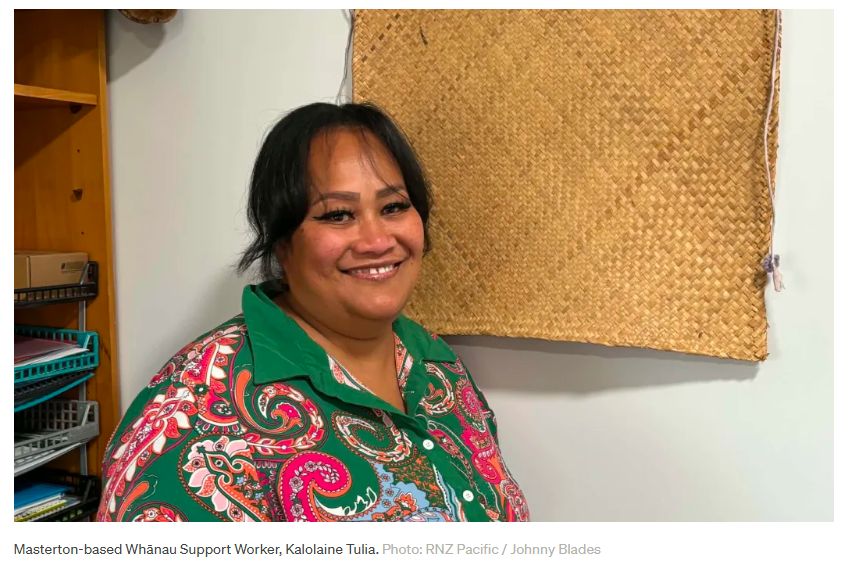
Kalolaine (Kalo) Tulia, a young Tongan mother
of six, is a Whānau Support Worker for Family
Works, based in Masterton. She also works for Pathways as a
Mental Health Worker.
“There’s a lot of Pasifika in
our clients, struggling with mental health, struggling with
addiction as well,” Kalo said.
Advertisement – scroll to continue reading
“Some of them doesn’t
really understand what that they are actually capable of or
qualify for, and then not only that, but there’s not a lot
of funding that’s coming through to help, because there’s a
lot of cuts.”
The
people who Kalo works to support are often dealing with
lifelong struggles with mental health or addiction – putting
the little money they have towards their addictions means
they don’t have enough to look after themselves.
“What
we do, we have a wellbeing workshop for them and help them
to budget themselves, and to navigate through these lives
without having a mental health breakdown,” she said, adding
that Pacific people also struggle for adequate housing in
the region.
Kalo is just trying to help her clients
keep their heads above water, to be able to simply survive
each day. But cuts to the agency’s funding in the past
couple of years have added strain.
“We don’t have
enough workers to cover a lot of clients, it’s only two
people working in the Wairarapa, but the whole lot of work
has to be done by more than two people, and it’s not done by
two people.
“There will be a lot of people who will be
missing out for her from our services because there’s not
enough people to cover that,” she
said.
Self-reliance
Kalo’s husband died in the
past year, and bringing up six kids as a solo-parent is
hard, especially with the cost of living so
high
Dependent on the hours she does each week in her
two part-time jobs, Kalo sometimes has some support from
WINZ, but mostly she is on her own.
“You try to
navigate life without having to step on other people’s toes,
and you’ve got to be more like reliant on yourself to do all
what you can do to provide for your children.”
She’s
just one example of Pacific people in Wairarapa who work on
the social frontline and feeling the bite of hard times
themselves.
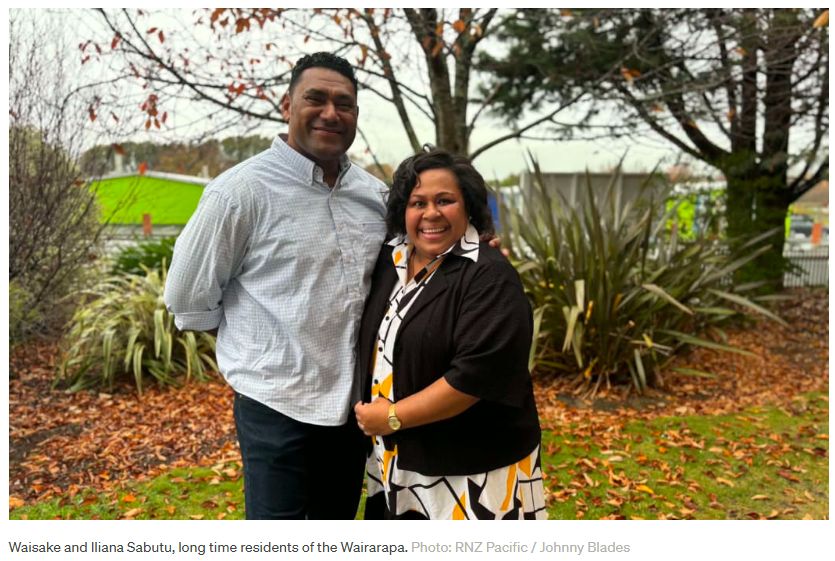
Other examples are Fijian couple Iliana
and Waisake Sabutu who moved to the Wairarapa twenty years
ago, and have three children.
Iliana has a background
in health and is working at Family Works as a Senior Whānau
Support Worker. Waisake works for Corrections at Rimutaka
Prison over the mountain range in Upper Hutt.
“It’s
very challenging nowadays. We are both full-time workers,
but we can feel that [cost of living pressure], and we’ve
got a side hustle as well, a business on our own, so we do
that when we can,” Iliana said.
Their costs are also
high because Waisake has to pay for petrol each day to
travel over the Remutaka Range for work.
Stressful
work
Waisake’s work with incarcerated people in
difficult, complex circumstances presents constant
challenges.
“The challenges change every day. You’ve
just got to set into a right mind to get into work every
day, because when you get into the gates, when you open the
doors, you don’t know what to expect, because everything
changes within the speed of a second,” Waisake
explained.
In her area of work, Iliana is seeing
certain trends among Pacific families, including growing
pressures on families who are new to the area, seeking to
navigate their visa requirements.
“Most are struggling
with their visas. The visa fees here – it used to be like a
grand for the whole family – but now I’m seeing other
families, they have been struggling with a couple of grand
for just one person, for a main applicant,” Iliana
said.
Adding to the stresses is the fact that young
Pacific families in particular face persistent difficulties
in securing adequate housing in the area, Pasifika O
Wairarapa Trust told RNZ Pacific.
Survival mode is a
common way of operating for many households in these times –
this is why Kalo Tulia said the social services sector needs
more support itself.
“So that people can get out
there, the community, and help those that are in need to
help them to be able to stand on their own to
feed.
Community
Where possible the small but
growing Pacific community in the Wairarapa gains support
from each other.
“We have our Fijian community. It’s
like three years now [since it was formed]. It is growing
because of our new families that move over for our forestry
workers, caregivers, nurses,” Iliana said.
“So it’s
growing. Before it used to be just a few, roughly five to
six families. Now it’s growing into, say, more than fifty or
sixty.”
Iliana and Waisake, and Kalo as well, say they
strive for a future where their kids can stand on their own
feet, and they will keep working hard to do
that.
New Zealand’s public broadcaster, providing comprehensive NZ news and current affairs, specialist audio features and documentaries.
Radio New Zealand is a Crown entity established under the Radio New Zealand Act 1995. Radio New Zealand News are vital elements in our programming, providing impartial news and information to New Zealanders every day. Radio New Zealand (RNZ) provides listeners with exciting and independent radio programmes in accordance with the Radio New Zealand Charter.

