



Giles
Dexter, Political Reporter
The
government wants taxpayers to pay for a new
liquefied natural gas import terminal, but is promising
lower power prices will come as a result.
It is
estimated the new terminal, expected to be ready next year
at the earliest, will save New Zealanders around $265
million a year by reducing price spikes and lowering the
risk premiums.
But a new levy will be charged to get
it built.
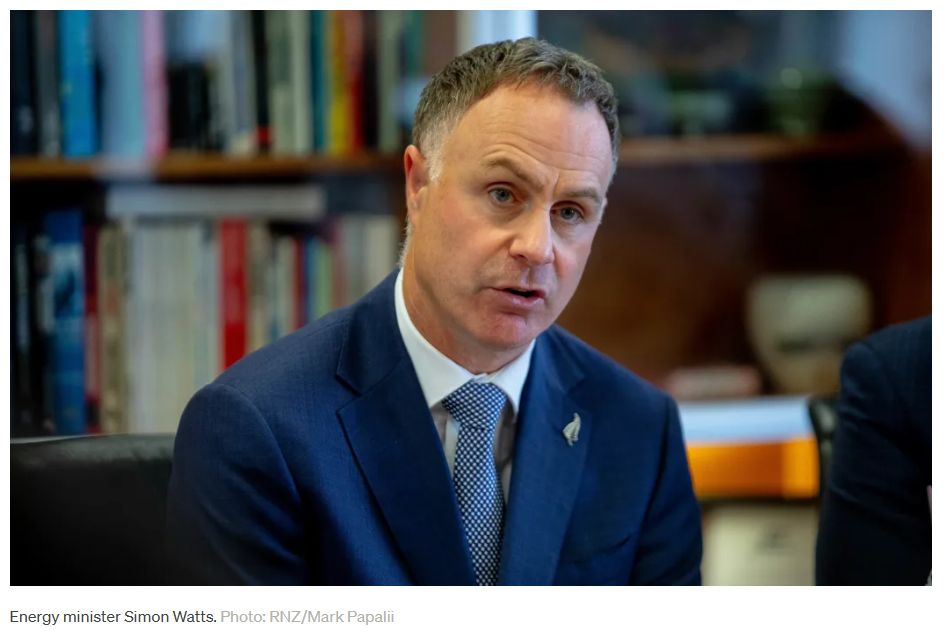
The government is touting it as a solution
to New Zealand’s energy woes.
“It will mean that
Kiwis will not need to suffer through an endless series of
winter bill shocks,” energy minister Simon Watts said on
Monday.
‘Vital part of the overall puzzle’ – Energy
Resources Aotearoa
The idea is that it will reduce
the risk of shortages during a dry year.
Liquefied
natural gas (LNG) can be imported at large volumes, stored,
and then ‘regasified’ to be sent out for use.
Advertisement – scroll to continue reading
John
Carnegie, chief executive of industry body Energy Resources
Aotearoa, said the terminal would be a useful insurance
policy for when the weather did not play ball.
“LNG
will be useful as a vital part of the overall puzzle of New
Zealand’s energy system security,” he said.
“LNG can
be expected to take the heat out of the electricity market
when renewable fuels like wind, water, and the sun don’t
turn up when they’re needed. It will place downward pressure
on wholesale electricity prices and reduce the risk premium
in the out years.”
Last year’s Frontier Report –
commissioned to review the performance of the electricity
market – warned
it should only be used as a last resort.
The
report said using it just to meet dry year risk made
no economic sense, as the large fixed costs would be
spread over a relatively small amount of output.
But
Carnegie said LNG provided a “virtuous circle” to support
the development of more renewables, and pointed the finger
at the previous government’s ban on offshore oil and gas
exploration as a reason why power prices were spiking in dry
years.
“More wind and solar and batteries are great,
but also the conundrum is their growth exacerbates the
problem of being too weather dependent. So we need a
reliable fuel to fill the gaps which domestic gas previously
filled. And so New Zealand’s energy system, I believe, will
be at its most effective when renewable generation and
firming fuels like LNG and domestic gas work in
harmony.”
A separate study by gas company Clarus,
along with the four gentailers, found it was feasible
but would likely be costly, and only needed
occasionally.
Following the announcement, Clarus’
chief executive Paul Goodeve said it would increase New
Zealand’s energy resilience and increase the range of
markets it could draw from.
“At the moment, the coal
that we import is relatively restricted where it comes from.
The global market in LNG is vast and diverse, and appears to
be continuing as we speak.”
Goodeve was confident it
could be financially sustainable, and the government’s
involvement in the procurement system made sense.
“It
appears as though they’ve got work done by financial
advisors who pointed out the benefits to the overall New
Zealand energy system, but particularly the electricity
system, of having LNG in the mix.”
Details on the
shortlist of six were being kept under wraps, but all were
in Taranaki.
Port of Taranaki chief executive Simon
Craddock said it was a great opportunity for the region, and
while the port was not an LNG developer, it was keen to
support it.
“The current terminal developments, as I
understand it, are all focused on the Taranaki region, and
the reason for that is largely proximity to the Maui gas
pipeline. But the developers are international companies who
may or may not partner with local interests.”
Craddock
said there was nothing the port had seen that could have
major adverse effects on its current trade.
“The port
has a number of advantages… the proximity to the pipeline,
we’re the only deep water port on the West Coast. So this is
the sort of thing we do day to day, where our main customer
to-date has been Methanex. We also have other petrochemical
customers on the port, so it really is within our core
business suite.”
ACT’s energy spokesperson Simon Court
said it was a “sad but necessary bookend” to the oil and gas
exploration ban.
“Labour promoted the view that gas is
something to be ashamed of. It’s not. Gas is a practical,
reliable option when hydro lakes are low. Gas keeps
factories running, heaters humming, and lights buzzing. And
the environmental case for gas is strong too, because when
we can’t burn gas, we burn coal,” he said.
‘It’s
cooked’ – Green Party
On Monday, Watts said
discussions were commercially sensitive but it would cost
“north of a billion dollars” to build.
To pay for
those infrastructure costs, the government will charge users
an electricity levy of $2 to $4 per megawatt hour.
But
Watts was keen to point to the net benefit, with advice
showing the facility was expected to cut future prices by at
least $10 per megawatt hour.
“So straight away, we’re
in the money in regards to benefits versus costs, and our
expectation of having that certainty of supply takes away
the price spikes that we saw, for example, in
2024.”
That has not convinced the Green
Party.
Co-leader Chlöe Swarbrick said the government
was guaranteeing added costs to New Zealanders, while
relying on “hopes, wishes, and prayers” for future
savings.

“I
think it’s absolutely bonkers for power bills, for the
planet, for our country’s energy resilience. The only people
who want this are the fossil fuel industry and seemingly the
National Party. Whatever claim, whatever remaining claim the
Nats have to being economic managers is now, frankly, up in
flames,” she said.
“Honestly, it’s cooked. Christopher
Luxon has once again chosen to throw New Zealanders’ money
at fossil fuels, which is bad for power bills, energy
security and the planet. This is Christopher Luxon’s New
Zealand. Profits are flowing offshore, while New Zealanders
are paying handsomely for it.”
‘Gas tax’ –
Labour
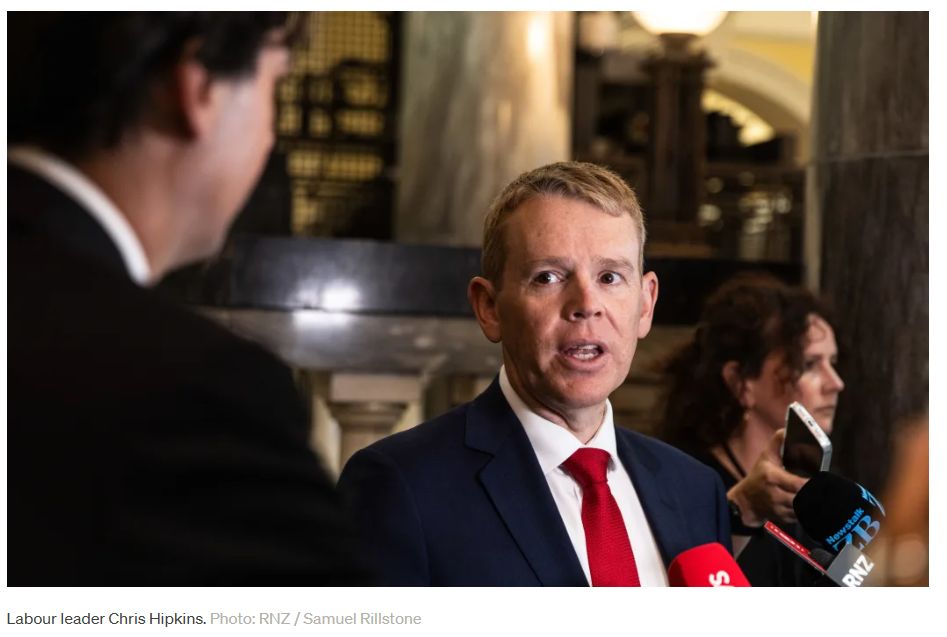
Labour, meanwhile, is calling it a “gas
tax”.
Leader Chris Hipkins said households were
already struggling with the cost of living, and he did not
believe it would reduce power prices.
“I think, if
anything, they’re trying to make the argument that this will
decrease the rate of increase in power prices. There are
other ways to do that. A billion dollars would buy you a
hell of a lot of solar panels and batteries, which would
save households a significant amount of
money.”
Hipkins dismissed questions over whether
Labour would terminate any agreements, or put the costs onto
the energy companies and take away the levy on households,
as “hypothetical.”
The prime minister’s assertion it
was a levy, and not a tax, was criticised by the Taxpayers’
Union.
“You
don’t make electricity bills cheaper by taxing them. Dancing
on the head of a pin over what is a tax and what is a levy
is a Labour Party talking point. Luxon should spare us the
spin and abandon this folly,” said spokesperson James
Ross.
Climate change advocacy group 350 Aotearoa was
previously one of twenty signatories that sent an open
letter to Luxon and Watts, urging against the new terminal
when it was first signalled in October.
Following the
confirmation, co-director Alva Feldmeier said while she
agreed with the government that New Zealanders were feeling
the squeeze with their power bills, the terminal was not the
solution.
“Essentially, what they’re doing now is
putting a new tax on every New Zealander’s power bill to
subsidise an expensive sunset industry,” she
said.
Feldmeier said LNG-generated electricity was
double the price of new renewable electricity, and the risk
of importing and being reliant on international fossil fuels
was that New Zealand could also import international price
shocks.
“This is a political choice this government is
making. They’d rather kowtow to the fossil fuel and the gas
lobbies and keep us hooked on gas for longer, than explore
how we’re going to get off it, and how we’re going to make
some tough decisions in the next few months and
years.”
New Zealand’s public broadcaster, providing comprehensive NZ news and current affairs, specialist audio features and documentaries.
Radio New Zealand is a Crown entity established under the Radio New Zealand Act 1995. Radio New Zealand News are vital elements in our programming, providing impartial news and information to New Zealanders every day. Radio New Zealand (RNZ) provides listeners with exciting and independent radio programmes in accordance with the Radio New Zealand Charter.

