



Tuwhenuaroa
Natanahira Political reporter
Scrapping
the Māori electorate seats could backfire on right bloc
parties, a Māori political expert says.
ACT leader
David Seymour is eyeing up abolishing the seats through a
referendum, arguing that they
are the cause of the overhang issues.
Te Pāti
Māori – who ran a candidate-only campaign during the
election – say ACT are trying to distract from a botched
overhang campaign on the right.
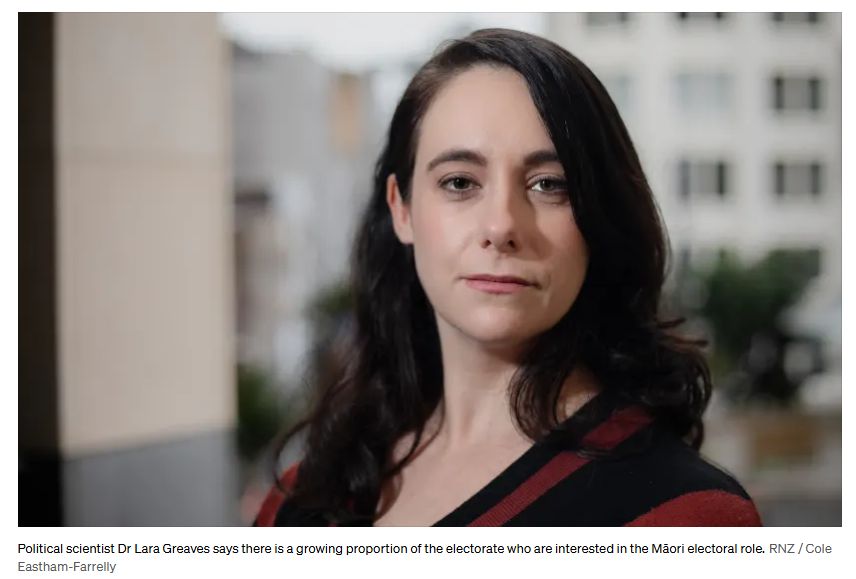
Victoria University
political scientist Dr Lara Greaves told RNZ that about
30,000 people vote in each of the seven Māori electorates –
around 210,000 in total – but the number of voters and voter
turnout varied from electorate to electorate.
That
left a voting block of about 190,000 who actually cast a
vote, she said.
Greaves said those voters had little
choice but to vote for left bloc candidates because the
coalition partners – except National – did not stand
candidates.
“We know that around 90 percent of the
party votes in those electorates tend to be those left-bloc
parties – Opportunity’s party vote was quite low – so the
right block and Opportunity don’t do very well in
them.
Advertisement – scroll to continue reading
“We don’t know exactly who their electorate vote
would go to but from the 200-odd thousand voters, we can see
that those voters tend to be left-party
voters.”
Greaves argued that scrapping the seats – as
ACT New Zealand First want to do – could see more left-wing
candidates from general seats make it into Parliament
because of an increasing Māori
population.
“Strategically, it could be quite a silly
move for them.
“Māori on average are having slightly
more than the rate of replacement in terms of children and
Māori now are kind of ‘proud to be Māori’ – we’ve seen
that in public opinion data.
“This is the kōhanga reo
generation of kids we’re talking about ageing and voting
now, and we know that we’ve got this significant group of
young people that is a growing proportion of the electorate
who are interested in the Māori electoral role and are
interested in politics and representing that.”
Greaves
said taking that growing group of left-leaning voters out of
Māori electorates and into general seats could see votes
shift to the left in places like Northland, Rotorua, the
East Coast and city centres.
She said she planned to
do more research into the issue shortly, but some figures
published by pollster David Farrar showed National could
have lost between nine to 14 seats if the Māori seats were
abolished before the 2026 election.
“In this
hypothetical scenario, it does seem like the general
electorate would become more left leaning because you’ve got
those 190,000 odd more left leaning voters across the
electorates,” she said.
Greaves is one of 46 experts
and academics urging politicians to consider changing MMP to
get rid of overhangs in the MMP electoral system.
She
said many Māori were strategic voters and would continue to
be.
“I think that the [overhangs] do need fixing quite
quickly, because otherwise, we’ll just end up in a tit for
tat, and it’s not going to be good for politics. I think
that will put people off generally, and I think that will
put Māori off generally.
“But no matter what we do, I
think that Māori voters are really good at vote splitting
and will continue to do that… without any politicians,
without Te Pāti Māori saying it, I still believe that
actually a lot of Māori voters would have done that and
actually delivered a few electorates for Te Pāti Māori,
whether they had said it or not.”
Greaves said getting
rid of the Māori seats through a referendum would cause
“considerable” protest action.
“What the cynic in me
would suspect they would do to try to get rid of the Māori
electorate is have a of referendum sometime in 2028 when no
one much is paying attention to politics.
“Removing
the Māori electorates and the Waitangi Tribunal as well –
which is another thing that might come up this term – would
be viewed as really terrible constitutional or structural
damage by a lot of Māori and that it would lead to
considerable protest action and advocacy,” she
said.
New Zealand’s public broadcaster, providing comprehensive NZ news and current affairs, specialist audio features and documentaries.
Radio New Zealand is a Crown entity established under the Radio New Zealand Act 1995. Radio New Zealand News are vital elements in our programming, providing impartial news and information to New Zealanders every day. Radio New Zealand (RNZ) provides listeners with exciting and independent radio programmes in accordance with the Radio New Zealand Charter.

