



Russell
Palmer Political reporter
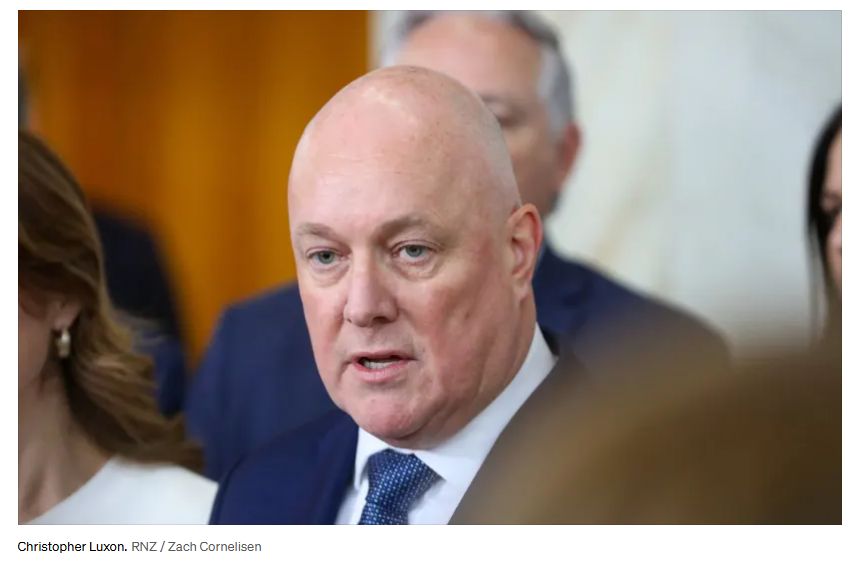
Christopher
Luxon is claiming it could take up to five weeks to count
the vote if his Government had not changed
enrolments.
He says although he has spoken to the
leaders of ACT, New Zealand First and the Opportunity Party
he will not hold negotiations until after the final count –
despite a constitutional law expert saying there’s no need
to wait.
The National leader also says suggestions the
party is becoming more conservative are “rubbish”, and New
Zealanders should trust him after he ruled out Opportunity
because they would not be happy to hold another
election.
With less than two weeks before the final
results, Luxon appeared on Morning Report with host
Ingrid Hipkiss, who pressed him on whether he was still
frustrated with the length of time taken.
Even after
electoral changes removed the ability to enrol and vote on
the same day, and pushed back enrolments to before the start
of advance voting, the final result is still expected to
take three weeks in total – the same as at the last
election.
He said it was important for democracy that
the Electoral Commission was independent, but “I do struggle
to understand why
it takes so long to count“.
Advertisement – scroll to continue reading
“I’ve watched US
midterm elections with tens of millions of people voting in
states across the US and even in close races like
Mississippi, you get a result turned around much quicker, so
I think that’s a legitimate question that we need to ask,”
he said.
“The reality is: who knows, it could take
them four or five weeks if we continued to see people
saying, ‘Look, I won’t bother enrolling, I’ll just do it on
the day when I go cast my vote.'”
He said it was “very
challenging, very overwhelming” for the commission to carry
out the “four component parts” of getting people enrolled,
then “run the actual election day and the vote, then do the
count, and… all those things at the same
time”.
Chief Electoral Officer Karl Le Quesne said
good progress was being made on the official count.
It
was important to deliver timely resultsand also to make sure
they were accurate, he said in a statement.
“Counting
votes is only part of the process. The checks we make
between election day and 27 November mean we can deliver
results that New Zealanders can trust.
“Staff are
working in our 64 electorate headquarters, national office
and enrolment teams to ensure all the steps that need to be
done are completed.”
Constitutional law expert Graeme
Edgeler told RNZ last week there was nothing
preventing negotiations starting before the final
count.
Luxon said he had spoken to David Seymour,
Winston Peters and Qiulae Wong, but with nearly 400,000
special votes unaccounted for formal negotiations would have
to wait because “we really do need to respect our democracy
and respect every vote that’s been cast”.
Asked why
voters should trust him if he was going back on his word –
Luxon had consistently ruled out working with Opportunity
before election day – he said New Zealanders would not want
to go back to the polls.
“We went through this last
week. We can go through it again another week,” he
said.
“I haven’t spoken to you in the last week,”
Hipkiss responded.
“You want to know, so let me take
you through it again, so look – on current numbers it’s
unlikely we actually need them to form a Government, as I’ve
said ad nauseam… if the specials come back, and if for
example there’s a hung Parliament… Kiwis wouldn’t thank us
for going back to the polls.
“One of my takeaways from
the election campaign, and actually even you saw it in the
debates, was that Kiwis want a lot more cross-party
collaboration… it’s important that I find areas of common
ground with all parties, if possible.”
Asked if his
rule-out position had changed, he said the idea the current
coalition parties – would need Opportunity was
“hypothetical”, and pointed to National having worked with
Labour over modern slavery laws and a social media
ban.
“All political leaders should try and put
politics aside and find the common ground,” he
said.
Luxon – who through the campaign insisted Nicola
Willis would be finance minister – maintained a National MP
holding that role was non-negotiable.
“Yes, I’ve
talked to that before,” he said.
Hipkiss asked if he
had “discussed that further with David Seymour”, who last
week said it was “no longer tenable” for National to demand
it.
“Look, to be honest Ingrid, you and I have spoken
about this in the last week and we can talk about it again
for this week, I’m a bit more focused on APEC [Asia-Pacific
Economic Cooperation] and some other big things going down,”
he said.
Hipkiss: “As opposed to forming the next
Government?”
Luxon: “Well, I am forming the next
Government. I’ve just told you the process, which is that
we’re waiting for the votes to be counted, and I think if
you’re in my position, you’d understand that that’s the
right position to be in.”
Luxon
will be attending APEC in China on Wednesday and
Thursday this week.
He said of departing Speaker Gerry
Brownlee’s criticisms that National’s campaign had been too
negative that every party had campaigned both on positive
policies and plans as well as “highlighting the contrast and
the risk of the alternative”.
Departing Banks
Peninsula MP Vanessa Weenink had also said she would not
miss abuse from the public with some saying they “hate”
National – that the
party had become too conservative and the Treaty
Principles Bill had hurt the country.
Luxon said
Weenink had been in a “tough seat” that was historically a
Labour seat, and the idea there were fewer liberals – with
the departures of the likes of Willis and Chris Bishop – was
“just absolute rubbish”.
“You might have levelled that
claim in 2020, but we had 20-plus new members come in in ’23
that were from lots of diverse backgrounds. We’ve got
another seven great new MPs that have come in this time as
well from various backgrounds. So, yeah, the National Party
is always, the genius of it, is that it balances urban and
rural, balances liberal and conservative, balances tradition
and aspiration, and the thing that unites us is our
values.”
New Zealand’s public broadcaster, providing comprehensive NZ news and current affairs, specialist audio features and documentaries.
Radio New Zealand is a Crown entity established under the Radio New Zealand Act 1995. Radio New Zealand News are vital elements in our programming, providing impartial news and information to New Zealanders every day. Radio New Zealand (RNZ) provides listeners with exciting and independent radio programmes in accordance with the Radio New Zealand Charter.

