

Several members of the United Nations Security Council (UNSC) condemned Russia’s continued occupation of Georgia’s Abkhazia and Tskhinvali/South Ossetia regions on August 20, calling the 2008 Russo-Georgian war the beginning of Moscow’s “more aggressive stance towards its neighbors.”
The UNSC held a closed meeting on August 20 to discuss the situation in the Russia-occupied Georgian regions and the Russo-Georgian conflict, marking the 18th anniversary of the August 2008 war. According to the Georgian Foreign Ministry, Mohamed Khaled Khiari, Assistant Secretary-General for the Middle East, Europe, the Americas, Asia and the Pacific, “briefed Council members on the latest developments on the ground and provided an update on the Geneva International Discussions.”
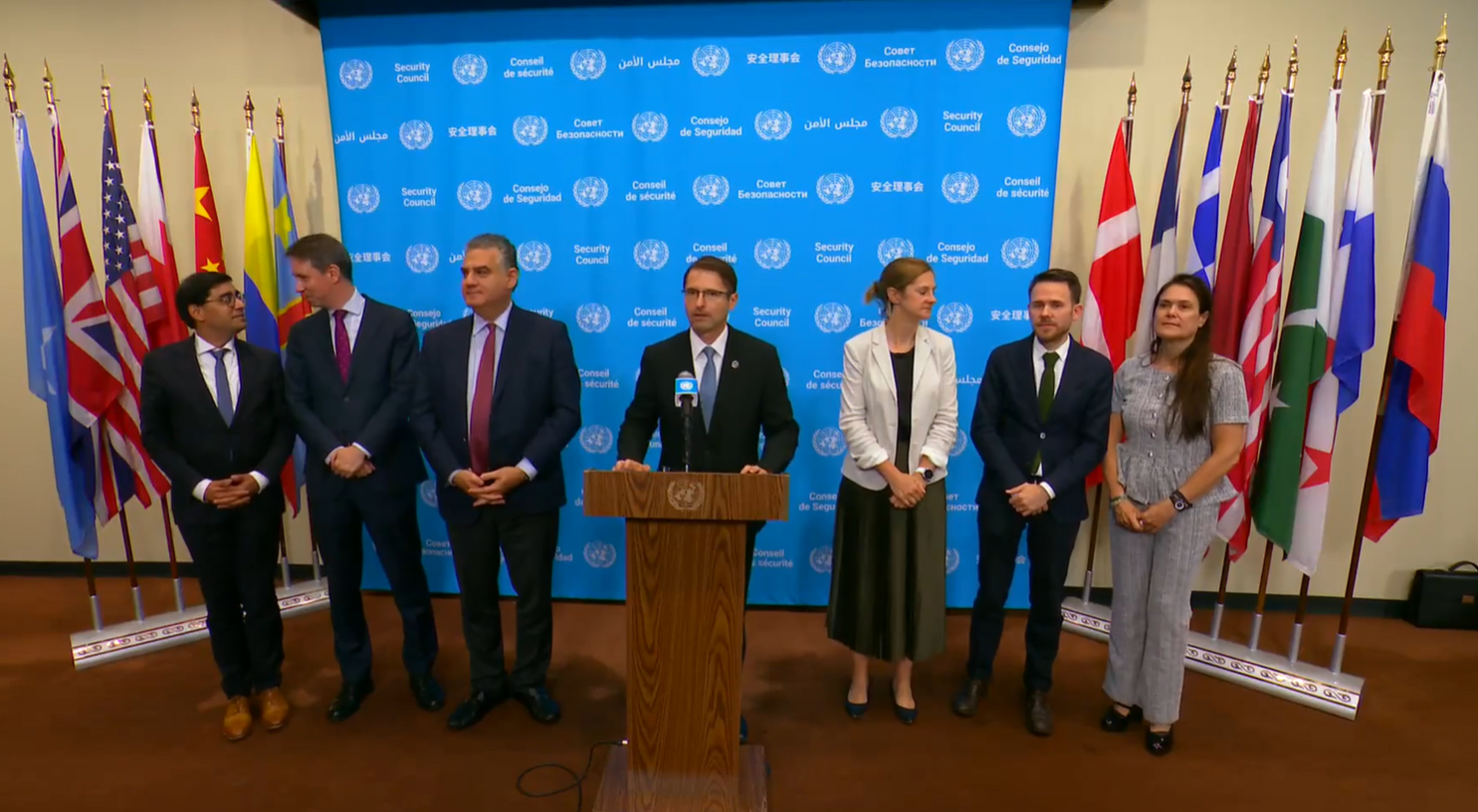
Following the meeting, representatives of UNSC members – Latvia, Denmark, France, Greece, and the United Kingdom, along with incoming Council members Austria and Portugal, issued a joint statement to the media. Deputy Permanent Representative of Latvia Oļegs Iļģis delivered the statement.
Statement in Detail
“Eighteen years have passed since Russia’s aggression and subsequent illegal occupation of Georgia’s sovereign territories of Abkhazia and Tskhinvali/South Ossetia regions,” Iļģis said.
“The Russian invasion of Georgia in August 2008 demonstrated the start of Russia’s more aggressive stance towards its neighbors. Russia has continued down this path with its unprovoked and unjustified aggression against Ukraine and reckless and dangerous actions against its neighbors.”
The signatories reaffirmed their support for Georgia’s independence, sovereignty, and territorial integrity within its internationally recognized borders, condemning Russia’s “brutal invasion and continued illegal military presence in contravention of the UN Charter and exercising of effective control and taking steps toward annexation of the two Georgian regions.”
The statement cited the so-called “Treaty on Deepening Allied Cooperation” signed in May by Russian President Vladimir Putin and Alan Gagloev, the de facto leader of Tskhinvali/South Ossetia at the time, as well as the appointment of “a Russian citizen,” apparently referring to Marat Kambolov, as the de facto leader of Georgia’s sovereign territory, “transferring strategically important parts of Georgian territory and infrastructure to Russia and conducting illegal so-called elections.”
The statement welcomed Nauru’s decision to withdraw its recognition of Abkhazia and the Tskhinvali/South Ossetia region, and called on “all states that have recognised, or established relations with, these entities to follow this example and to respect Georgia’s sovereignty and territorial integrity within its internationally recognised borders.”
The countries reiterated their condemnation of Russia’s “continuous provocations, violations of international law and militarization” of the two occupied regions, pointing to “restrictions of freedom of movement, unlawful detentions and abductions of the local population, discrimination against ethnic Georgians, prohibition of education in their language, deliberate damage to Georgian cultural heritage,” as well as “erecting barbed wire fences and establishing unauthorized flights, railway and naval connections between Russia and Abkhazia region.”
The statement also condemned the killings of Georgian citizens, including Davit Basharuli, Giga Otkhozoria, Archil Tatunashvili, Tamaz Ginturi, Vitali Karbalia, and Irakli Kvaratskhelia, saying, “the perpetrators of these crimes must be brought to justice and held accountable.”
The countries recalled several judgments by the European Court of Human Rights, which have found that Russia exercises effective control over Abkhazia and Tskhinvali/South Ossetia and is therefore “responsible for grave human rights violations, including killing of civilians, torture, inhumane and degrading treatment,” urging it to “implement those rulings.”
“We also emphasize the issuance of arrest warrants by the International Criminal Court for alleged war crimes committed against Georgian civilians,” it added.
The statement further said the countries “remain deeply concerned” that Russia has failed to fulfill its obligations under the EU-mediated 2008 Ceasefire Agreement to withdraw its forces to the positions held before the outbreak of hostilities. They also criticized Russia for denying international human rights monitoring mechanisms, including the Office of the UN High Commissioner for Human Rights, “unhindered access” to the occupied regions.
It stressed the need for “safe and unhindered humanitarian access to all persons in need,” emphasizing “the importance of protecting the rights and responding to the needs of internally displaced persons and refugees, and allowing for their safe and dignified return to their homes.”
The countries reaffirmed their commitment to the Geneva International Discussions (GID), describing them as the “sole format to ensure implementation of the EU-mediated 2008 Ceasefire Agreement and return of the IDPs and refugees to their homes.” They also voiced support for the work of the European Union Monitoring Mission (EUMM) and called on Russia to enable “access of the Mission to Georgia’s Abkhazia and Tskhinvali/South Ossetia regions as per its mandate.”
The statement welcomed the continued meetings of the Incident Prevention and Response Mechanism (IPRM) in Ergneti and called for the “immediate resumption,” without preconditions, of the Gali IPRM, which has been suspended since 2018.
The countries reiterated their call on Russia to “fully implement the 2008 Ceasefire Agreement and withdraw its forces from the territory of Georgia without delay.” They also repeated their longstanding demands for Moscow “to reverse the recognition of the so-called independence of the two Georgian regions, not to impede the creation of international security mechanisms, and to allow access of international human rights and humanitarian organizations to both regions.”
“To conclude, we stress the necessity of a peaceful resolution of the Russia-Georgia conflict based on international law, including the UN Charter, and on the Helsinki Final Act,” Iļģis said.
Also Read:

