

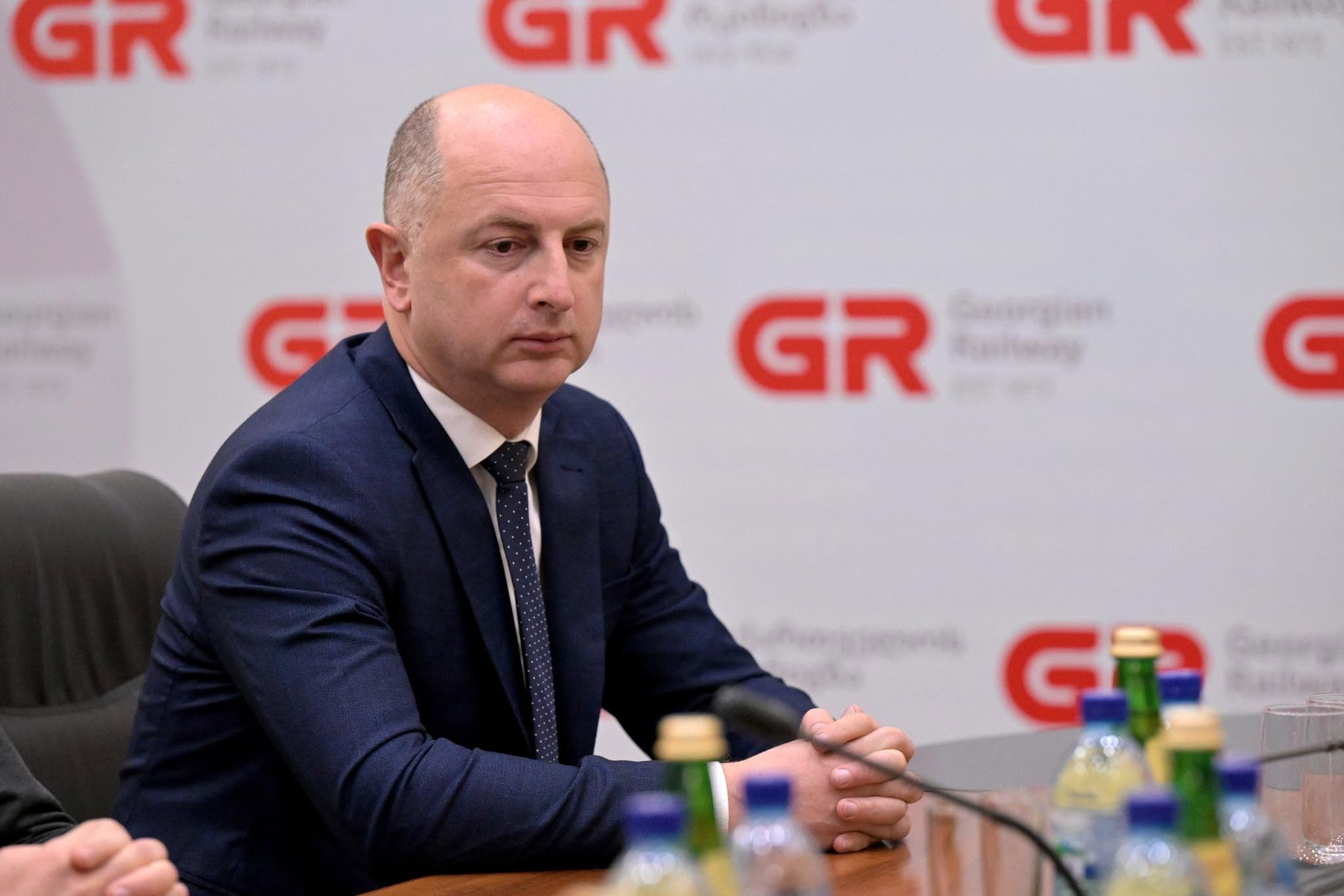
The State Security Service of Georgia (SSSG) has opened criminal proceedings against former Georgian Railway CEO Davit Peradze and seven other individuals over an alleged large-scale corruption scheme. Six of them were detained, while two, including Peradze, were declared wanted.
The alleged criminal scheme involves, among other claims, large-scale fraud, abuse of official position, document forgery, and money laundering. If convicted, the suspects face nine to twelve years in prison.
Davit Peradze headed Georgian Railway from 2017 until May 2025, when he was replaced by Lasha Abashidze. Peradze reportedly had close ties with Georgian Dream founder and Honorary Chairman Bidzina Ivanishvili. From 2007 to 2011, he held several roles at Ivanishvili’s Cartu Group, and from 2014 to 2017, he served as director of Mtkvari HES Ltd., a hydro-energy project backed by Ivanishvili’s Co-Investment Fund.
Alleged Scrap Metal Scheme
Emzar Gagnidze, director of the SSSG’s Anti-Corruption Agency, announced the alleged criminal scheme at the June 16 briefing.
According to him, in the fall of 2019, Peradze formed an “organized criminal group acting in coordination and with a structured form” to fraudulently seize large amounts of property belonging to JSC Georgian Railway. The scheme was designed so that scrap metal belonging to the state company would be collected, transported, cut, and sorted for subsequent sale “in such a form that it would become impossible to determine its exact original quantity.”
At the same time, Magradze added, pre-selected companies were used to create false tax documents that would give the stolen metal an “ostensibly legal origin” before it was sold on.
“Davit Peradze gradually involved numerous persons in the criminal scheme, including the then Infrastructure Director of JSC Georgian Railway. Also involved in the criminal scheme was another person who had actual control over several business entities: LLC ‘Kakheti’, LLC ‘Nova Transi,’ LLC ‘Jadeksa,’ LLC ‘Construction and Repair Company Khuro,’ and LLC ‘Grand Kakheti’,” the SSSG official said.
He added that “in accordance with the criminal agreement,” Georgian Railway announced two tenders on February 8 and September 9, 2020, for the procurement of services for the transportation, sorting, cutting, and collection of scrap metal. LLC Kakheti, which was under the “actual control of persons involved in the criminal scheme, was declared the winner,” he said.
“Bypassing authorized employees of JSC Georgian Railway,” Gagnidze said, one person ensured that the scrap metal to be removed was taken from the railway “without counting and weighing, and in some cases with artificially reduced quantities” recorded in documents. He added that documents were arranged so that “it would become impossible in the future to identify the person responsible for the existence of a shortage,” leading to the write-off of missing material from the company’s balance sheet.
Part of the collected metal was allegedly transported directly to the Rustavi-based company LLC Geostil instead of being stored in warehouses, Maghradze said, adding that in order to conceal the metal’s criminal origin and facilitate its sale, the group allegedly produced “false tax documents” for the business entities participating in the crime.
Maghradze added that “during 2020–2021, through deception and with the intent of unlawful appropriation, a total of 22,120 tons of scrap metal belonging to JSC Georgian Railway was seized,” which, after a change of origin, was “purchased by LLC Geostil for GEL 17,391,121. The funds received from LLC ‘Geostil’ were accumulated in the bank accounts of LLC ‘Nova Transi’ and LLC ‘Jadeksa’, and were periodically withdrawn in cash and distributed among the group members.”
The investigation also covers a separate contract allegedly signed on April 29, 2022, between Georgian Railway and LLC Raveld for the repair of railway-track defects. According to Maghradze, the contract was worth USD 999,768 and provided for the welding of up to 1,600 rail units, with payments tied to “acceptance-transfer acts.”
Maghradze said that the director of LLC Raveld, “acting in agreement with Georgian Railway’s then-Infrastructure Director,” deliberately inflated the number of completed rail welds in official documents. The records claimed that 1,200 rail units had been welded, while investigators say only 987 were actually completed. The false documents were signed by Georgian Railway employees under the instruction of the infrastructure director, the agency said. As a result, Raveld received an excess payment of GEL 403,844.
“Active investigative actions continue at the Anti-Corruption Agency of the State Security Service for the purpose of identifying other members of the organized group and implementing the measures provided for by law against them,” Maghradze warned.
Also Read:

