

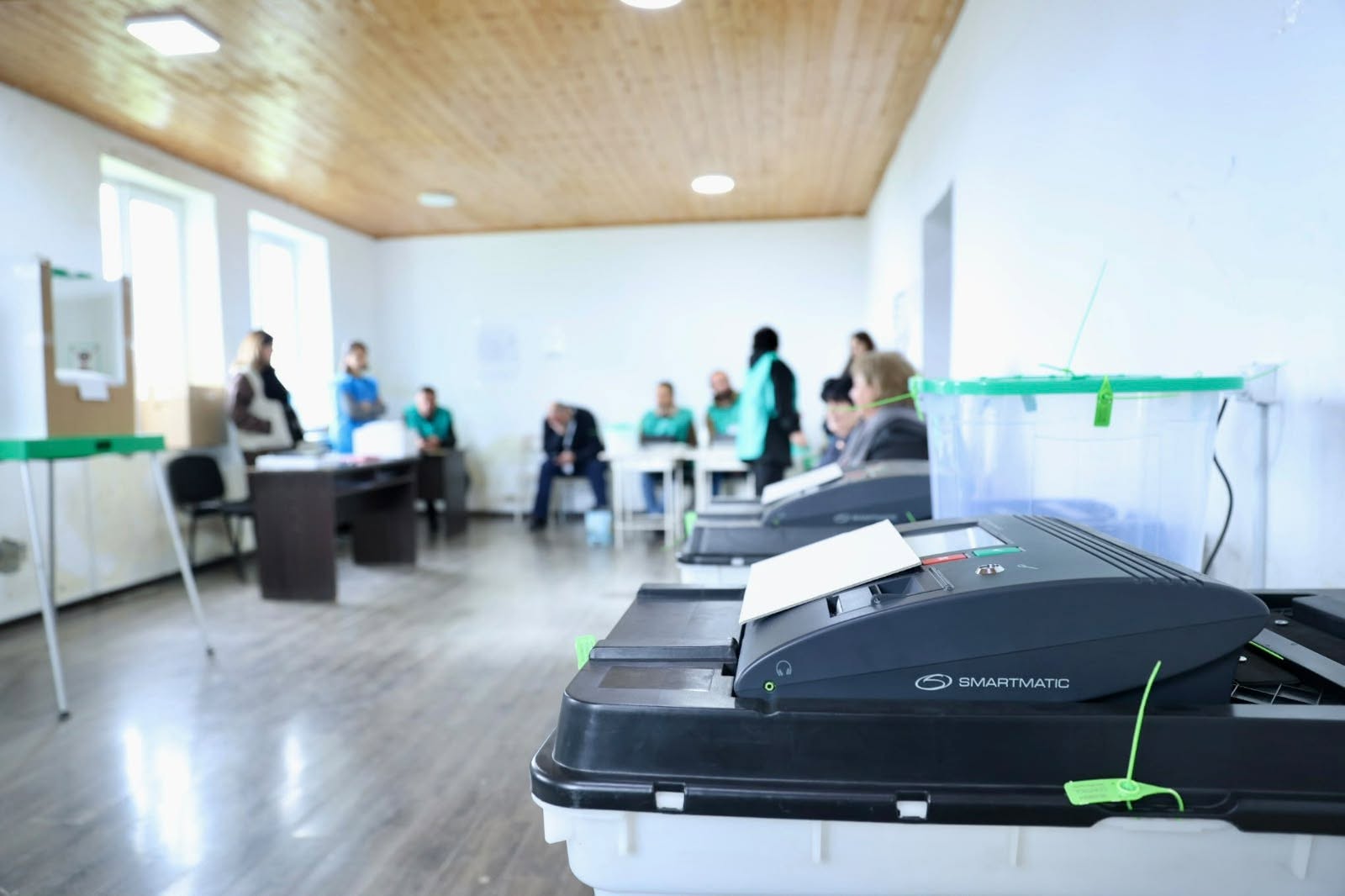
Three Georgian election watchdog organizations have criticized proposed changes to the country’s election laws, warning that they would limit vote appeal possibilities, make election results harder to verify, restrict judicial oversight, and further centralize election administration. Georgian officials claim, on the other hand, that changes are intended to adapt the administration to electronic voting.
The watchdogs, including Georgian Young Lawyers’ Association, the International Society for Fair Elections and Democracy, and Transparency International Georgia, said the legislative package submitted to parliament on October 28 by six lawmakers from the ruling Georgian Dream party “will further weaken already limited oversight mechanisms and increase the centralization of election administration.”
The proposed legislation “must be assessed in the context of the personalized lawmaking and repressive practices established in recent years,” the organizations said, arguing that legal rules increasingly serve the interests of the ruling group while mechanisms of public oversight are progressively weakened.
The proposed changes include amendments to the Election Code and Local Self-Governance Code, while the first plenary sitting to review the bills is expected to take place on November 10.
According to the statement, the proposed amendments limit the possibility of appealing the Central Election Commission’s (CEC) summary protocol exclusively to technical errors, abolish mandatory ballot recounts, and transfer decisions on the registration of election observer watchdogs from the entire commission to the commission’s chairman.
“Additional procedural and advertising restrictions, meanwhile, will further undermine the conditions for participation in the electoral process and political competition,” the watchdogs said.
The organizations said they were particularly concerned about a provision allowing appeals against the final CEC tallies only to correct mechanical or technical errors, noting it would prevent courts from considering systemic violations and their combined impact on election results.
“The proposed change grossly restricts and weakens guarantees for the effective protection of electoral rights,” the statement said, arguing that some electoral violations may become apparent only after results from multiple polling stations are analyzed together, making challenges involving individual precincts insufficient to ensure effective judicial oversight.
The proposed legislation would also eliminate a requirement for district election commissions to randomly select five polling stations and recount their votes within six days of an election. The procedure has been an important safeguard against electoral manipulation and a mechanism for verifying the accuracy of vote counts, the watchdogs argue, fearing that the abolition “will reduce the transparency of the process and further weaken public confidence in official results.”
Under another proposed change, decisions on registering domestic and international observer organizations would be made by central or district election commission chairpersons rather than by commissions collectively. The organizations warned that replacing collective decision-making with decisions made by a single official “increases the risk of subjective and politically motivated decisions.”
The legislative package would also shorten the deadline for certain election contestants to submit financial reports from 12 days to five days after an election, the watchdogs said, and also require observers and media representatives to register for runoff elections at least seven days in advance, rather than five.
Another amendment would prohibit broadcasters and newspapers from redistributing unused free advertising time or space among other electoral contestants. The watchdogs said the advertising restrictions could further disadvantage opposition parties, several of which lost access to free airtime under legislative changes adopted in 2021.
The organizations also criticized the process through which the legislation was prepared, saying it had not been preceded by public discussions or consultations with relevant stakeholders, including the election administration.
Georgian Dream Prime Minister Irakli Kobakhidze defended the proposed amendments on November 5, saying they were intended to simplify election procedures following the introduction of electronic voting technology.
“Nothing is being restricted. The results protocols from every polling station can be appealed,” Kobakhidze told reporters. “The rest is simply being clarified because electronic equipment has been introduced. Since elections are conducted electronically, certain procedures could be simplified, and that is exactly what the legislation provides for.”
Georgia’s election administration has faced scrutiny and controversies over the past years, particularly intensifying since the heavily disputed 2024 parliamentary vote.
The ruling Georgian Dream party has further amended election laws and rules since then, drawing both local and international criticism. The more recent amendments include changes in local election rules abolishing the 40% threshold for majoritarian city council (Sakrebulo) seats, increasing the share of majoritarian seats over proportional ones, and modifying vote-counting functions in the commissions to favor the better-performing party.
In December 2025, Georgian Dream also adopted a new version of the election code which, among others, ended the right of Georgian to vote from abroad.
Also Read:

