

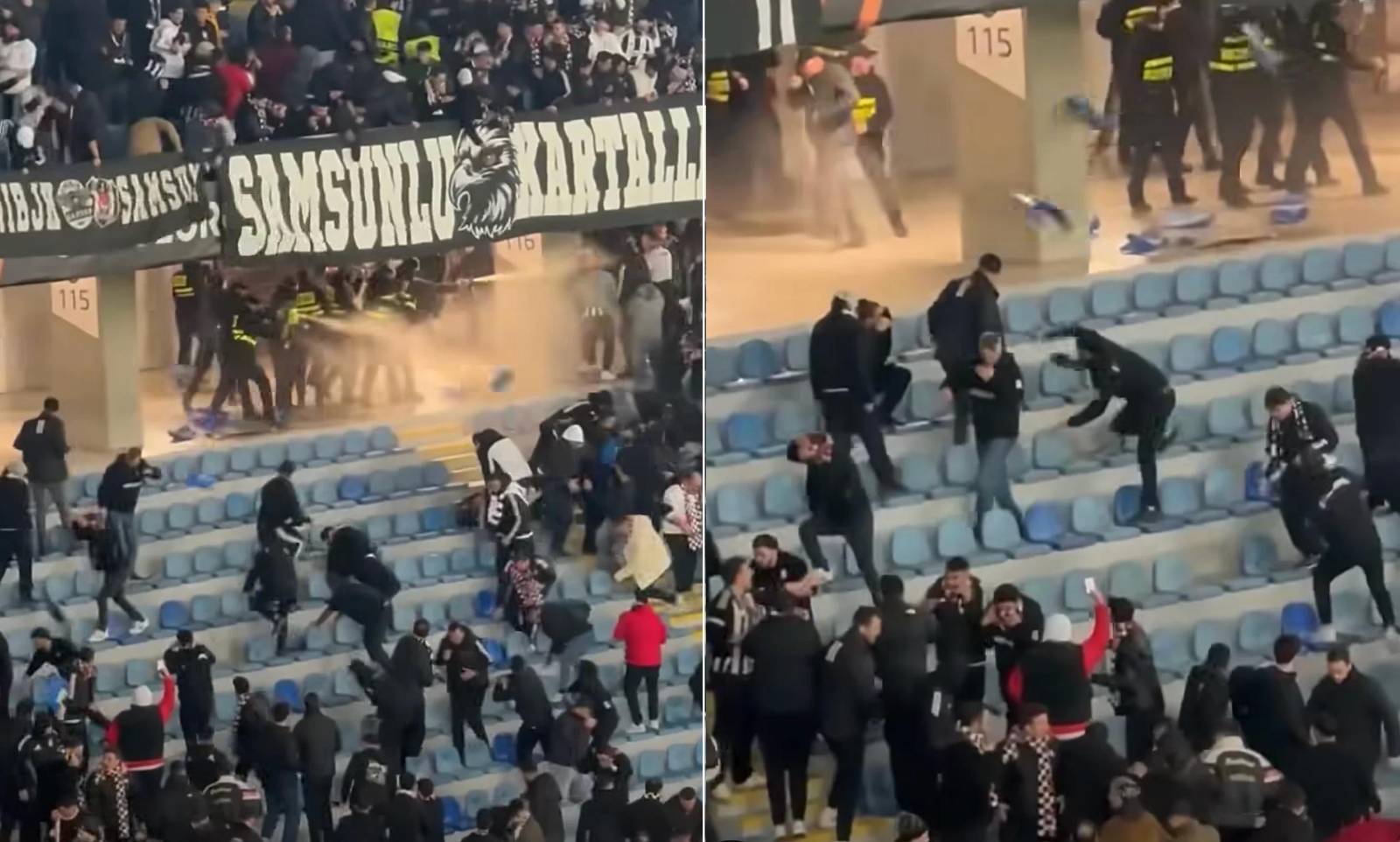
Ankara has reportedly summoned the Georgian ambassador amid “disproportionate force” allegations, while Georgian officials continue to defend police action and blame fans after November 26 clashes between Georgian police and Turkish football fans in Batumi triggered conflicting reactions among the officials of the two countries.
The incident occurred during a UEFA Europa League match between Turkish club Beşiktaş and Israeli side Hapoel Be’er Sheva at Batumi Arena, in Georgia’s coastal city close to the Turkish border. The game was temporarily suspended after clashes broke out between Georgian police and Beşiktaş supporters in the stands. Footage circulated on social media showed police using pepper spray as fans threw various objects, including stadium seats, at officers. The match later resumed, with Beşiktaş winning 2-1.
The incident led Turkish officials and football clubs to condemn Georgian police intervention as “disproportionate,” linking it with Turkish fans displaying Palestine flags and pro-Palestinian banners. There were reports that Turkish Interior, Foreign, and Justice Ministers made phone calls with their Georgian counterparts.
Georgia’s Interior Ministry initially said that 16 people had been detained, later also specifying that four police officers injured in the incidents. The Ministry rejected Turkish reports that the display of Palestinian flags and banners prompted the police intervention, arguing the fans had grown violent already before the match. Georgian authorities later said that all those detained under “administrative” procedures had been released and that the Interior Ministry had facilitated the Turkish supporters’ return home.
The incident triggered separate heated exchanges on social media, as Turkish users kept alleging police ill-treatment, while Georgian users argued Beşiktaş fans disrespected the host country, while also accusing Turkish fans of displaying a banner allegedly featuring territorial claims over Batumi.
UEFA, meanwhile, said it understood that the escalation between police and Beşiktaş supporters began after officers intervened to contain clashes among the supporters themselves. The statement noted, however, that UEFA “was not the match organiser and was therefore not responsible for and had no control over security matters in the venue.”
Batumi was chosen in October as the venue for the Europa League match “for safety and security reasons,” reportedly amid Turkish-Israeli tensions over war in Gaza.
Turkish Officials, Clubs Condemn Police Intervention
Turkish officials, media, and fans have criticised the police response, including the use of pepper spray, while also linking the origin of the unrest with Turkish fans displaying Palestinian flag and pro-Palestine banners, an allegation Georgian authorities have rejected.
Late on November 26, Turkish Interior Minister Mustafa Çiftçi held a phone conversation with his Georgian counterpart, Sulkhan Tamazashvili, over the incident.
In a statement posted on X, Çiftçi said he had expressed concern over what he described as the “disproportionate use of force” against Turkish citizens, asking that measures be taken to ensure the supporters’ safety and their unhindered return home.
Turkish minister cited Tamazashvili as saying that “it was not Georgian government officials but UEFA officials who took the Palestinian flags from our fans’ hands, and that he had sent his Deputy Minister to the stadium in response to the incidents.”
However, Tamazashvili offered a conflicting account on November 27, saying that UEFA had informed the sides ahead of the match that no flags or symbols other than those of Turkey, Israel, and Georgia were allowed to be displayed. He added that the staff member who approached the fans and called for the flag to be taken down was from a company “hired and contracted by Beşiktaş, which was responsible for this action.”
Beşiktaş Club also released a statement on November 26, “strongly condemning” what it called the “disproportionate force” used by security forces before and during the match, extending “sympathies to the fans affected by these incidents.” The club described the events as a “tragic” occurrence.
Turkish media also reported that several major football clubs, including Galatasaray, Fenerbahçe and Trabzonspor, had issued statements expressing solidarity with Beşiktaş.
Later, state-run Turkish news outlet Anadolu Agency reported that Ankara summoned Georgian Ambassador Archil Kalandia over the incident.
Georgian Officials Slam ‘Grave Provocations’, Defend Police
Commenting on the unrest throughout November 27, Georgian officials, including Prime Minister Irakli Kobakhidze and Interior Minister Sulkhan Tamazashvili, defended police response while pointing at “grave provocations” from Besiktas fans.
According to Kobakhidze, Tbilisi offered “Turkish friends” a “unique” opportunity to play this football match in Georgia at the full stadium despite “risks” and as a “friendly gesture,” adding that the vast majority of Turkish fans received the offer “very respectfully and came to [Georgia] in a very dignified manner.”
“However, there were several hundred fans – whom I would not even call fans – who displayed provocative actions. This was, naturally, very disappointing for us. When you make this kind of offer to fans, and they respond with inappropriate actions, it is very hurtful and disappointing,” Kobakhidze told journalists on November 27. He then thanked police officers, arguing that, ultimately, “police ensured the protection of order.”
Earlier in the day, Zurab Pataridze, Chair of the Government of the Autonomous Republic of Adjara, said he met with Turkish Ambassador to Georgia Mustafa Türker Arı to discuss the events surrounding the match “in detail.”
Pataridze said that he explained to the Ambassador that a “not-insignificant part” of Beşiktaş supporters had “behaved provocatively” both before and during the match; “repeatedly and deliberately, they threw bottles, stones and blunt objects at police officers, as a result of which several police officers were injured.” He also added that the supporters “damaged the city’s infrastructure and stood out for their obscene shouts directed at police officers, which, naturally, could not have gone without an appropriate response.”
Pataridze further said that “provocative banners” brought by the fans had been found at the border before the match. Their content, he argued, “is sensitive to the Georgian population, and displaying them at the stadium or in the city would have inevitably caused provocations. Accordingly, the prohibition on publicly displaying these banners was dictated, first and foremost, by the aim of ensuring the safety of the Turkish fans themselves,” he explained.
While Pataridze did not specify the content of the banners in question, public attention in Georgia went to photographs circulated on social media, apparently showing Turkish fans displaying a banner reading “82 Batum” before travelling to Georgia. Some Georgian social media users interpreted the number as a territorial claim, noting that Turkey has 81 provinces and suggesting that the banner implied Batumi would be its 82nd.
Authorities Criticized Over Hosting Match, Handling Incident
Some of the government-critical voices, too, expressed dissatisfaction with both the conduct of fans and the Turkish response, but also criticised Georgian authorities for agreeing to host the match.
“Every official – whether from the [football] federation or state structures who brought this match to Georgia must immediately resign,” Nika Gvaramia, leader of the opposition Ahali party, wrote on Facebook. “Everyone knew very well what we would be dealing with, what grave events would unfold, and how our image would be tarnished in front of the entire world. They knew it and simply didn’t give a damn, because they smelled big money.”
Georgian political analyst Zurab Batiashvili also argued that the authorities had failed to properly consider the tensions between Turkey and Israel before accepting the match, suggesting that economic interests had taken precedence over security considerations.
“In this love of money, they [Georgian Dream] are so clouded in mind that they neither care for themselves nor ask anyone what is going on between Turkey and Israel, or what it means to be a fan club of “Beşiktaş,” and they gladly agreed to this offer,” Batiashvili wrote.
Separately, while Turkish officials criticised Georgian police for using what they described as “disproportionate” force, Georgian authorities faced criticism from local observers for what they saw as a far more lenient police response and legal consequences compared to those imposed on Georgian protesters.
Georgian authorities have long faced criticism over excessive police force against protesters and the impunity enjoyed by officers, while protesters have been handed lengthy prison sentences on violence-related charges. The developments, alongside reports that those detained during the Batumi unrest had been released, prompted critics to recall similar cases, including the high-profile case of journalist Mzia Amaglobeli, who was sentenced to two years in prison for slapping a police chief during protests in January 2025, an incident that also occurred in Batumi.

