

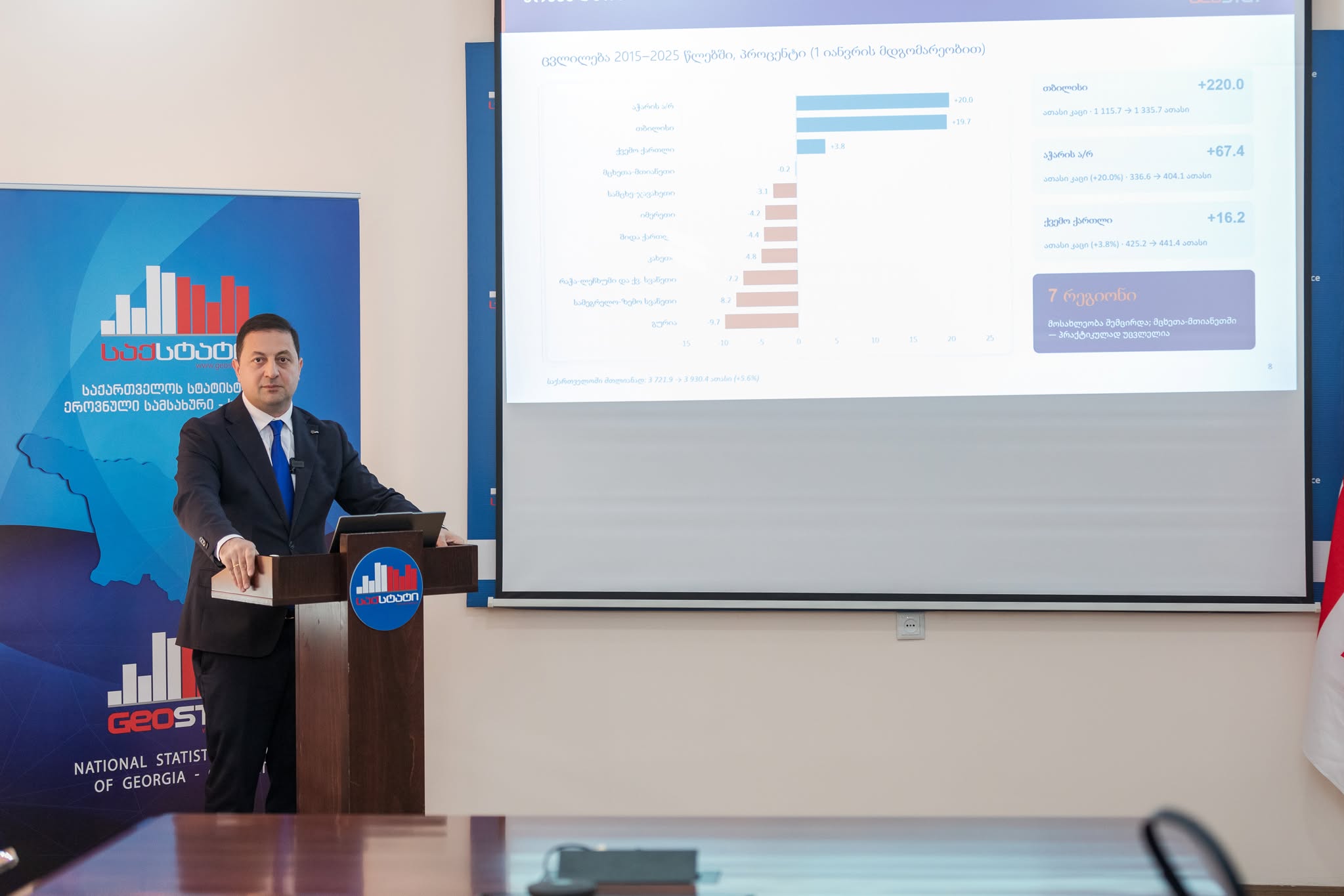
Georgia’s National Statistics Office (Geostat) has substantially revised its population estimates and demographic statistics for 2015–2025 as part of an intercensal recalculation, resulting in reduced emigration figures among Georgians while also raising the immigration numbers of Russian nationals in recent years.
Geostat said the recalculation, mainly affecting migration data, was prompted by the results of the 2024 Population Census and aimed to “harmonize the historical time series with the census results,” noting that intercensal recalculation is an “internationally recognised practice” for ensuring “the consistency and comparability of estimates for the period between successive censuses.”
The revision comes months after Georgia published the detailed results of the 2024 census, which showed that Georgia’s population stood at 3,929,581 as of November 14, 2024, an increase of 215,777 people, or 5.8%, compared with the previous 2014 census. The latest census showed that, while the number of Georgians increased over the decade, their share of the total population declined from 99.2% to 96.1%. Foreign citizens permanently residing in Georgia numbered 133,857.
The revised data also came weeks after Geostat published its initial assessment of Georgia’s demographic situation in October, presenting the 2025 population and migration figures.
What Changed
The updated estimates now put Georgia’s population as of January 1, 2025, at 3.930 million, up by 226,000 people (6.1%) from the previously reported 3.704 million, which is more in line with the latest census data.
The revised data show 715,644 cases of emigration among Georgian nationals between 2015 and 2025 – against the previously reported 869,146, and 590,659 cases of immigration, against the previously reported 628,718. The recalculation thus produced a smaller gap between cases of emigration and immigration among Georgian nationals (-124,985) than previously reported (-240,428).
The recalculation showed a particularly different picture for 2023, when, according to initial figures, 163,480 Georgian nationals had left the country, with the new figures reducing the number of emigrated Georgian nationals in 2023 to 64,427.
Below are the migration data for Georgian nationals before and after intercensal recalculation:


The recalculated statistics also change the picture of migration involving Russian nationals, with revised figures recording more cases of immigration and fewer cases of emigration than previously reported.
Per revised figures, between 2015 and 2025, Georgia recorded 249,744 cases of immigration among Russian nationals – against the initially reported 229,369, and 101,255 cases of emigration, against the initially reported 131,366. The difference between immigration and emigration cases now stands at 148,489, against the initially reported 98,003.
The changes are most pronounced in the period following Russia’s full-scale invasion of Ukraine. Between 2022 and 2025, the revised figures show 169,868 cases of immigration among Russian nationals – against the initially reported 158,644, and 65,656 cases of emigration, against the initially estimated 86,117.
Below are the migration data for Russian nationals before and after intercensal recalculation:


Why Geostat Recalculated Migration Figures?
According to Geostat, the discrepancy identified in the intercensal demographic balance was addressed through revision of the migration component, while the births and deaths were retained without revision. Geostat explained differences between the annually updated migration data and once-in-a-decade census numbers with three factors:
The agency said that, firstly, the census and current migration statistics differ in terms of time criteria to determine usual residence and migrant status, with the census focusing on a 12-month criterion, while current migration statistics apply a six-month threshold.
Another factor, according to Geostat, is the unavailability of comprehensive administrative information on population movements between the occupied territories and Georgia proper, with such movements “not captured in current international migration statistics.”
The third factor, the agency said, is the methods used in calculations, with current migration statistics relying on state border crossings data. According to Geostat, classifying border-crossing records as migration events requires the application of duration-of-stay criteria, algorithms and estimation procedures. “Some estimation coefficients and allocation parameters used in current migration statistics had been based on migration patterns and behavioural models established during the previous census.”
Below are the migration data for all nationalities before and after intercensal recalculation:


Revised Population Trends
According to Geostat’s revised estimates, Georgia’s population grew relatively moderately between 2015 and 2021, increasing by 63,500 people, or 1.7%. As of January 1, 2022, the population had declined by 25,000 compared to the previous year.
The trend subsequently changed markedly. “Between 2022 and 2025, the population increased by 169.9 thousand persons (4.5%),” Geostat said.
The agency noted that this growth occurred despite negative natural population change during 2022–2024, when deaths exceeded births by a cumulative 13,800. “Nevertheless, the total population continued to increase,” Geostat said, adding that the change “reflects the combined effects of demographic processes.”
The revised data also show a rising level of urbanization. As of January 1, 2015, 2.136 million people lived in urban settlements, accounting for 57.4% of the country’s population. By 2025, the urban population had increased to 2.445 million, or 62.2% of the total population — a rise of 4.8 percentage points over the decade.
Over the same period, the urban population increased by 309,800 people, or 14.5%, while the rural population declined by 101,300, or 6.4%. Geostat noted that “all of the net national population increase during 2015–2025 occurred against a background of urban population growth, whereas the rural population followed a downward trend.”
The country’s age structure also changed, with the most pronounced increase recorded among people aged 65 and older. Their number, under the revised data, rose from 531,300 in 2015 to 690,400 in 2025, an increase of 159,100 people, or 29.9%. Their share of the total population consequently increased from 14.3% to 17.6%.
The population aged 0-14 also increased, from 702,800 to 773,300, with its share rising from 18.9% to 19.7%. However, despite overall population growth, the working-age population (15-64) declined from 2.488 million to 2.467 million, a decrease of 21,100 people. Its share of the population fell from 66.8% to 62.8%.
Geostat also reported a slight change in the population’s sex composition. The number of men increased from 1.777 million in 2015 to 1.881 million in 2025, while the number of women rose from 1.94 million to 2.049 million. Consequently, the share of men increased from 47.7% to 47.9%, while that of women declined from 52.3% to 52.1%.
Also Read:

