

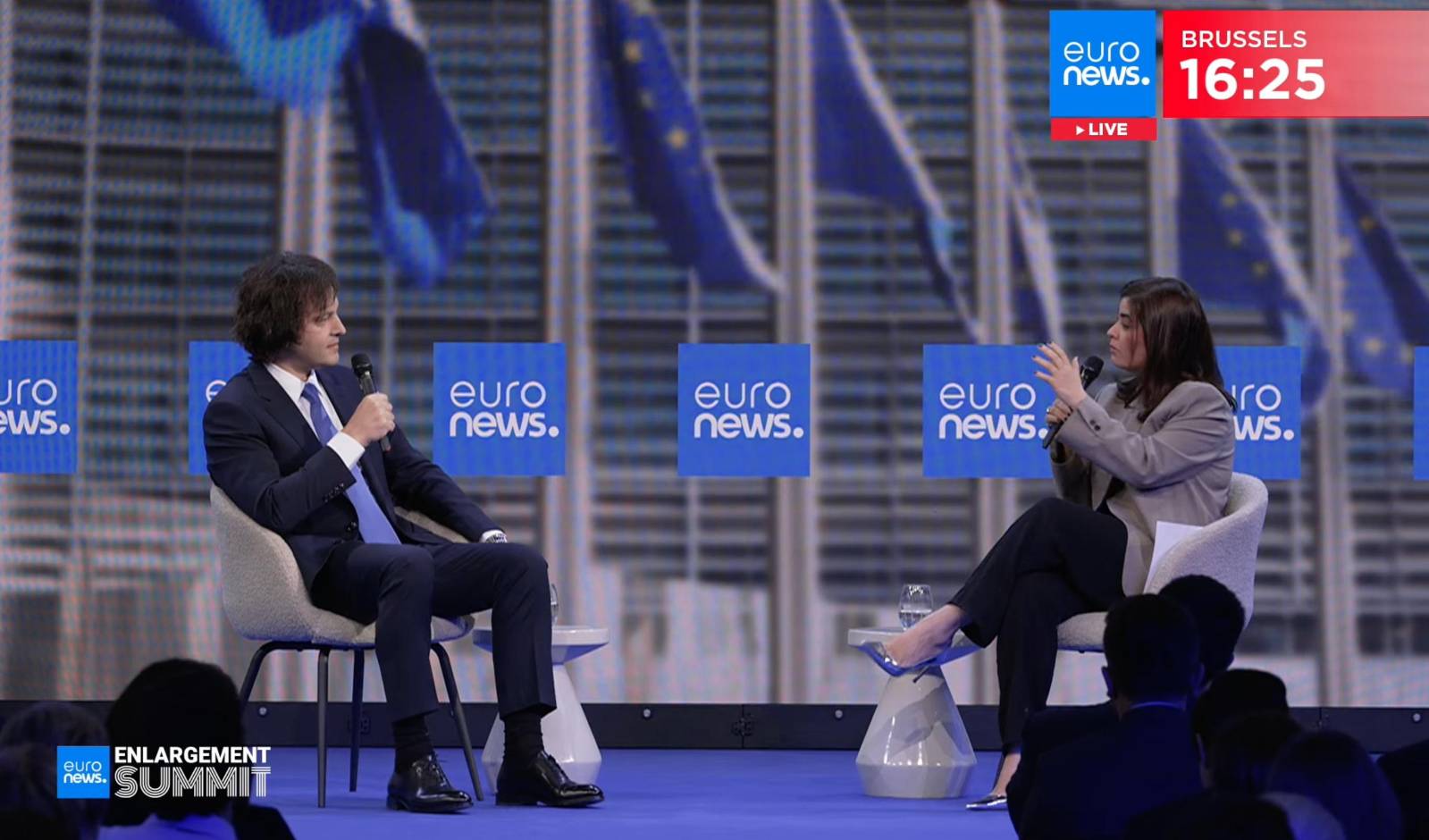
Georgian Prime Minister Irakli Kobakhidze dismissed European criticism of Georgia’s democratic record, invited European Commission representatives to a public debate and said Georgia still wants to join the EU “with dignity”, in a nearly 40-minute interview at the Euronews EU Enlargement Summit in Brussels on 3 November.
Key points
- Euronews Brussels correspondent Maria Tadeo interviewed Kobakhidze on 3 November, a day before the European Commission was due to publish its annual enlargement reports.
- Kobakhidze said the European assessments of Georgia do not match reality and proposed a public debate with Commission representatives.
- He defended the lawsuit to ban five opposition parties as a legal matter and the 2024 foreign agents law as a transparency measure.
- Reaction in Georgia was split: government figures criticised the interviewer, while opposition politicians criticised the prime minister’s performance.
Background
Georgia became an EU candidate country in 2023, but relations with Brussels have worsened amid the Georgian Dream government’s policies and its criticism of EU institutions. In November 2025 the EU said Georgia was a candidate “in name only” and moved to suspend visa-free travel for Georgian holders of diplomatic and service passports. Kobakhidze appeared at the summit while Georgia has been left out of major formal and informal enlargement events organised by the EU institutions. Other participants included European Council President António Costa and Armenian Prime Minister Nikol Pashinyan.
What Kobakhidze said
On the EU’s assessments. Kobakhidze said his government is fully confident that the findings of the 2025 enlargement report are not in line with reality, and he proposed a public debate with Commission representatives. He argued that, according to what he described as expert assessments published by the Commission, Georgia is among the most democratic EU candidate countries, with protected human rights and rule of law, and one of the fastest-growing economies in the region.
On pressure from Brussels. He accused the Commission of using Georgia’s candidate status, and later the accession talks, to “blackmail” Georgia and its society.
On the foreign agents law. Asked about calls from European institutions to repeal the 2024 Law on Transparency of Foreign Influence, he defended it as a measure to ensure transparency of foreign financing. He rejected the Council of Europe’s Venice Commission criticism of the law as political and not based on legal standards.
On membership. Asked why Georgia still wants to join the EU while criticising European institutions, Kobakhidze said the government is optimistic that they will change. Pressed about his 28 November 2024 announcement delaying accession talks, he said Georgia remains committed to membership but should not be expected to compromise its sovereignty or accept an unequal relationship. He compared the approach he attributed to Brussels with Georgia’s Soviet-era relationship with Moscow.
On dialogue. He said the government is ready to discuss every issue and that the problem is that European officials will not talk to it. Asked what steps Georgia would take to restore the accession process, he said both sides should first discuss what needs to change, and that the preconditions are sovereignty, dignity, democracy and the rule of law.
On the party ban case. Kobakhidze described the lawsuit as a legal case, saying the government asked the Constitutional Court to examine the constitutionality of five opposition parties. He accused European officials of interfering in the independence of Georgia’s judiciary by commenting on the case with political rather than legal arguments, and said the judiciary is independent.
When the interviewer said some heads of state do not want to be photographed with him, Kobakhidze replied that he has taken pictures with all of them.
Pashinyan on Georgia’s EU path
At the same summit, Pashinyan said Georgia’s EU accession is important for Armenia, and that Georgia’s success matters even for how Armenians perceive their own European policy and prospects.
Reaction
Parliament Speaker Shalva Papuashvili criticised the Euronews host, saying she was not listening to anyone but herself. Opposition leader Giorgi Gakharia said Kobakhidze demonstrated “sheer incompetence” during the Brussels visit. Before the summit, Polish MEP Krzysztof Brejza had criticised Euronews for inviting Kobakhidze alongside European leaders.
What happens next
The Commission published its 2026 enlargement package on 4 November, including the report on Georgia.
Read more: More Georgia news

