

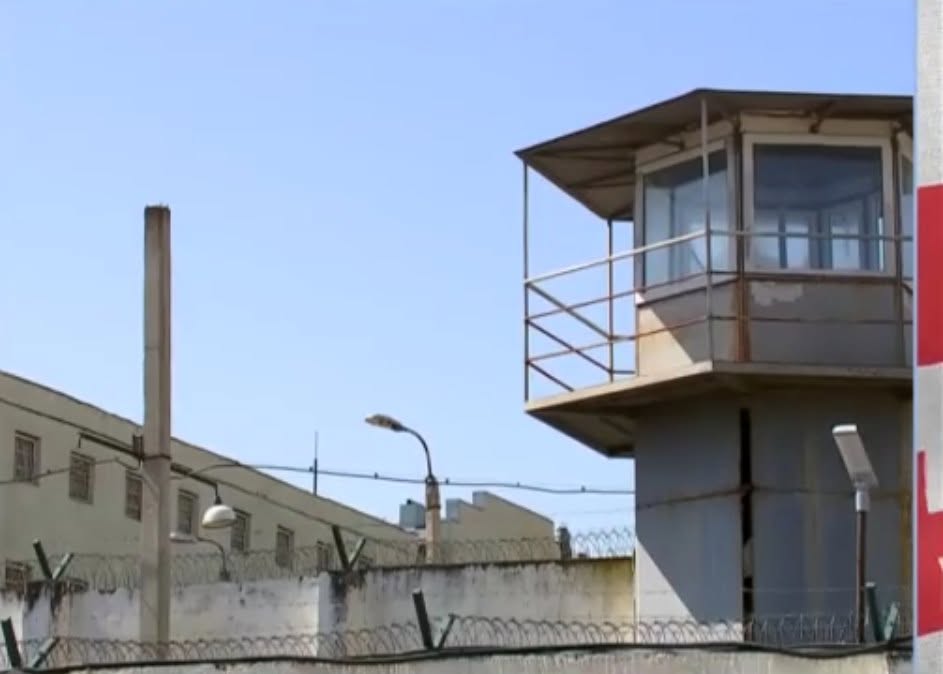
Georgia’s prison controversy, which followed allegations by an inmate that he was sexually abused at the hands of prison guards, has escalated amid allegations that more prisoners have been punished, including through physical violence, for expressing support for the inmate.
The controversy erupted after convicted Giorgi Davitadze, 36, the son of Avtandil Davitadze, a former Georgian Dream member of the Tbilisi City Council, alleged that prison guards sexually abused him with a finger during a check in a de-escalation cell.
While the authorities denied the allegations and published footage of the check, which contains no sound, in an attempt to support their claim, the footage ended up raising more questions, prompting calls for a more thorough investigation and review of the recordings.
The footage shows several guards restraining the inmate on a bed, with moments when their positioning makes it impossible to establish the exact procedures carried out on the prisoner. At least one of the guards, standing to the left of the inmate, is seen wearing what appears to be rubber gloves.
Davitadze’s allegations were followed by a statement by the Special Penitentiary Service late on October 4 that Davitadze “demonstratively swallowed an unknown small object,” in the presence of a guard. According to the agency, he was offered hospitalization at Vivamedi civilian clinic but refused. The Service added that Davitadze’s health was being monitored by medical staff at the penitentiary facility and “further appropriate measures are taken based on their recommendations.”
Following a meeting with the inmate, the Public Defender’s Office later cited Davitadze as saying that he was refusing hospitalization until three other inmates, whom he said had been transferred to de-escalation cells after joining the noise protest in his support, were returned to their cells.
The Penitentiary Service denied that the three inmates had been punished for protesting, saying they had been placed in de-escalation cells after physically attacking prison employees. It released footage showing two separate incidents featuring inmates physically attacking guards.
“On October 2, at 22:14, B. Ch. kicked David Nikolaishvili, Deputy Director of Facility No. 6, in the stomach as he attempted to enter the cell. At the same facility on October 4, 2026, at 20:22, convicted J. J. and V. T. physically assaulted facility employees upon returning from a walk,” the Penitentiary Service said.
The agency warned that an attack on a prison employee constitutes a “grave criminal offense,” adding that every such case would receive an appropriate legal assessment and response under the law.
Separately, Ana Akopova, a lawyer representing another inmate, Lasha Chachanidze, alleged that Chachanidze and four other prisoners were physically assaulted by guards after participating in the noise protest in solidarity with Davitadze.
“As Lasha describes, he was beaten with batons, as well as with hands and feet,” Akopova said to Formula TV, adding that, according to Chachanidze, Prison No. 6 Director Shota Trapaidze also took part in the beating.
Akopova also noted that Chachanidze complains of a “severe headache” after the incident and has “visible injuries” on his body. After this alleged incident, Chachanidze was taken to Batumi’s Prison No. 3, she added.
The Special Penitentiary Service rejected the allegations to the media, saying that no such incident had taken place.
Information about alleged tensions at Prison No. 6 was further voiced by Saba Skhvitaridze, an activist jailed in connection with the 2024 pro-EU protests. In a letter, Skhvitaridze described the situation at the Rustavi prison as “tense,” claiming that one inmate had cut his veins, several others had gone on hunger strike, while one was beaten in front of his cell.
“Some of the prisoners have been moved to another prison; we don’t know where they are. Some have been moved to a de-escalation room,” Skhvitaridze said, adding that the prisoners are also demanding that the Public Defender be allowed to see all hunger-striking prisoners.
Later, Public Defender Levan Ioseliani’s controversial remarks added to the controversy.
Responding to a TV Pirveli journalist’s question about whether the alleged insertion of a finger, referring to Davitadze’s sexual assault allegations during checks, is part of the procedure, he said that it should be checked in a relevant “provision” whether such a practice is allowed.
“How this is spelled out in the regulation, we need to check there. Whether there is a possibility to search so thoroughly. However, the fact that a search must be carried out, including with a detector and a scanner, is set out in the regulation,” he said.
Asked by the journalist to clarify, “But is the search with a finger, a rubber glove, part of the search procedure?” Iolesiani said that “this is his statement,” adding that this allegation is not visible in the circulated footage.
Media later cited the actual provision, which apparently states that “internal checks” are to be carried out by medical personnel, in accordance with medical ethics, in an isolated room and only when necessary.
The following day, the family and supporters of Davitadze held a rally in Tbilisi, demanding the dismissal of Trapaidze and the prison employees accused of violence. The family also called for the release of full footage of the search, with audio, noting that the video previously published by the Penitentiary Service has no sound.
Also Read:

