

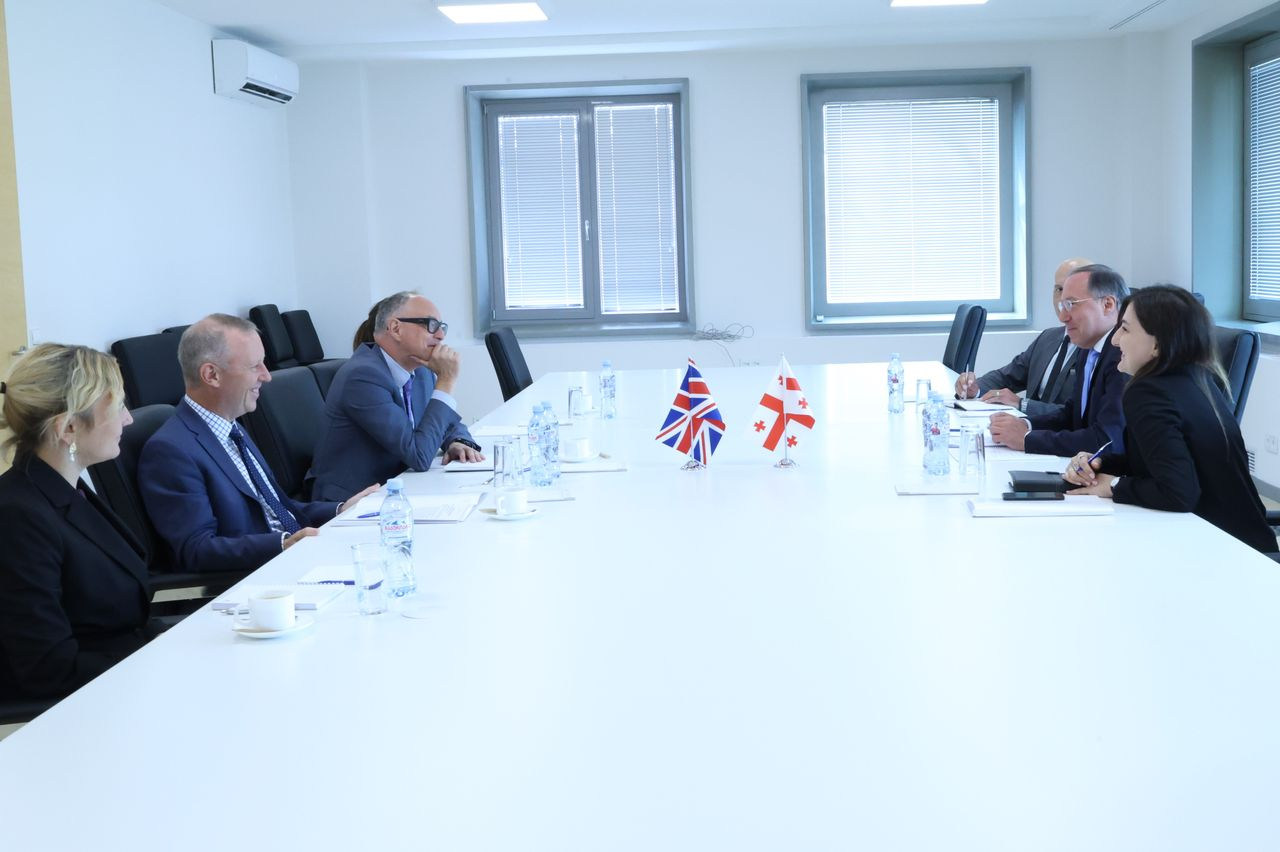
George Zurabashvili, the First Deputy Minister of Foreign Affairs of Georgia, met on August 5 with Mark Clayton, Deputy Director at the UK Foreign Office’s Eastern Europe and Central Asia Directorate (EECAD) and a former UK ambassador to Georgia, the Georgian Foreign Ministry said. Clayton was part of a UK Foreign Office delegation, while the meeting was also attended by current British Ambassador to Georgia Gareth Ward.
According to the ministry press release, the parties discussed “the agenda of bilateral and multilateral cooperation, along with the existing challenges and future prospects between Georgia and the United Kingdom,” and emphasized “the importance of fully restoring the existing strategic dialogue formats between Georgia and the UK.”
The meeting also focused on “Georgia’s European and Euro-Atlantic integration process,” with Zurabashvili reaffirming “once again the irreversibility of our country’s European choice.”
The ministry said the officials also discussed the regional security environment, “related challenges,” and the situation in Georgia’s occupied regions. It noted that the UK side reaffirmed its “unwavering support” for Georgia’s sovereignty, territorial integrity, and non-recognition policy.
The press release added that the meeting also covered “political developments in Georgia” and UK-Georgia relations. “The parties reaffirmed readiness for cooperation in addressing the common challenges, and based on mutual respect, for further strengthening the partnership,” it concluded.
The meeting comes amid strained relations between Tbilisi and London. It also follows a series of meetings and events in Tbilisi in July involving the London Stock Exchange Group that focused on UK-Georgian economic cooperation and British investment.
Around the same time, UK Minister of State for Europe, North America and the Overseas Territories Stephen Doughty said in a written answer to a parliamentary question that while investment decisions are made by businesses, the UK continues to monitor political and economic developments in Georgia closely, as part of its broader bilateral engagement with Tbilisi.
In May, London sanctioned three Georgia-registered companies “operating Russia-focused exchanges seeking to evade sanctions,” as part of its broader crackdown on crypto and illicit finance networks exploited by Moscow to circumvent UK sanctions.
Earlier, in February, the UK imposed sanctions on Georgia’s two major pro-government TV channels, Imedi TV and POSTV, over “Russian disinformation,” accusing them of “deliberately misleading information concerning Russia’s full-scale invasion of Ukraine” that “destabilizes” Ukraine or “undermines or threatens” its territorial integrity, sovereignty, or independence.
Also Read:
This post is also available in:

