
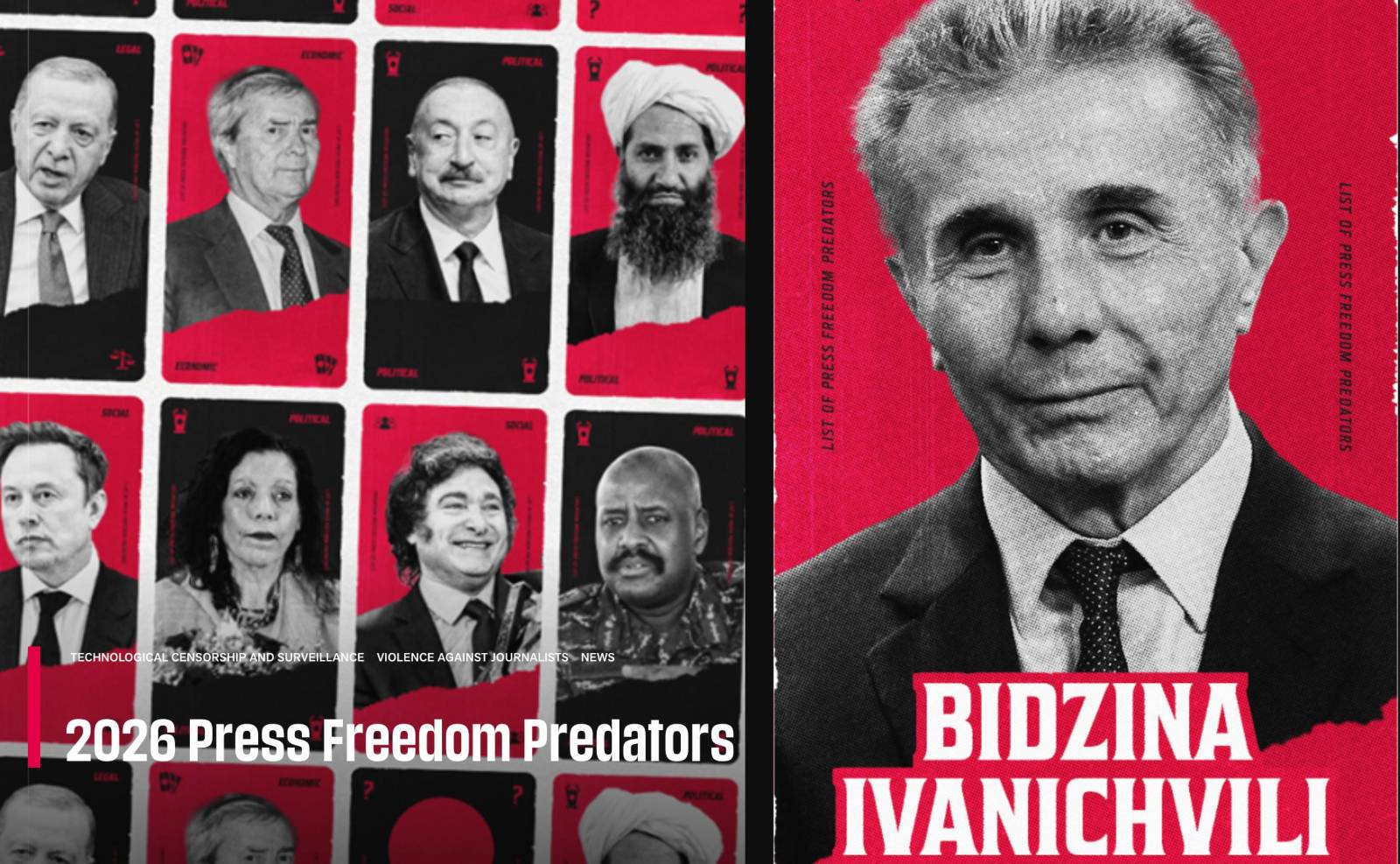
Georgian Dream parliamentary majority leader Irakli Kirtskhalia held a briefing to accuse Reporters Without Borders (RSF) of operating under the influence of the “Deep State” and “Global War Party” after the Paris-based media watchdog included party founder and Honorary Chairman Bidzina Ivanishvili on its Press Freedom Predators list for the second year in a row.
At a November 3 press briefing, during which he interchangeably invoked “Deep State” and “Global War Party” conspiracy theories, used by GD to claim the West is under the influence of informal oligarchic forces, Kirtskhalia also claimed that Georgia was “one of the world’s leading countries in terms of both media freedom and democracy.”
“Our political team believes it is important to use the absurdity published by one of the instruments controlled by the Global War Party, more specifically, this latest attempt to exert pressure on Mr. Bidzina Ivanishvili and Georgian Dream, to illustrate how their mechanisms operate against leaders and national forces that do not act in the interests of informal oligarchic powers, but instead choose peace over war, freedom over obedience, and sovereignty over acting under the dictates of foreign influence,” Kirtskhalia said, claiming that Ivanishvili was “deliberately included” in the list.
The remarks followed RSF’s November 2 publication of its 2026 Press Freedom Predators list, on which Ivanishvili retained its status after also appearing on the 2025 list.
Ivanishvili appears in the economic category, which lists figures and entities who “illustrate the range of strategies involving financial pressure used to weaken independent media, impact their funding and undermine their editorial independence.”
Others listed in the same category include tech companies Alphabet and Meta, French billionaire Vincent Bolloré, communications strategist and Kremlin ally Vladimir Tabak, and Kenyan President William Ruto. The broader list of “Press Freedom Predators” also includes figures such as Elon Musk, Robert Fico, Margarita Simonyan, with U.S. President Donald Trump also added this year.
During the briefing, Kirtskhalia described Ivanishvili’s inclusion on the RSF list as “nothing other than the price being paid” for refusing to sacrifice Georgia’s “peace, national interests, and sovereignty” to the “Global War Party,” saying the Georgian Dream founder was preventing the country from becoming “a sacrificial pawn on the grand political chessboard.”
“It appears that the logic of the ‘Deep State’ is as follows: the more colossal the lie, the more absurd and implausible the accusation, and the more its brazenness exceeds all conceivable limits, the more convincing it is supposed to sound,” Kirtskhalia said.
Drawing comparisons with the rule of former President Mikheil Saakashvili and his United National Movement (2004-2012), Kirtskhalia claimed that “every major media outlet capable of broadcasting nationwide was subject to the complete control and influence of a single political party.” He also accused Saakashvili of acting as an agent of foreign powers, arguing that international organizations had overlooked alleged repression under his government.
“This example clearly demonstrates how selective the assessments of international actors operating under the influence of informal oligarchic powers are, and how frequently these forces place political interests above reality,” he said.
Defending Georgia’s current media environment, Kirtskhalia argued that it was so pluralistic that outlets could “express the harshest criticism of the authorities and level any accusation whatsoever without providing a single argument to support it.”
“It is impossible to assess the media environment in Georgia and refuse to see the reality where the objective assessment clearly shows that Georgia is one of the world’s leading countries today, both in terms of media freedom and democracy,” Kirtskhalia said.
The remarks come amid growing concerns over restrictions on Georgia’s independent media. Through a series of laws and amendments adopted since 2024 on foreign funding, the ruling Georgian Dream party restricted access to financial sources for Georgian broadcasters and online media outlets. The 2025 amendments to the Law on Broadcasting also expanded the powers of the Communications Commission (ComCom), the country’s media regulator, over the content of Georgian TV and radio stations, leading to repeated financial sanctions.
In an October 9 report, Transparency International Georgia said it had identified 93 distinct words and phrases that ComCom had “prohibited” government-critical broadcasters from using following the amendments.
Also Read:
This post is also available in:

