

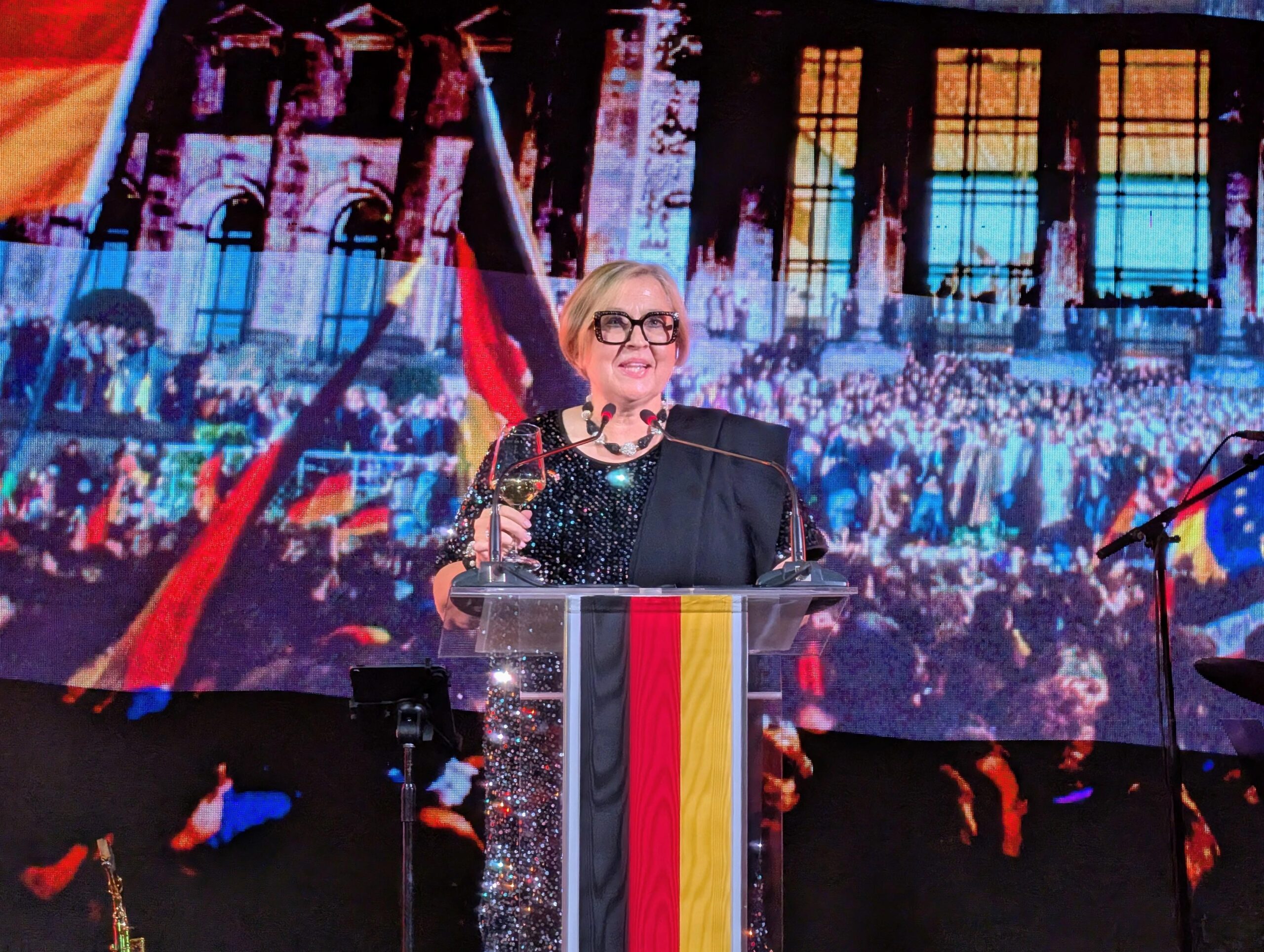
Designated German Ambassador Barbara Voss spoke about “damage” in the legacy of German-Georgian friendship, efforts to preserve “what has been built” between the two countries, and areas of future cooperation in an address delivered during the German Unity Day reception in Tbilisi on October 2.
Voss assumed her official duties in August, succeeding Peter Fischer after his tenure ended late in June amid the deepening low in relations between the two traditional close partners.
“Speaking about German-Georgian friendship today also means expressing our sorrow over how much of what we’ve built together has been damaged over the past years,” the diplomat said during her address, stressing “exceptionally long and intensive relations” between Georgia and Germany.
“Ilia State University, which has risen over the past 20 years to become Georgia’s internationally most renowned university, backed by immense financial resources, particularly from Germany, and which cooperates closely with Germany in research, is now facing a threat to its very existence,” Voss said. Ilia State University was among the public institutions worst affected by Georgian Dream’s controversial higher education reforms, which stripped the university of many of its key programs.
The diplomat then touched upon key German foundations halting their activities in Georgia, with two of them — Konrad Adenauer Foundation and the Friedrich Naumann Foundation — recently announcing the closure of their Tbilisi offices after the Georgian Dream government rejected their grant applications under the restrictive foreign funding laws.
“All four of our political foundations, which have supported Georgia and its people for decades on its path to European integration, were forced to temporarily suspend their work due to a decision by the Georgian government,” Voss said.
The diplomat pledged to “personally dedicate” her efforts “to preserving as much as possible of what has been built” between the two countries, noting she will also “actively advocate for this in [her] dialogue with the Georgian government.”
“Whether through the scientific cooperation of the Max Weber Foundation, the Eastern Partnership projects, or the scholarship program of the DAAD, or with the excellent German school, the German federal government will continue to allocate significant resources next year to foster exchange and understanding, particularly between the young people of our two countries,” she said.
The diplomat then turned to international security, noting that the two countries “share identical interests and threats in this field” with Russia “attempting to destabilize Europe and divide peoples through disinformation, threats, sabotage, and aggression.”
“Georgians know the pain of Russian invasion deeply, having 20 percent of their territory occupied, and know that Russia is not seeking to balance power, but to dominate,” Voss said.
According to the designated ambassador, Germany continues “to firmly support Georgia’s sovereignty and territorial integrity and its right to determine its own security choices,” including by maintaining cooperation with Georgian Defense Forces through NATO frameworks “to further reinforce their defense capabilities against possible aggression and contribute to security across the South Caucasus and Europe.”
Voss further spoke about the prospects of continued development cooperation “in selected areas” despite the differences.
“Alongside our support for Georgian civil society, we must continue to support Georgia despite all current differences in our bilateral relations in fields like environmental and nature protection,” she noted.
Speaking about Ukraine’s EU integration efforts, Voss also expressed hope that “in the coming years also Georgia will return to the European path.”
Barbara Voss arrived in Georgia following a turbulent period in bilateral relations. Peter Fischer’s tenure was marked by his public criticism of Georgian Dream policies and anti-Western rhetoric, diplomatic summonses by the Georgian Foreign Ministry and the German Foreign Office, attacks and accusations against Fischer from Georgian Dream officials and allied media, and repeated statements from Berlin defending its ambassador.
In a separate controversy, Tbilisi raised concerns over Berlin delaying accepting the credentials of Georgian Ambassador Alexander Kartozia. Kartozia finally presented his credentials to German President Frank-Walter Steinmeier on July 23, ten months after his appointment in October 2025.
Georgian officials, including Foreign Minister Maka Botchorishvili, have expressed the hope that the arrival of a new German ambassador in Georgia would be an opportunity to bring the relations between the two countries “back to a normal framework.”
Also Read:

