

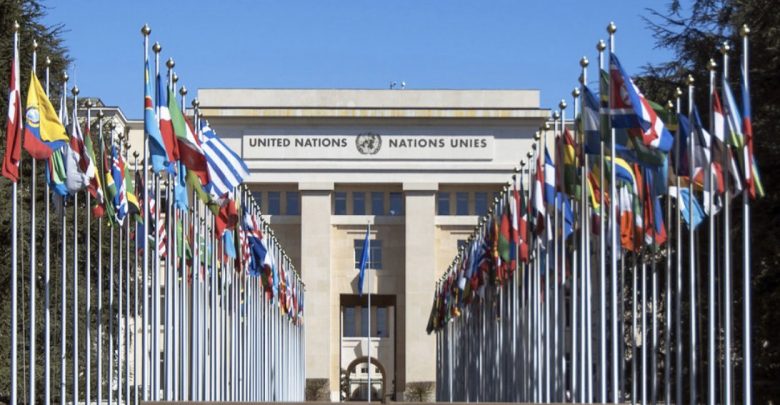
The 68th round of the Geneva International Discussions (GID), a multilateral forum for addressing the security and humanitarian consequences of the 2008 Russia–Georgia War, took place in Geneva on November 10-11.
The Geneva International Discussions/GID were established based on the ceasefire agreement of August 12, 2008, brokered by the European Union. GID are co-chaired by representatives of OSCE, EU, and UN, and involve participants from Georgia, Russia, and the U.S., as well as members of both the exiled Georgian administrations of Abkhazia and Tskhinvali Region/South Ossetia and the two regions’ Russian-backed authorities, in their personal capacities. Sessions are held in two working groups, with the first group discussing peace and security matters, and the second – humanitarian concerns. The main issues discussed at the GID are the implementation of the ceasefire agreement, the safe and dignified return of internally displaced persons and refugees to their homes, and the security and humanitarian problems created as a result of the Russian occupation.
Geneva Co-Chairs Communiqué
In a joint press communiqué, the GID co-chairs said the continued functioning of the talks, “a unique platform for dialogue between relevant stakeholders on conflict-related matters,” was welcomed by all participants as “a clear expression of their commitment to a peaceful settlement of all pending issues.”
In Working Group I, participants reviewed the security situation on the ground since the previous round in July 2026. According to the communiqué, they “expressed diverging assessments of the overall security environment in the region,” while “the absence of major security incidents over the past few months was noted.”
An “in-depth discussion” took place on the agenda item “Non-Use of Force and International Security Arrangements,” the co-chairs said, adding that they “will continue their consultations with all participants with a view to bridging remaining differences.”
Participants welcomed the “contribution to security and stability” of the Ergneti Incident Prevention and Response Mechanism (IPRM) and the related EUMM-managed hotline. They also “reiterated their support to the resumption of the Gali IPRM and explored possible options,” the communiqué said.
In Working Group II, participants addressed the humanitarian situation on the ground, including crossings, documentation, livelihoods, missing persons, and education. They also held an “in-depth discussion on freedom of movement and external mobility,” which included “exchanges on potential steps to be built upon in upcoming rounds.”
“The core agenda item ‘returns’ of internally displaced persons and refugees was not discussed during this round, due to a walkout by some participants,” the communiqué said, referring to the established practice of representatives of the Russian Federation and the occupation regimes. The co-chairs “reiterated their call on participants to engage on all agenda items.”
Russian MFA Statement
The Russian Ministry of Foreign Affairs stated that participants showed a “general commitment” to continuing work within the GID, which it described as “the only format” for the “post-conflict restoration of relations between Tbilisi and Sokhumi and Tskhinvali.” It highlighted the “stable functioning” of existing negotiation channels, including regular rounds, the 24-hour hotlines, and meetings of the Ergneti IPRM.
Moscow again called for “concrete practical steps” to ensure the “lasting security” of Sokhumi and Tskhinvali. According to the ministry, Russia and its “Abkhaz and South Ossetian allies” believe the priorities should be agreeing “legal guarantees of Tbilisi’s non-use of force against the two sovereign republics,” launching a “process of border delimitation between Georgia and its neighbors,” and resuming the Gali IPRM.
The ministry said these measures are needed because of “persisting risks” to the “independence” of the two regions, coming “both from radical forces in Georgia itself and from a number of its closest foreign partners, primarily NATO member states,” which it accused of “refusing to recognize the realities” in the South Caucasus and “continuing to build up military cooperation with Tbilisi.”
The ministry also reiterated that, “taking into account Switzerland’s de facto departure from its declared neutral status” through joining “illegal anti-Russian sanctions of the European Union,” Moscow, “with the support of Sokhumi and Tskhinvali,” continued efforts to build consensus on moving GID sessions from Geneva to “another, truly neutral venue acceptable to all participants.”
Tskhinvali/South Ossetian Participants
The participants from the occupied Tskhinvali region/South Ossetia were headed by First Deputy de facto Foreign Minister Andrey Tskhovrebov.
Representatives of the occupied Tskhinvali region were cited as saying the security discussions focused on the situation along the so-called “state border” [occupation line], which they described as “relatively calm.” They noted the important role of the Interregional Border Service (IDS) and the IPRM in maintaining a “stable and predictable situation.”
The delegation called on international organizations to “strictly adhere to the principles of neutrality, objectivity and equidistance” and to avoid steps that could be described as “destructive.”
“Despite substantial differences in the parties’ approaches to developing a political document on the non-use of force, the South Ossetian participants spoke in favor of the need to continue work on this project, which would become an important step toward preparing a full-fledged legally binding agreement on the non-use of force or threat of force between Georgia and the Republic of South Ossetia,” the de facto Foreign Ministry said.
The participants accused Georgian authorities of “sabotage” that prevents progress in the investigation of what they called the “enforced disappearance” of South Ossetian citizens S. Pliev, A. Khachirov and A. Khugaev. Other humanitarian issues were also discussed, they said.
Occupied Tskhinvali participants said there was no discussion of IDPs and refugees during the round, adding that talks on the issue could resume only if Georgia ends its “artificial politicization” of the problem.
Abkhaz Participants
The Abkhaz participants said that the central issue on the security agenda remained developing and signing a “legally binding document on international guarantees that Georgia will not use force against the Republic of Abkhazia”. They stressed that reaching such an agreement is of “fundamental importance” for “lasting security and stability in the South Caucasus.”
The Abkhaz side also focused on the prospects of resuming the work of the Gali IPRM, suspended since 2018. They said they remain interested in restoring the format’s full activity and presented additional proposals for “overcoming existing disagreements” and “finding mutually acceptable solutions necessary to unblock the mechanism.”
The Abkhaz delegation also told participants about alleged “attempts by the Georgian side to obstruct” performances by athletes from Abkhazia at international competitions, citing alleged pressure on the organizers of a rhythmic gymnastics tournament in Turkey and the world domino championship in Spain.
They also raised alleged “pressure and threats” against Elchin Adzinba, an associate professor at Adnan Menderes University in Turkey. According to the Abkhaz side, the threats began after her speech at the UN Forum on Minority Issues in Geneva, where she addressed “the problem of the international isolation of the citizens of Abkhazia.”
The Abkhaz side declared the inadmissibility of “politicizing humanitarian, educational and sports-related contacts” and called for respect for fundamental freedoms, including freedom of expression.
In the second working group, the sides exchanged views on humanitarian issues, including freedom of movement and access to education, and the co-chairs reported on the activities of UN agencies and international organizations in Abkhazia.
The next, 69th round of the Geneva International Discussions was scheduled for March 2027.
The post may be updated when the Georgian Foreign Ministry also comments on the meeting.
Also Read:

