
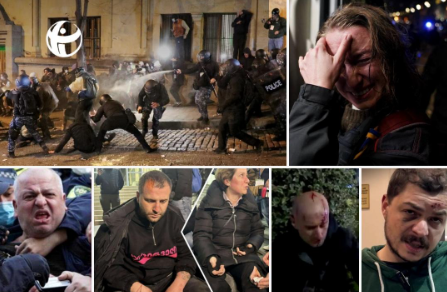
Transparency International Georgia (TI Georgia), a local watchdog, said in a November 27 report that it had documented more than 600 cases of various forms of violence, harassment, and other forms of obstruction targeting journalists and independent media outlets over two years of ongoing pro-European protests, nearly 200 of them in 2026 alone.
“Over the two-year period of continuous protests, Transparency International Georgia documented more than 600 cases of various forms of violence, attacks, intimidation, persecution, threats, harassment, and obstruction of journalistic activities targeting independent, critical media outlets and journalists. Of these, nearly 200 cases occurred in the current year alone,” the watchdog said.
The watchdog examined the use of state institutions and bodies under Georgian Dream’s (GD) influence against independent media, focusing on the judiciary and law enforcement system, Parliament, and the Communications Commission (ComCom), Georgia’s media regulator.
The report said that following the GD government’s November 2024 announcement to suspend the country’s EU accession process, the authorities used “every tool at the disposal,” including persecution, intimidation, physical and verbal attacks on journalists, arrests, fines and financial pressure. Despite this, independent media “has remained a voice that could not be silenced.”
TI Georgia said the use of state institutions against journalists “has emerged as a prominent trend this year and has become one of the main tools used to harass independent media.”
While recording the two-year statistics, the report examined in more depth the alleged breaches documented between May and the end of November 2026.
Judiciary and Law Enforcement
According to the report, Georgian Dream and individuals affiliated with it continue to use the judicial and law enforcement systems against journalists.
“This is reflected in the initiation of so-called SLAPP (Strategic Lawsuits Against Public Participation) cases against them, as well as in the imposition of fines and imprisonment,” the watchdog said.
Among the cases documented are the administrative detention of TV Pirveli host Nanuka Zhorzholiani, over rallying on the sidewalk; the arrest of Akhali Kavkasia (New Caucasus) journalist Irakli Chikhladze on espionage charges; GD supporter Goga Khaindrava’s lawsuit against opposition-leaning Formula TV; and the fines and administrative detention of Formula journalist Vako Sanaia.
The report also cites the migration detention of Hungarian journalist László Róbert Mészáros; the detention and subsequent fine of Adjara TV journalist Koba Partenadze; the arrest of Asaval-Dasavali journalist Dito Chubinidze on treason charges; the fine imposed on blogger and journalist Tornike Razmadze; Bera Ivanishvili’s lawsuit against Formula and TV Pirveli; and the sentencing of Chronika+ founder and editor Eliso Kiladze to 10 years in prison.
Restriction of Parliament Accreditation
TI Georgia said that following the tightening of accreditation rules, Parliament “has become one of the most inaccessible institutions for journalists.”
“Representatives of critical media outlets have their accreditation suspended for varying periods, including up to one year, for asking questions that members of Georgian Dream find unacceptable,” the report said.
The watchdog mentioned that the “draconian accreditation rules” are exploited by GD representatives “in bad faith to punish journalists for asking critical questions,” significantly hampering independent media’s ability to keep the public informed. TI Georgia also noted that while GD representatives refuse to engage with independent media through alternative formats, the Communications Commission “requires broadcasters to adhere to the principle of balance.”
“In the current year alone, at least 20 representatives of critical media outlets have had their parliamentary accreditation suspended, revoked before its expiry, and/or been denied one-time accreditation,” the watchdog said.
ComCom as Georgian Dream’s ‘Censor’
TI Georgia said that following the United Kingdom’s February sanctions against pro-government broadcasters Imedi and POSTV, the Communications Commission “assumed the role of a censor.”
Since the beginning of 2026, the regulator has issued “a total of seven formal notices against the critical broadcasters Formula and TV Pirveli,” the watchdog said.
The broadcasters initially received verbal warnings before being fined 2,500 each and subsequently GEL 5,000 each for “using words and phrases deemed unacceptable by Georgian Dream representatives.” On October 1, ComCom imposed a further GEL 10,000 fine on Formula.
While the commission also scrutinized pro-government broadcasters Imedi, POSTV and Rustavi 2, fining each GEL 2,500 following verbal warnings, TI Georgia questioned the nature of those proceedings.
“Observing these proceedings gives the impression that they are largely a formality, serving to portray the Commission to interested parties as an objective observer and arbiter,” the watchdog said.
Also Read:
This post is also available in:

