

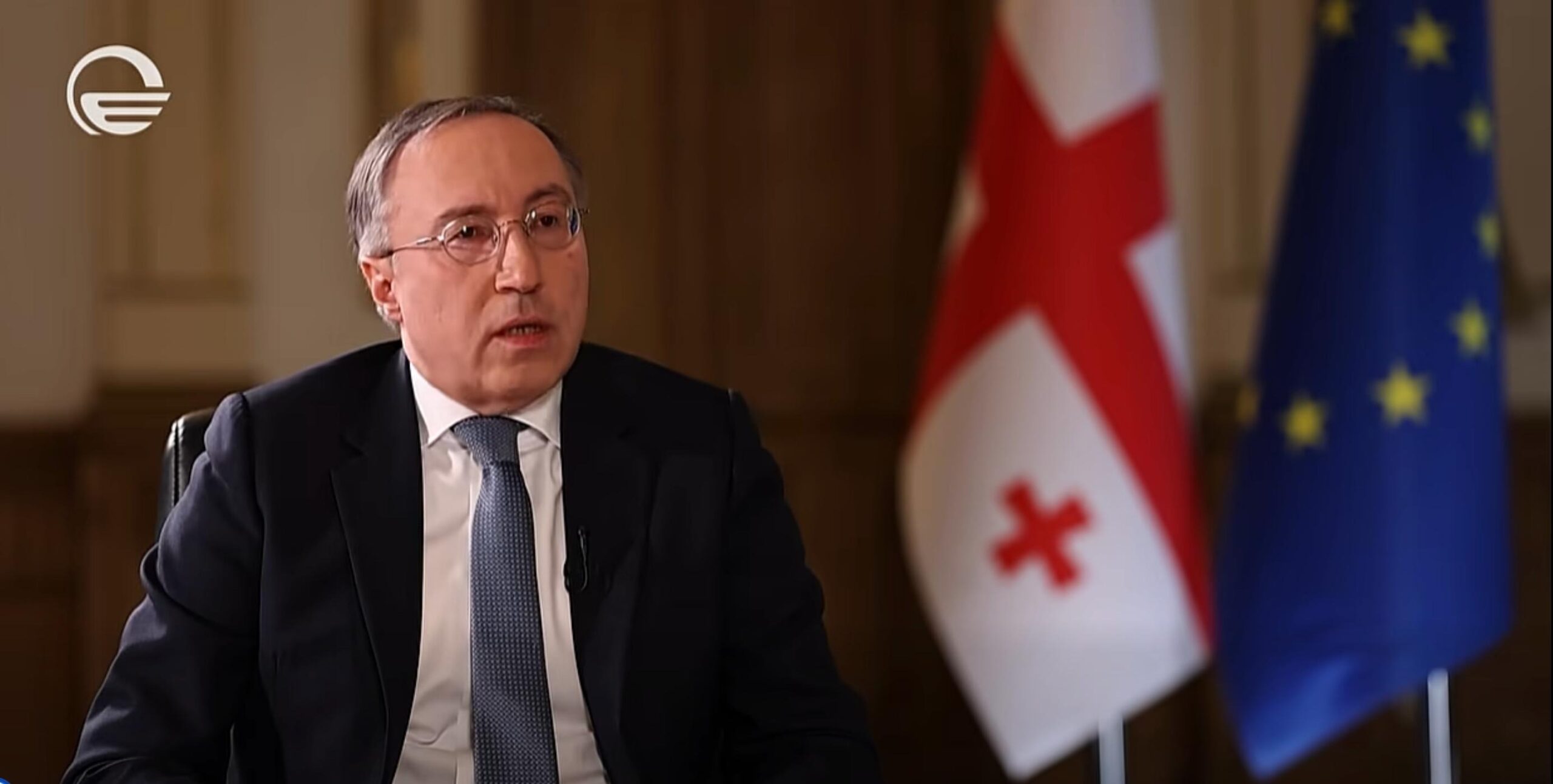
George Zurabashvili, Georgia’s first deputy foreign minister recently appointed as prime minister’s special representative for relations with Russia, defended Tbilisi’s resumed dialogue with Russia but said Moscow’s approach was feeding opposition narratives, while also implying the limited-mandate talks were resumed to discuss occupation and sovereignty as well, as he spoke about the talks during his November 25 interview with Imedi TV.
In a brief interview with Magda Anikashvili, host of Imedi Live, Zurabashvili recounted his first meeting with Mikhail Galuzin, Russia’s Deputy Foreign Minister and his designated counterpart in the resumed Russia-Georgia talks. He expressed disappointment with Moscow’s lack of readiness to lift restrictions on Georgian wines, while also arguing that the issues raised by Moscow “are directed against the Georgian Dream government.”
Zurabashvili, however, still defended the resumed dialogue, arguing it is necessary to achieve Georgia’s reunification and the settlement of bilateral relations.
Zurabashvili and Galuzin met in Minsk on November 19 in a resumption of the talks format that has attracted scrutiny over a possible expansion of its limited mandate to also cover security issues, and concerns that it could amount to a de facto upgrade of bilateral relations to the diplomatic level, despite the formal absence of diplomatic ties.
On Mandate: Need to Talk De-Occupation, Sovereignty
Asked by Anikashvili about the scope of the mandate and the reason for resuming the dialogue, Zurabashvili said that Georgia and Russia have had “very difficult relations” for decades, driven “by the disagreement that is Georgia’s sovereignty, its internationally recognized borders, and de-occupation.”
“Precisely because of these problems, and for these problems, dialogue is necessary, it is necessary to discuss them, and meetings are necessary so that we can find common ways to resolve these problems,” Zurabashvili said, indirectly confirming the criticism that the mandate, previously limited to trade and humanitarian issues, may have extended to include security issues as well.
On Import Restrictions: ‘Surprised and Stunned’
Recounting the November 19 meeting in Minsk, Zurabashvili said that the “main and principal” issue for the Georgian side was to “bring back Georgian wine to the Russian market” following Moscow’s recent import and sale restrictions on drinks from several major Georgian producers.
According to Zurabashvili, Galuzin listed during the meeting three main causes for the restrictions, including “concerning the quality” but also “that as if these companies fund Ukraine’s war, the war in favor of Ukraine,” and that “these [companies] were engaged in anti-Russian narratives.”
“I, of course, explained to Mr. Galuzin that Georgian wine enjoys a very high reputation, that it is of high quality, that they [wines] hold numerous international certificates and licenses, and that the allegation that Georgian wine is of low quality was absolutely groundless,” Zurabashvili said. “As for the other two issues, the financing of Ukraine and the anti-Russian narrative, these are absolutely irrelevant, absolutely not corresponding to the truth, and nothing of the sort is happening.”
However, against Tbilisi’s expectations on lifting these restrictions, Zurabashvili said that Galuzin told him that Russia is considering sanctioning two more Georgian wine companies.
“Of course, I was surprised and stunned by this news, because nothing of the sort is happening. He was unable to provide me with a single fact, either regarding the quality [of the wine] or regarding the allegations concerning the financing of Ukraine or [engaging in] anti-Russian propaganda. So, these are political issues that have absolutely no factual basis,” Zurabashvili told Imedi.
Moscow’s Agenda ‘Feeding Energy to Opposition Forces’
Zurabashvili went on to say that Tbilisi has put forward “several technical issues,” while the Russian side has “approximately ten issues.”
“These were mainly issues in the humanitarian sphere, seemingly harmless ones,” Zurabashvili said, citing an example of Moscow wanting the University of Don (apparently Don State Technical University in Rostov-on-Don) to twin with one of Georgia’s state universities.
“This may seem like a truly harmless matter, but if you look closely and analyze it, all of this is directed against the Georgian Dream government and reinforces the false propaganda and narrative as if Georgian Dream is pro-Russian,” he said, adding: “I would also say that all of this is directed at feeding and giving energy to our opposition forces.”
Zurabashvili went on to claim that, summing up all the listed issues, including on wine restrictions and humanitarian requests, “all this is directed against the Georgian Dream government, is strengthening opposition, and is giving more energy to opposition.”
“But I am convinced that these issues not only harm the Georgian Government and the Georgian people, but I am sure these issues are also very significant and harmful to the Russian population,” Zurabashvili added.
Dialogue Necessary to Achieve ‘United, Strong Georgia’
Asked about the future prospects of the dialogue, Zurabashvili told Anikashvili that, despite the listed difficulties and the skepticism from the meeting, “dialogue is necessary.”
“It is necessary that this dialogue, a very frank one, continue, so that we can discuss all the issues that concern our people and our government, and achieve the settlement of our relations, achieve the reunification of our territories,” Zurabashvili said, adding: “without this, it will be impossible for us to move forward and achieve our main dream: a united, strong Georgia.”
The informal direct dialogue between Georgia and Russia, commonly known as the Abashidze-Karasin format, was launched in late 2012, with Tbilisi introducing the post of a “Special Representative for Relations with Russia” for that purpose. In its original design, the format was limited to addressing trade, economic, humanitarian, and cultural issues, as diplomatic relations remain cut off amid Russia’s continued occupation of Georgian territories and its recognition of Abkhazia and Tskhinvali/South Ossetia as “independent states.”
George Zurabashvili was appointed as Georgian Dream Prime Minister Irakli Kobakhidze’s special representative for relations with Russia on October 21, filling a position that had been vacant since December 2025. He was also allowed to retain his post as the first deputy foreign minister. Zurabashvili’s appointment raised concerns among former Georgian diplomats, who warned of a “dangerous trend” and questioned whether the move could signal a de facto restoration of diplomatic relations with Moscow, while also pointing to what they saw as the expansion of the post’s limited mandate to include security issues as well.

