

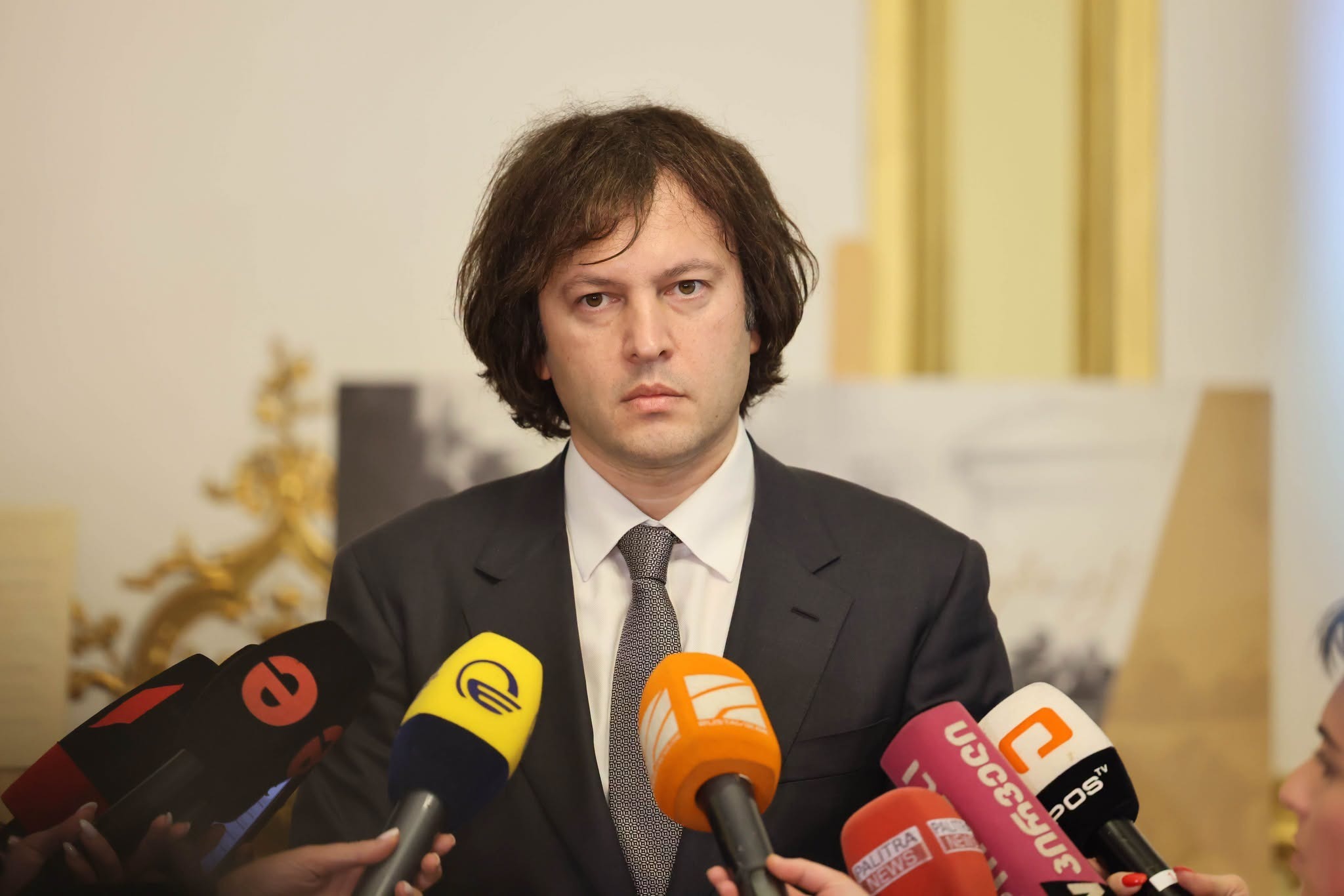
Georgian Dream Prime Minister Irakli Kobakhidze has suggested that the so-called “Deep State” may have influenced Russia’s decision to restrict imports of wine from several Georgian producers, including through bribing mid-level Russian officials he did not name.
“The Deep State has very considerable influence, and it is possible that the middle tier here, too, may simply have been bribed. The handwriting is exactly the same – acting against the interests of one’s own state. We are absolutely convinced that this list directly goes contrary to the interests of the Russian Federation, including its state interests,” Kobakhidze told journalists on November 26, invoking the “Deep State” conspiracy theory that Georgia’s ruling party has used to claim the West is governed by informal oligarchic influences.
“I will not identify names, but it is entirely possible that the middle tier has been bribed. I hope that this matter will be given due consideration in the highest echelons of the Russian authorities, and we hope that the issue will be resolved,” Kobakhidze added, drawing parallels to what he claims has been a practice of “European bureaucracy.”
The remarks followed the comments made by George Zurabashvili, Georgia’s first deputy foreign minister and the recently-appointed special representative for relations with Russia, who recounted the Minsk discussions with Russian deputy foreign minister Mikhail Galuzin, his counterpart in the resumed Russia-Georgia dialogue.
Zurabashvili and Galuzin held their first meeting as part of the resumed format in Minsk on November 19, amid scrutiny over a possible expansion of its limited mandate to also cover security issues, and concerns that it could amount to a de facto upgrade of bilateral relations to the diplomatic level, despite the formal absence of diplomatic ties.
The meeting came several weeks after Russia imposed import and sale restrictions on drinks by several major Georgian producers. Recounting the meeting during a November 25 interview, Zurabashvili cited Galuzin as listing three reasons for the restrictions during their meeting: concerns about product quality, allegations that the companies were financing Ukraine’s war effort, and claims that they were involved in spreading “anti-Russian narratives.”
Zurabashvili further said that he had expected from the meeting Moscow to lift the sanctions, but instead was informed that Russia is considering sanctioning two more Georgian wine companies.
Speaking to media on November 26, Kobakhidze dismissed Galuzin’s cited justifications as “totally absurd,” saying Tbilisi had expected the negotiations to result in the “complete annulment” of the restrictions list and to resolve the issue “in the simplest way.”
“However, instead of this, we received information from Mr. Galuzin’s side that two companies may be added to this list… which is an absolutely wrong attitude. The very compilation of this list was itself a manifestation of a wrong attitude, and naturally, this new attitude is also the subject of the same assessment, which for us is absolutely stunning,” he said.
Kobakhidze went on to draw parallels between the Russian restrictions and what he described as the influence of the “Deep State” on European bureaucrats and politicians.
“We are accustomed, from the side of European bureaucracy, to the fact that there is a bureaucracy there which is bribed from outside. It is bribed by the so-called ‘Deep State’, and under such conditions these people, European bureaucrats and politicians, make such decisions that directly oppose, again and again, Europe’s own interests,” he said. “Only and solely under conditions of bribery can such a thing happen, and one more thing that characterizes them is speaking entirely without arguments and carrying out actions without any arguments whatsoever, including against Georgia.”
He said he saw “the same tendency” in the recent talks with Russia. Therefore, he continued, “it is completely inexplicable, and they [Russia] speak to us without any arguments or facts, which shows that the handwriting is the same. However, I will not specify surnames, but the bribery of the middle tier may be absolutely real.”
Defending the dialogue with Russia despite the concerns over continued restrictions, Kobakhidze said: “The dialogue, however, must be based on specific principles, and we must be convinced that the course of this dialogue is determined not by the Deep State, but in accordance with the objective reality and objective interests.”
Resumed Dialogue
The informal direct dialogue between Georgia and Russia, commonly known as the Abashidze-Karasin format, was launched in late 2012, with Tbilisi introducing the post of a “Special Representative for Relations with Russia” for that purpose. In its original design, the format was limited to addressing trade, economic, humanitarian, and cultural issues, as diplomatic relations remain cut off amid Russia’s continued occupation of Georgian territories and its recognition of Abkhazia and Tskhinvali/South Ossetia as “independent states.”
George Zurabashvili was appointed as Georgian Dream Prime Minister Irakli Kobakhidze’s special representative for relations with Russia on October 21, filling a position that had been vacant since December 2025. He was also allowed to retain his post as the first deputy foreign minister. Zurabashvili’s appointment raised concerns among former Georgian diplomats, who warned of a “dangerous trend” and questioned whether the move could signal a de facto restoration of diplomatic relations with Moscow, while also pointing to what they saw as the expansion of the post’s limited mandate to include security issues as well.
Also Read:

