

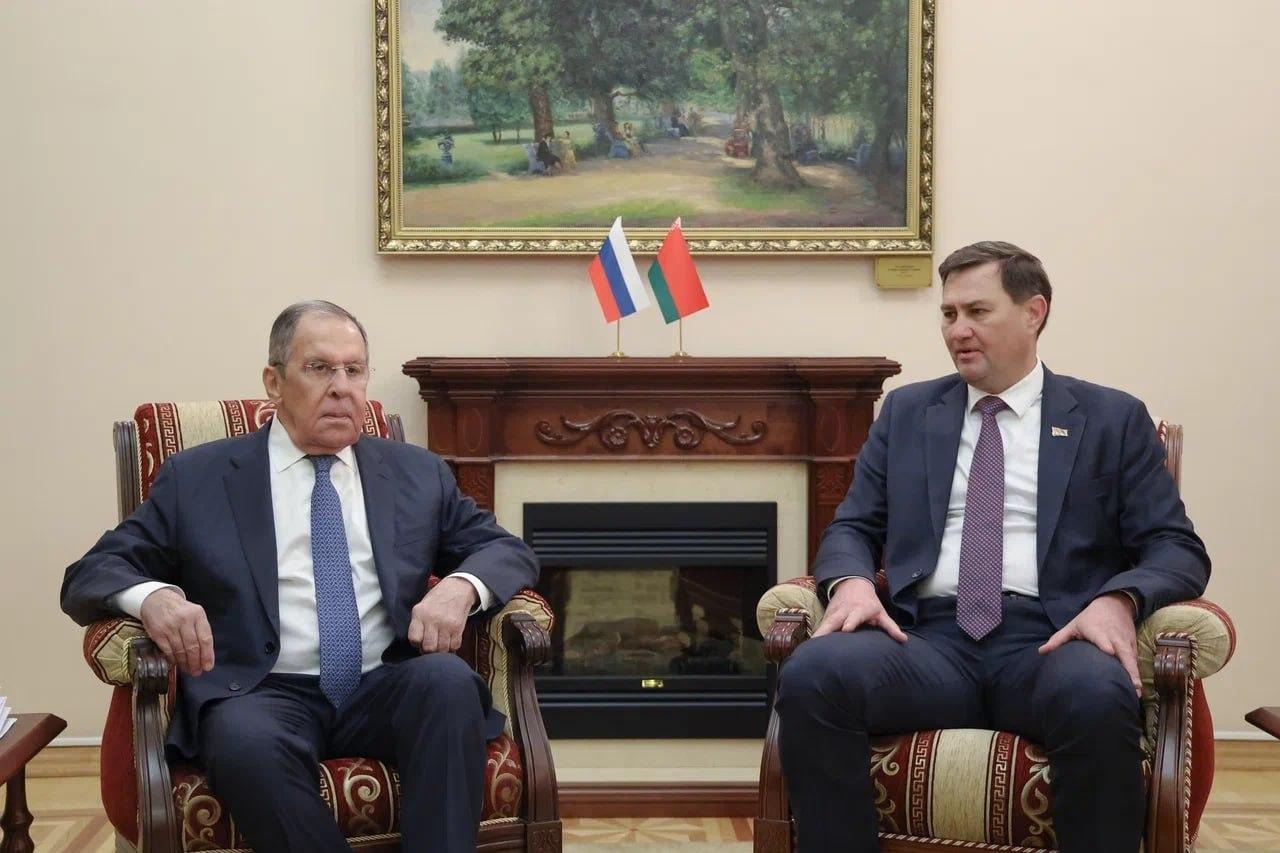
Russian Foreign Minister Sergey Lavrov said Moscow is interested in normalizing relations with Georgia, welcoming Georgian Foreign Minister Maka Botchorishvili’s recent defense of renewed contacts with Russia. Separately, Belarusian Foreign Minister Maxim Ryzhenkov was cited by Russian media as suggesting the renewed Russia-Georgia talks, which recently took place in Minsk, may eventually move to the capitals of the two countries.
The remarks come about a week after George Zurabashvili, Georgia’s first deputy foreign minister, who has recently been appointed special representative for relations with Russia, met with Russian Deputy Foreign Minister Mikhail Galuzin in Minsk, Belarus, in their first meeting under what Moscow described as a “resumed direct Russia-Georgia dialogue.”
Following a meeting with Ryzhenkov in Belarus’ Gomel on November 25, Lavrov was asked about the recent Minsk meeting between Russian and Georgian representatives, described by the journalist as “the first contact in this format since 2008,” and whether it was a one-off encounter or a sign that Belarus could become a venue for further direct dialogue.
“I would like to thank our Belarusian friends for providing a venue for talks on this issue. We are interested in normalizing relations with Georgia,” the Russian Foreign Ministry quoted Lavrov as saying.”
“I welcome the statement recently made by Georgian Foreign Minister [Maka] Bochorishvili that there is no need to fear contacts with the Russian Federation. I believe this is a pragmatic approach that serves the interests of the Georgian people and of our relations with Georgia,” he added.
Botchorishvili’s Remarks
Lavrov’s remarks appear to refer to comments Botchorishvili made during a late-night appearance on Imedi TV on November 19, the same day as the Minsk meeting, in which she defended the decision to hold talks in Belarus and argued that dialogue with Russia is necessary despite the unresolved issues between the two countries.
Asked why the meeting had been moved to Minsk, Botchorishvili said the venue was not the main consideration, stressing instead the importance of holding the talks and addressing issues affecting Georgia and its citizens.
“When we talk about a meeting, of course, the venue must be acceptable to the participants. We had nothing against the venue in this case, even if it was Minsk. When we talk in general about the need for this format, some needs stem precisely from Georgia’s interests, from the interests of Georgian citizens, and these issues require, first of all, immediate talks and dialogue, and this is precisely what the holding of this meeting served,” she said.
“In this case, the venue, let’s say, is not at all the first priority or important; what was important was holding the meeting itself in a timely manner to talk about the issues that are important to us and to our citizens,” Bochorishvili added.
Asked by the host about criticism of the meeting in Tbilisi, including interpretations that it could signal a de facto restoration of diplomatic relations or replace the Geneva International Discussions, Botchorishvili dismissed the criticism, arguing that dialogue with Russia should not be treated as unacceptable.
“In recent years, they [critics] have wanted to instill fear of dialogue with Russia, fear of talking, and complete unacceptability. On the other hand, this is the country with which we have the most and the biggest problems, and if we are talking about resolving or settling a problem, without talking and dialogue, naturally, it is impossible to do this,” she said.
“Therefore, firstly, what we need to do is overcome the fear of talking. Nothing is frightening about this when you talk to the one with whom you have problems. This is necessary.”
Ryzhenkov: Meetings May Move to Russian, Georgian Capitals
Also on November 25, Russia’s TASS cited Belarusian Foreign Minister Maxim Ryzhenkov as welcoming Russia-Georgia dialogue and suggesting the talks may move to the capitals of the two countries.
“During the very lengthy and substantive negotiations – as we have been informed by representatives of both sides – the parties made significant progress in building mutual trust, making it possible to move further negotiations to the capitals of the two countries,” Ryzhenkov was quoted as saying while “summing up the results of the joint meeting of the collegiums of the foreign ministries of Belarus and Russia.”
“Because there is nothing better or, indeed, more reliable than negotiations in the capitals, when the parties reach such a level of mutual understanding that they can visit each other to discuss the issues of mutual concern,” the Belarusian foreign minister was cited by TASS.
The informal direct dialogue between Georgia and Russia, commonly known as the Abashidze-Karasin format, was launched in late 2012, with Tbilisi introducing the post of a “Special Representative for Relations with Russia” for that purpose. In its original design, the format was limited to addressing trade, economic, humanitarian, and cultural issues, as diplomatic relations remain cut off amid Russia’s continued occupation of Georgian territories and its recognition of Abkhazia and Tskhinvali/South Ossetia as “independent states.”
George Zurabashvili was appointed as Georgian Dream Prime Minister Irakli Kobakhidze’s special representative for relations with Russia on October 21, filling a position that had been vacant since December 2025. Zurabashvili’s appointment raised concerns among former Georgian diplomats, who warned of a “dangerous trend” and questioned whether the move could signal a de facto restoration of diplomatic relations with Moscow, while also pointing to what they saw as the expansion of the post’s limited mandate to include security issues as well.
Also Read:

