

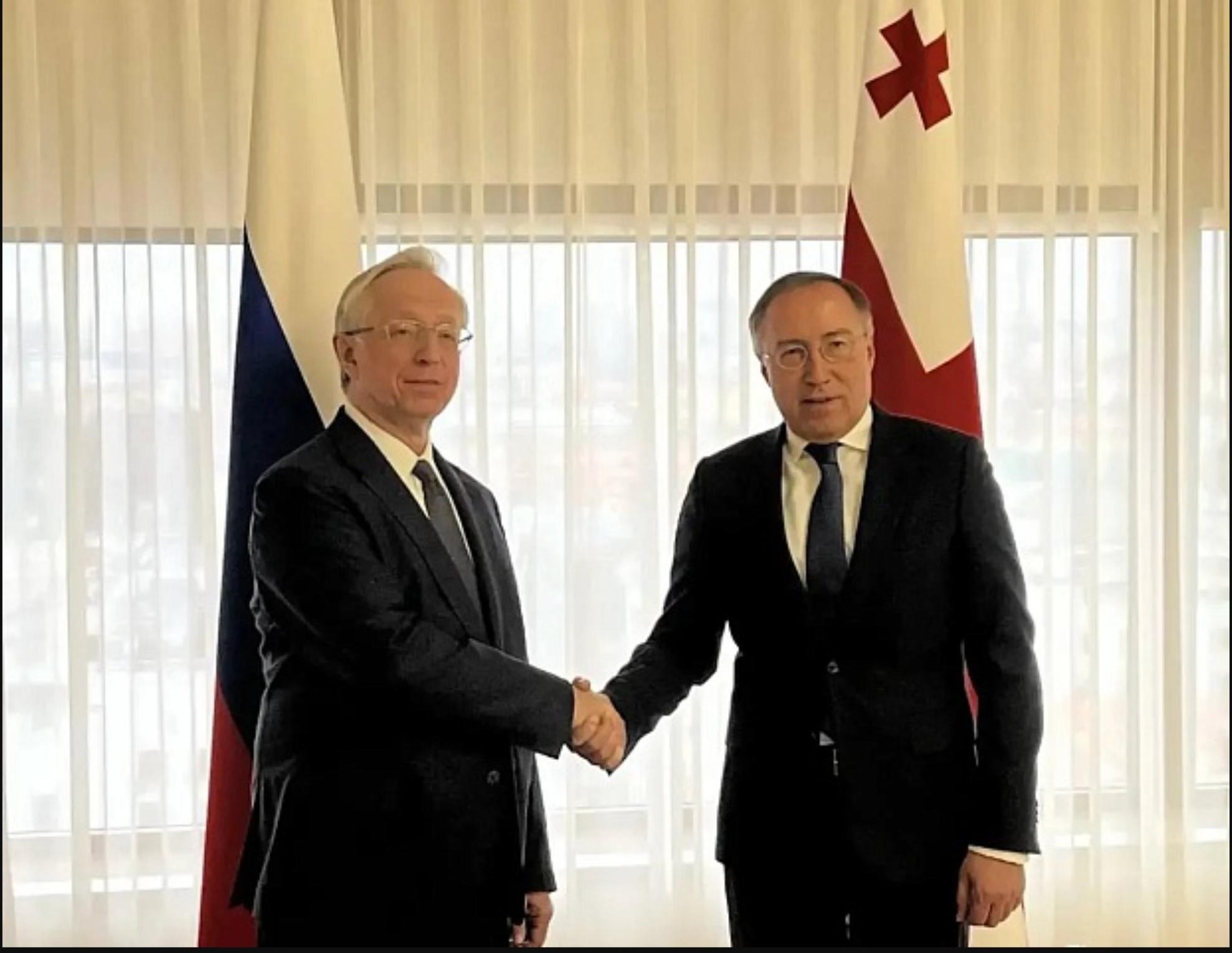
George Zurabashvili, Georgia’s first deputy foreign minister who has recently been appointed special representative for relations with Russia, met with Russian Deputy Foreign Minister Mikhail Galuzin in Minsk, Belarus, on November 19, in their first meeting under what Moscow described as a “resumed direct Russia-Georgia dialogue.”
A post of a Special Representative was established as part of the informal direct dialogue between Georgia and Russia launched in late 2012, commonly known as the Abashidze-Karasin format. In its original design, the format was limited to address trade, economic, humanitarian, and cultural issues, as diplomatic relations remain cut off amid Russia’s continued occupation of Georgian territories and its recognition of Abkhazia and Tskhinvali/South Ossetia as “independent states.”
According to the Russian Foreign Ministry’s statement, the Minsk meeting saw “a substantive exchange of views on current issues of bilateral cooperation, with a focus on trade-economic and cultural-humanitarian cooperation,” with “a number of practical agreements reached,” while “regional security issues were also discussed.”
The Russian MFA also said that the heads of both delegations “expressed their gratitude to the Belarusian side for facilitating the organization of the Russia-Georgia meeting,” and that “it was agreed to maintain contacts in the interests of further developing relations between Russia and Georgia.”
The meeting has drawn a new wave of criticism from political and professional circles, including over what critics see as an upgrade in the bilateral relations, a possibly expanded mandate of the direct talk format, and the designation of Minsk as the venue for meetings that have traditionally taken place in Prague.
Concerns Over Upgraded Ties, Expanded Mandate
Zurabashvili was appointed as Georgian Dream Prime Minister Irakli Kobakhidze’s special representative for relations with Russia on October 21, filling a position that had been vacant since December 2025. He was permitted to retain his post as the first deputy foreign minister, a move that required the parliament to adopt legislative amendments in October.
Russian media reported on Galuzin’s designation as Zurabashvili’s counterpart in November, citing the Russian Foreign Ministry as describing the developments as the resumption of the Russian-Georgian dialogue launched in 2012.
Zurabashvili’s appointment raised concerns among former Georgian diplomats, who warned of a “dangerous trend” and questioned whether the move could signal a de facto restoration of diplomatic relations with Moscow, while also pointing to what they saw as the expansion of the post’s limited mandate.
Kobakhidze’s remarks while presenting the new Special Representative also left an impression among professional circles that Tbilisi was expanding the post’s mandate, previously limited to trade, economic, humanitarian, and cultural issues, to now also cover “the peaceful resolution of the conflict with the Russian Federation.”
Izvestia, on the other hand, cited the Russian MFA in November as saying that it views “the promotion of people-to-people contacts, the development of trade and economic cooperation, tourism, transportation links, and the implementation of cultural projects as the priority tasks of this new channel of communication.”
Zurabashvili replaced Giorgi Kajaia, who took up the post in March 2024 after a four-year term as Head of Georgia’s Interests Section at the Swiss Embassy in Russia, and held it until December 2025, according to Kobakhidze. Kajaia succeeded Zurab Abashidze, who served as Special Representative from 2012 and was later appointed Kobakhidze’s advisor.
Minsk Venue ‘More Than Logistical Matter’
The November 19 meeting between Georgian and Russian officials drew criticism from former diplomats and opposition figures, who warned that the talks could signal a shift in Georgia’s foreign policy and a de facto restoration of diplomatic relations with Moscow.
The change of venue for the direct informal talks follows repeated calls by Moscow since 2022 to move Geneva International Discussions (GID), a parallel internationally-chaired multilateral forum for addressing the security and humanitarian consequences of the 2008 Russia–Georgia War, away from Switzerland.
In a November 19 statement, the Diplomatic Society of Georgia, uniting Georgian Dream-critical former diplomats and career diplomats, described the appointment of a special representative for relations with Russia and the choice of Minsk as the meeting venue as “another clear indication of a shift in Georgia’s foreign policy course.”
“Holding talks with an occupying state, without international mediators, in the capital of a country allied with Russia is not merely a technical or logistical matter. It is a political choice that means conducting negotiations in an environment favourable to Russia and in a format acceptable to Moscow,” the statement read.
The group added that the dialogue with Russia “serves not to secure the de-occupation of Georgia’s occupied territories, but rather to normalise relations on Russia’s terms.”
Nika Gvaramia, a leader of the opposition Coalition for Change, also criticized the meeting, describing it as the formalization of previously covert channels of communication with Russia.
“Zurabashvili was actually appointed for this very purpose — what we are witnessing is the formalization of these covert channels of communication with Russia,” Gvaramia said ahead of the talks.
He argued that Zurabashvili’s meeting with Russian officials in Minsk signaled that the Georgian Dream government was moving toward closer relations with Moscow “officially and openly.”
“Diplomatic relations are not just a label; diplomatic relations are defined by concrete actions,” Gvaramia said. “When a deputy foreign minister meets with a Russian representative, and that meeting takes place in Belarus, this can be called nothing other than the restoration of diplomatic relations.”
Opposition Strong Georgia’s leader Grigol Gegelia also weighed in, saying: “Formats that propose Georgia sit alone, face-to-face with Russia are, in our firm belief, neither appropriate nor justified, given our national security and foreign policy interests.”
Also Read:

