



Tiana
Haxton RNZ Pacific journalist/presenter
Pacific
artists are using the power of storytelling to challenge
world leaders to turn climate promises into action at COP31
in Türkiye this week.
TheTrouble in Paradise:
Climate Change in the Pacific exhibition features 25
photographs selected from more than 300 entries in a climate
change photography competition, capturing the impacts of the
climate crisis on everyday life.
Among the featured
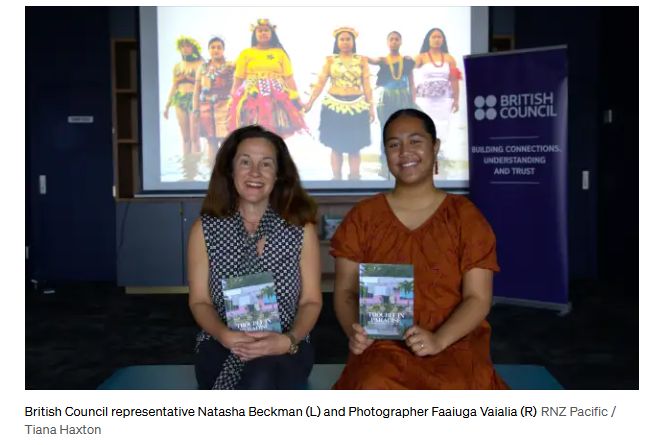
works is Young Women of the Islands by Samoan-New
Zealand photographer Faaiuga Vaialia, whose image of six
Pacific women holding hands represent solidarity between
island communities and the diaspora.
Vaialia believes
photography offers something that statistics and political
discussions cannot always communicate.
“Photos speak
more than words, and they show the livable experiences that
people in the Pacific are going through with climate
change,” she told RNZ Pacific.
“They can see firsthand
what the effects of climate change is currently doing, and
it has it’s not it’s not nothing new.”
The photograph,
taken in Auckland before the Covid-19 pandemic was created
to remind Pacific communities that those living overseas are
just as committed to the fight for climate
justice.
Her work is among the images being presented
to global audiences as part of an effort to ensure Pacific
voices are heard in global climate discussions.
Advertisement – scroll to continue reading
The
exhibition was developed by the British Council New Zealand
following a UK government photography competition.
It
has since travelled the world, with exhibits in New Zealand,
Samoa and Brussels.
British Council representative
Natasha Beckman said it had been well received, including by
King Charles III.
“Our patron King Charles, when we
were in Samoa, asked for us to create a pop-up version of
this exhibition for the heads of state banquet dinner that
he was hosting. So the fact that people like that, these
images in this exhibition resonates is so exciting,” she
said.
“When we were in Samoa, we were fortunate enough
to have the Prime Minister of Samoa speak at the opening, as
well as other dignitaries and the then secretary-general of
the Commonwealth Patricia Scotland, was kind enough to
endorse the exhibition and speak on camera.
“And also
Lord Collins of Highbury, who is now a deputy leader in the
House of Lords, who chose one of his favourite photographs
and talked about it in context of the rest of the
exhibition.”
She said the photography could connect
with decision-makers on a deeper level.
Beckman noted
how the photographs also highlight the injustice faced by
Pacific communities who contribute the least to global
emissions, but bare the greatest consequences.
“Some
of these photographs are really devastating, but they also
have a sense of hope as well.
“One of the messages
that really resonates, and we want to convey is that the
Pacific communities are the lowest emitting communities and
the hardest hit.”
And as the exhibition reaches COP31,
Vaialia hopes her photograph will encourage world leaders to
recognize the urgency of the climate crisis and make
meaningful commitments to the Pacific.
“Our Pacific
islands are paradises. Like they’re such beautiful homes,
and if we don’t face or don’t try and resolve the issue of
climate change, they won’t longer look like
paradise.
“They’ll just look like flooded lands and
some villages going under the sea. So it is actually
‘trouble in paradise’ and if we don’t save it now, it might
not be paradise anymore.”
But the message is not only
about the damage climate change is causing, it is also about
the strength and resilience of Pacific
people.
Samoan-Tongan poet Zech Soakai will join
Vaialia for a public discussion at New Zealand Maritime
Museum on 12 November to explore how art can amplify Pacific
voices in the fight for climate justice.
Soakai said
poetry and other forms of storytelling have an important
role in making complex issues accessible while emphasising
the human consequences of the climate crisis.
“I think
storytelling in any shape or form, whether that’s poetry or
photography or stop motion or whatever it is has this really
important job of making sense of what can be really hard,
jargon-heavy science, and then recentering the heart amongst
it.
“Because not all of us are literate in science,
but all of us have things that we can do to both prevent,
slow down, and then also build much more sustainable
worlds.”
He added that the Pacific must also challenge
narratives that only portray island communities as
victims.
“We as Pacific people are not drowning; we
are fighting, and that hope is very much grounded both in
audaciousness, but also through ancestry, and that’s kind of
what superpowers and keeps the light on so to
speak.”
‘Trouble
in Paradise: Performance and Panel Discussion’ is free
and open to the public, but online registration is
encouraged.
It also forms part of the New Zealand
Maritime Museum’s ‘Our Ocean of Islands’ exhibition
public programmes.
Soakai will open the evening with a
poem.
New Zealand’s public broadcaster, providing comprehensive NZ news and current affairs, specialist audio features and documentaries.
Radio New Zealand is a Crown entity established under the Radio New Zealand Act 1995. Radio New Zealand News are vital elements in our programming, providing impartial news and information to New Zealanders every day. Radio New Zealand (RNZ) provides listeners with exciting and independent radio programmes in accordance with the Radio New Zealand Charter.

