


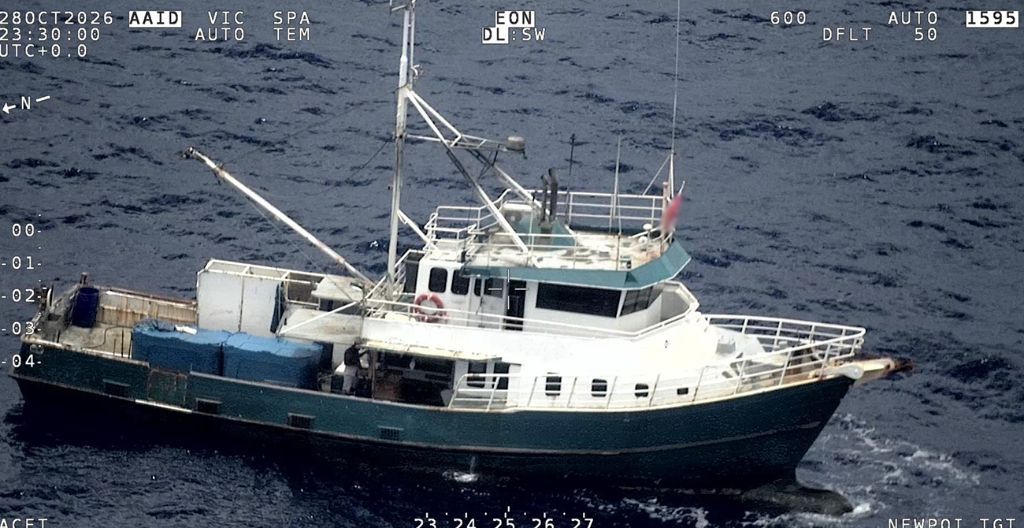
vessel photographed inside the Tongan EEZ, not transmitting
its location and with a licence discrepancy
(Photo/Supplied)
*Photograph has been altered to
withhold identity of the
vessel.
From monitoring a
submarine volcano to surveilling potential ‘dark
vessels’, a Royal New Zealand Air Force (RNZAF) P-8A
Poseidon has kept a close eye on the South-West Pacific and
northern approaches to New Zealand throughout
October.
Three deployments in the month demonstrated
the value of the aircraft to New Zealand and Pacific
nations.
Operating in support of the Forum Fisheries
Agency (FFA) Operation Kurukuru, New Zealand Customs
Service’s Operation Kiwa, Department of Conservation (DOC)
and the governments of Fiji, Tonga, Tuvalu and the Cook
Islands, the aircraft and crew were tasked to monitor
commercial fishing vessels and pleasure craft to ensure
compliance with international regulations.
Covering
the high seas and Exclusive Economic Zones of Fiji, Tonga,
Tuvalu and the Cook Islands, the aircraft crew photographed
fishing vessels that were non-compliant, and potential
‘dark vessels’ (those that deliberately obscure their
identification, location or ownership while at sea) for
reporting to the FFA or relevant authorities.
One case
of potential marine pollution from a commercial fishing
vessel was also photographed and reported.
Advertisement – scroll to continue reading
Customs’
Assistant Comptroller Maritime Operations Paul Campbell said
support from the New Zealand Defence Force was particularly
valuable during the small craft arrival
season.
“Warmer weather and better sailing
conditions bring more yachts and other small craft through
the Pacific towards New Zealand, particularly in
October.
“By monitoring pleasure craft near Minerva
Reef and the Kermadec Islands, the P-8A gives us greater
visibility across New Zealand’s wider maritime environment
and helps identify activity requiring closer
attention.
“The aircraft also monitored vessels in
the Cook Islands’ EEZ in support of Operation Kiwa, which
combines the capabilities of Customs, the NZDF and the
Government Communications Security Bureau to deter
transnational, serious and organised
crime.
“Combining the P-8A’s long-range
surveillance with Customs’ intelligence and targeting, and
information from Pacific partners, helps agencies assess
risks earlier and focus their efforts where they are needed
most. This strengthens maritime security across the
region.”
The aircraft crew were also tasked to
collect imagery of Raoul Island buildings and infrastructure
for DOC, and to observe the active Monowai submarine
volcano, located on the Kermadec Ridge approximately 100
metres below sea level.
Acting Air Component
Commander, Group Captain Brett Clayton, said the breadth of
tasks the P-8A can achieve makes it a valuable tool for New
Zealand and its Pacific neighbours.
“The P-8A
Poseidon’s ability to cover vast distances and gather
critical information makes it an indispensable asset for
maritime domain awareness, supporting a diverse range of
government agencies and helping Pacific nations deter
organised crime and protect their
resources.”

