



Giff
Johnson RNZ Pacific Marshall Islands
correspondent
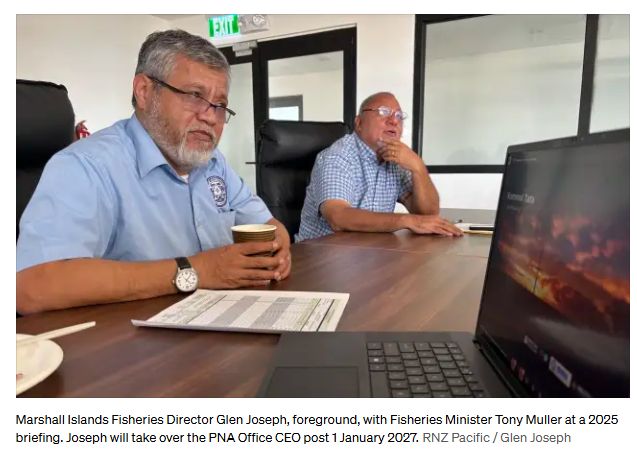
When Marshall Islands Marine Resources
Authority (MIMRA) executive director Glen Joseph moves to
take up the reins as chief executive of the Parties to the
Nauru Agreement (PNA) Office, he will become the fifth from
US-affiliated islands of Micronesia – and only the second
Marshallese – to head a major regional
organisation.
After 21 years at the helm of MIMRA, and
30 with the fisheries authority altogether, Joseph is one of
the region’s most experienced fisheries managers.
The
Marshall Islands government earlier in the year nominated
him for the PNA Office CEO post once current CEO Dr Sangaa
Clark confirmed her intent to wrap up her second term as CEO
later this year.
Joseph’s nomination was endorsed by
PNA fisheries ministers who met in Majuro Tuesday this
week.
When he takes over from Dr Clark on 1 January
2027, Joseph will become the fourth PNA Office
CEO.
Joseph started in fisheries from the ground up
while studying for his bachelor’s degree at the University
of the South Pacific in Suva in the mid-1990s when he
interned with MIMRA during school breaks.
After
graduating, he took a full-time role at MIMRA and performed
numerous hands-on fisheries jobs from fisheries observer
work to fisheries enforcement to fisheries vessel
licensing.
By the early 2000s, Joseph was elevated to
deputy director under Director Danny Wase. When Wase stepped
aside in early 2005, the MIMRA board named Joseph to head
the fisheries department.
Advertisement – scroll to continue reading
Under
Joseph’s leadership, the Marshall Islands engagement in
regional fisheries matters increased dramatically. And
Joseph’s influence in the Forum Fisheries Agency and PNA
grew.
Although the PNA group was established in 1982,
it was not until 2008-2009 that it began flexing its muscle
for implementing a then novel approach to managing purse
seine tuna fishing: Restricting “effort” rather than capping
the number of vessels allowed to fish. This innovation was
known as the Vessel Day Scheme and today is the operative
management mechanism for the eight PNA nations, which
includes the Marshall Islands, in whose waters over 50
percent of the world’s skipjack tuna is caught.
During
that 2008-2009 period, a triumvirate of fisheries
visionaries – Papua New Guinea’s National Fisheries
Authority Managing Director Sylvester Pokajam, FFA deputy
director Dr Transform Aqorau, and Joseph – with the backing
of the late Marshall Islands fisheries Minister Mattlan
Zackhras, hatched the plan to establish a PNA Office to be
located in Majuro.
With PNG carrying significant
weight in the PNA due to its huge fisheries footprint,
Pokajam’s support for the PNA Office to be placed in Majuro
was crucial.
That office opened in April 2010, with
Aqorau as its first CEO.
What the PNA Office did with
Aqorau at the helm and fisheries leaders like Joseph and
Pokajam behind him was nothing short of
spectacular.
Despite heavy push-back from the fishing
industry at the beginning of full implementation of the
Vessel Day Scheme (VDS), the PNA enforced it, raising the
level of revenue generated for the PNA members from US$60
million a year to US$500 million annually by the 2020s.
Moreover, the VDS is the foundation for managing the purse
seine fishery in a sustainable manner, a fact confirmed by
stock assessments issued regularly by the scientists at the
Pacific Community (SPC).
The VDS is also a platform
for tuna value chain participation for the eight PNA
members. It is in this area that Joseph and MIMRA stand out
in the region.
Since 1987, when the United States
Pacific Islands Tuna Treaty was signed with the FFA member
countries, the agreement included the possibility of trade
arrangements between Pacific Islands and the US market. But
try as they may, for decades the FFA got nowhere with the US
government as it sought a pathway for fish exports to the US
market.
Meantime, MIMRA set up a joint venture with
long-time NGO partner The Nature Conservancy, establishing
Pacific Island Tuna, a tuna supply company based in
Majuro.
This upstart company was established to elbow
into the lucrative tuna supply market, one that is dominated
by a handful of global corporations. And engage it did.
Pacific Island Tuna negotiated a deal with Walmart, the
world’s biggest retail corporation, to supply sustainably
caught tuna from PNA waters.
And just like that, the
Marshall Islands opened the door into the US market after
decades of the FFA finding that door closed by the US
government. The tuna supply deal with Walmart is now in its
fourth year.
Meanwhile, under Joseph’s management,
MIMRA built a new headquarters building in Majuro, funded by
its PNA fisheries revenue, that opened in 2019.
It
contains state of the art fisheries monitoring, control and
surveillance facilities and equipment – elevating MIMRA’s
fisheries management operation.
The sophisticated
systems at the new headquarters were accompanied by a major
investment in MIMRA Oceanic Division’s port state control
work, which included nearly 100 percent monitoring of all
transshipment and unloading of tuna to carrier vessels in
the lagoon or at dockside, and the dispatch of fisheries
observers on both purse seine and longline vessel fishing
trips.
But an even bigger prize in the tuna value
chain was on the horizon: Access to the European Union’s 27
member nations, the largest fisheries market in the
world.
The EU, however, requires strict hygiene and
anti-illegal fishing standards from any country wanting to
access its market.
Joseph looked to PNG, which had
gained EU certification years earlier, hiring a consultant
who had worked on PNG’s process of accreditation.
This
led to establishment within MIMRA of a Competent Authority
and further to the expansion of its headquarters building
with an annex that contains a sophisticated laboratory for
testing fish quality in order to meet the stringent
standards set by the EU.
Last December, MIMRA’s
Competent Authority was audited by the EU after six years of
painstaking preparation. That led to ongoing follow-up to
fill in gaps. As 2026 comes to a close, Joseph last week
said in an interview he expects that once the EU concludes
its own internal review process, the Marshall Islands will
become the latest nation to be certified to export marine
products to the EU market.
When this happens, the
Marshall Islands will be the fifth country in the Pacific
certified to export to the EU following in the footsteps of
PNG, Fiji, Solomon Islands and Kiribati.
In the
meantime, while these innovations relate to the PNA and
regional tuna fisheries, Joseph has pushed the Coastal
Fisheries program at MIMRA to new heights.
Last year,
for example, MIMRA hosted its second National Ocean
Symposium for public discussions heavily focused on managing
coastal marine resources sustainably. MIMRA’s work in 2023
and 2024 paved the way for President Hilda Heine to join
other leaders early last year in declaring the country’s
first National Marine Sanctuary encompassing uninhabited
Bikar and Bokak atolls in the northern
Marshalls.
MIMRA in recent years has partnered with
the National Geographic’s Pristine Seas program to major
benefit for the Marshall Islands. These and other
partnerships, including with the Ocean Exploration Trust,
have led to unprecedented levels of both deep ocean surveys
throughout this watery nation and surveys of coral reef
habitats at Bikar, Bokak, Bikini and Rongelap
atolls.
Focus on accountability
Something
Joseph expresses particular pride in relates to
accountability and donor partnerships.
This year,
MIMRA was the first Marshall Islands government entity to
complete its fiscal year 2025 audit – while many government
agencies were still working on their FY2024
audits.
Similarly, MIMRA has a partnership with the
World Bank unlike any other agency in country. It manages
the Pacific Islands Regional Oceanscape Program for Economic
Resilience (PROPER) that is run through MIMRA’s own project
management unit, not that of the Ministry of Finance. A
World Bank review of PROPER last week upgraded MIMRA’s
rating for progress toward achieving its Project Development
Objectives to “Highly Satisfactory.”
It is a testament
to the organization Joseph has built in his two decades of
leadership that the authority maintains a high level of
accountability and transparency in operations.
MIMRA
was recognized several years ago by the regional fisheries
expert Robert Gillett for being “one of the few fisheries
departments in the Pacific that produces an annual report,
which is essential for both promoting the fisheries and
being transparent in operations.”
Joseph’s legacy at
MIMRA is visible for all to see. As he prepares to step into
the PNA CEO position, he leaves behind a fully functioning
organization that is effectively managing fisheries at all
levels for the Marshall
Islands.
New Zealand’s public broadcaster, providing comprehensive NZ news and current affairs, specialist audio features and documentaries.
Radio New Zealand is a Crown entity established under the Radio New Zealand Act 1995. Radio New Zealand News are vital elements in our programming, providing impartial news and information to New Zealanders every day. Radio New Zealand (RNZ) provides listeners with exciting and independent radio programmes in accordance with the Radio New Zealand Charter.

